
Dear medical establishment, we need to talk.
Because some proteins have been strutting around the cell acting un-druggable for years, and this new paper basically walks in holding a molecular seating chart. The study, Proximity Binding Assay for PROTAC Ternary Complex Analysis, describes a clever new way to watch PROTACs do their job in real time. And if that sentence sounds a little niche, stay with me, because this is one of those methods papers that quietly changes what researchers can actually measure, which is where science often gets dangerously interesting.
First, what even is a PROTAC?
A PROTAC is a small molecule built like a very determined social connector. One end grabs a target protein, the other end grabs an E3 ligase, which is part of the cell's protein disposal machinery. Bring those two together, and the cell may tag the target for destruction. Not blocked. Not muffled. Not politely asked to stop. Destroyed.
That is a big deal because many disease-driving proteins are hard to inhibit directly. They do not have nice neat pockets for conventional drugs to sit in. PROTACs get around that by recruiting the cell's own cleanup crew. It is less "please stop causing trouble" and more "you no longer work here."
But there is a catch. Actually, several.
The whole trick depends on a three-way handshake
For a PROTAC to work, it has to form a ternary complex: target protein, PROTAC, and E3 ligase all bound together. That three-part interaction is the magic step. If it is weak, unstable, or too brief, the whole degradation strategy can fall apart.
And this is where the paper earns its coffee.
Researchers already know how to study simple two-part binding events reasonably well. Protein A binds molecule B. Fine. Nice. Clean. But PROTACs are not simple. They live or die by how well they coordinate a three-body interaction, and measuring both binary and ternary binding in one unified setup has been a headache. Drug discovery people have been trying to judge a group project by interviewing each student separately. Helpful, but not the same thing.
So what did this team build?
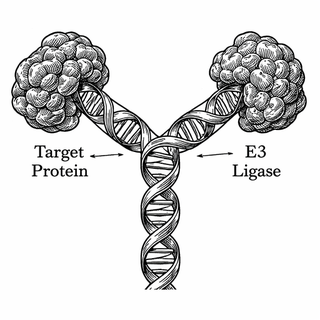
They created a proximity binding assay on a biosensor surface using a Y-shaped DNA scaffold. Yes, a Y-shaped DNA scaffold. Which is already the kind of phrase that makes my inner grad student sit up like a meerkat.
In this setup, the target protein and the E3 ligase component are attached to mobile "swivel arms" on that DNA scaffold. The geometry matters. By holding the proteins near each other while still allowing movement, the system mimics the spatial setup needed for PROTACs to bridge them into a ternary complex.
Then the readout gets even better.
When a PROTAC successfully promotes ternary complex formation, the assay detects it through fluorescence energy transfer, or FRET. When the PROTAC interacts in a binary way, that shows up through fluorescence quenching. So instead of running separate experiments and trying to stitch the story together afterward, the researchers can observe both kinds of interactions in the same general framework, in real time.
Wait, it gets better.
This is not just elegant. It is fast.
The paper reports automated workflows that can generate 384 real-time sensorgrams in a single run using only picomole quantities of sample. That is the sort of detail that makes method developers smile in a slightly sleep-deprived way. High throughput plus tiny sample requirements is exactly the kind of combination that can move a screening platform from "very neat" to "actually useful."
And they did not test it on toy examples either. The assay was applied to two major E3 ligase substrate receptors, cereblon (CRBN) and von Hippel-Lindau (VHL), along with a panel of known PROTACs including AT1, MZ1, dBETs, and ARV-825. The targets were bromodomains from BRD2, BRD3, BRD4, and BRDT, all proteins with real relevance in gene regulation and cancer biology.
So this is not just a proof-of-principle built from spare parts and optimism. It is a serious attempt to measure the binding behavior of molecules people already care about.
Why this matters beyond assay nerdery
Drug discovery for PROTACs has a strange problem: a molecule can look good in a simple binding test and still disappoint when the full three-part complex has to form. That means researchers need tools that capture the actual choreography, not just isolated dance steps.
This assay helps fill that gap by giving kinetic information about both binary and ternary interactions under proximity-controlled conditions. Translation: scientists can start asking sharper questions.
Does a PROTAC bind the target strongly but fail to recruit the ligase efficiently? Does it form a ternary complex quickly but let go too fast? Does one E3 ligase receptor perform better than another for a specific target family? Those are not academic side quests. Those are the questions that shape which molecules get pushed forward and which ones get sent back to medicinal chemistry for a stern redesign.
The bigger picture for targeted protein degradation
Targeted protein degradation is one of the most exciting areas in modern drug development because it expands the range of what might be treatable. Instead of only inhibiting proteins with convenient active sites, researchers can aim to remove harmful proteins from the system altogether.
That said, the field is still wrestling with selectivity, resistance mechanisms, cell permeability, and the maddening fact that intracellular biology rarely behaves like a tidy diagram. A better assay does not solve all of that. But it does give researchers a sharper map. And honestly, half of experimental frustration is realizing your ruler was weird.
If follow-up development succeeds, methods like this could help scientists identify PROTACs and molecular glues with stronger, more useful binding behavior earlier in the pipeline. That can save time, reduce wasted effort on weak candidates, and improve the odds that promising degraders make it to meaningful preclinical and clinical testing.
My favorite part? It respects the problem
What I like most about this paper is that it does not pretend ternary complex biology is simple. It builds a system that leans into the complexity instead of flattening it away. The Y-shaped scaffold, the proximity effect, the dual fluorescence readouts, the real-time kinetics - all of it feels designed by people who have spent enough time being annoyed by incomplete measurements to finally do something about it.
That is the energy I trust in science. Not hype for hype's sake. Just a very smart workaround to a very real bottleneck.
And if PROTACs are going to keep maturing as a therapeutic strategy, this kind of measurement tech is exactly the backstage engineering that could make the headliners look brilliant.
This blog post discusses research findings and should not be taken as medical advice. If you have concerns about diseases that may one day be addressed through targeted protein degradation, please consult a healthcare provider. Research discussed here represents ongoing scientific investigation and clinical validation is still in progress.
All images used in this post are decorative illustrations only and do not represent or reflect the accuracy, reality, or correctness of the referenced research.
Primary Source: Proximity Binding Assay for PROTAC Ternary Complex Analysis. PubMed Record 42011828. https://pubmed.ncbi.nlm.nih.gov/42011828/