
A technician is pipetting clear liquid into a row of tiny tubes, and somewhere inside those almost comically small volumes is a very big ambition: get cancer drugs to the tumor, not to everything else. That sounds obvious until you remember how blunt many anticancer treatments still are. Chemotherapy, for all its lifesaving power, has a long history of behaving like a fire alarm that also sets off the sprinklers, locks the doors, and annoys the entire building.
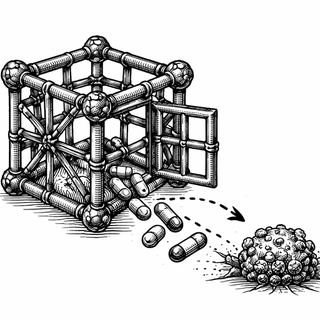
That is why this review on stimuli-responsive zirconium-based metal-organic frameworks, or Zr-MOFs, caught my eye. The basic idea is elegant in a very data-scientist-friendly way: if the tumor environment has distinct signals, build a drug carrier that responds to those signals and releases its payload only where the pattern matches. Less random wandering. More conditional logic. Cancer therapy, meet if tumor then release drug.
What exactly is a Zr-MOF?
A metal-organic framework is a nanostructure made from metal ions linked by organic molecules into a porous scaffold. Think of it as an ultra-tiny cage with an absurd amount of internal space relative to its size. In drug delivery, that matters because more internal space can mean more room to load therapeutic molecules.
Zirconium-based MOFs stand out because they offer a useful trio of properties: chemical stability, biocompatibility, and modifiability. In plain English, they are relatively sturdy, potentially friendlier to biological systems than many alternatives, and easy to tweak on the surface or within the structure.
Those are not cosmetic features. They determine whether a nanocarrier can survive long enough in the body, carry a meaningful drug dose, and respond to biological conditions in a controlled way rather than like a suitcase that bursts open in the parking lot.
Why tumors are such tempting targets
Tumors are not just fast-growing lumps of cells. They are strange neighborhoods with their own chemistry, metabolism, and local resource shortages. The review highlights several features of the tumor microenvironment that researchers try to exploit:
- More acidic pH
- Different redox conditions
- Higher ATP levels
- Abnormal enzyme activity
- Altered ionic conditions
That list may look technical, but the pattern is simple: tumors often create a biochemical setting that does not quite match normal tissue. If a carrier can sense those differences, it can use them as a release trigger.
This is where the numbers mindset becomes useful. Drug delivery is rarely about absolute perfection. It is about improving ratios. More drug at the tumor site. Less in healthy tissue. Better loading. Better timing. Better release precision. In a field where side effects are often the cost of doing business, even a modest shift in those ratios can matter.
From passive container to smart container
The review describes Zr-MOFs not as passive storage bins but as responsive nanoplatforms. That word matters. A passive particle just carries cargo. A responsive particle can behave differently when conditions change.
Some Zr-MOF systems are designed to release drugs when they encounter the tumor's acidic environment. Others react to redox gradients or ATP-rich conditions. Still others rely on external triggers like light, heat, or ultrasound.
That expands the design space considerably. Researchers are not limited to asking, "Can this particle carry a drug?" They can ask, "Can this particle carry a drug, stay stable in circulation, recognize a meaningful biological cue, and release the drug when and where we want?" That is a much harder question, but it is also the one that matters.
The clever part is that these triggers can be combined. Multistimuli-responsive systems aim to require more than one condition before releasing a payload. In theory, that should improve specificity. In practice, it is a bit like giving the drug carrier a stricter security policy instead of one flimsy password.
Why zirconium keeps showing up
There are many MOFs, but zirconium-based ones keep attracting attention because they hit a useful engineering sweet spot. The review points to their modular composition, tunable pore architecture, and flexible surface chemistry.
Those phrases translate into a real advantage: researchers can adjust the framework for different drugs and different delivery goals. Need higher loading? Adjust the pore environment. Need targeting molecules on the surface? Modify the chemistry. Need trigger-sensitive behavior? Build that into the structure or coating.
This flexibility is one reason Zr-MOFs look promising on paper. A single platform type can potentially be adapted across multiple cancer contexts rather than redesigned from scratch every time. Scientists love that because it suggests scalability. Regulators, eventually, may love it for the same reason. The body, of course, gets a vote too, and it tends to be the toughest reviewer in the room.
What the review says these systems can do
The review summarizes representative Zr-MOF systems in terms of:
- Drug loading capacity
- Release mechanisms
- Targeting strategies
- In vitro anticancer effects
- In vivo anticancer effects
That mix is important because it prevents the conversation from drifting into nanotech poetry. A carrier can look marvelous structurally and still fail if it cannot hold enough drug, release it predictably, or produce meaningful biological effects.
The appeal of Zr-MOFs is that they seem to offer control at multiple levels. You can load the drug, functionalize the surface, tune the response to triggers, and potentially direct the carrier toward tumor tissue. It is a layered strategy rather than a one-trick system.
And that layered strategy makes sense. Cancer is not a simple target. It is heterogeneous, adaptive, and annoyingly good at refusing tidy solutions. Any delivery system hoping to outperform conventional approaches probably needs more than one useful property.
The part where reality clears its throat
Now for the less glamorous, more honest section. The review is also clear about the obstacles.
First, biosafety remains a real question. A nanocarrier does not get points for cleverness if its breakdown products cause trouble or if it accumulates where it should not. Second, degradation behavior matters. A carrier must be stable enough to do its job but not so persistent that it becomes an uninvited long-term resident.
Third, tumors are not uniform. Tumor heterogeneity means one patient's tumor, or even one region of the same tumor, may not share the exact same trigger conditions as another. A system tuned to acidity or ATP may perform beautifully in one setting and much less impressively in another.
Finally, there is the perennial gap between promising lab results and actual clinical use. Plenty of biomedical technologies have looked dazzling in cell studies and encouraging in animal models, only to discover that human biology is less cooperative than the grant proposal implied.
Why this still matters
Even with those caveats, this research area is compelling because it addresses a stubborn problem with a rational design strategy. Instead of treating drug delivery as a logistics afterthought, stimuli-responsive Zr-MOFs treat it as part of the therapy itself.
That is the big shift. The carrier is not just packaging. It is an active decision-making component, engineered to interpret local conditions and respond accordingly. If future work can improve safety, reproducibility, and real-world performance, that could make cancer treatment more precise and less punishing.
No, this is not a near-finished clinical revolution waiting in the wings. But it is a sharp example of where oncology and materials science are heading: toward systems that are smarter, more selective, and less willing to carpet-bomb healthy tissue just to reach malignant cells.
For now, the numbers do not say "mission accomplished." They say something more interesting: the logic of the platform is strong, the design toolbox is expanding, and the next gains may come not from inventing entirely new drugs, but from getting existing ones to the right place at the right time with far less collateral chaos.
This blog post discusses research findings and should not be taken as medical advice. If you have concerns about cancer diagnosis or treatment, please consult a healthcare provider. Research discussed here represents ongoing scientific investigation and clinical validation is still in progress.
All images used in this post are decorative illustrations only and do not represent or reflect the accuracy, reality, or correctness of the referenced research.
Primary Source: Stimuli-Responsive Zirconium-Based Metal-Organic Frameworks for Targeted Cancer Drug Delivery. PubMed Record 42049683. Source