
Things I learned this week: your eyes are ruthlessly efficient at ejecting anything you put in them, fungal infections of the cornea are genuinely terrifying, and someone has figured out a rather clever way to deal with both problems simultaneously.
Let me explain.
Your Eyes Are Basically Bouncers
You know those nightclub bouncers who look at you with absolute disinterest and say "you're not on the list"? Your tear film does that to medication. You instill eye drops, feel briefly virtuous about your eye health, and within a few minutes the drainage system has whisked away 95% of whatever you just applied. The drug barely grazes the corneal surface before getting evicted.
For most conditions, this is inconvenient. For fungal keratitis, it is a serious problem.
Fungal keratitis is an infection of the cornea - the clear front dome of your eye - caused by fungi that have no business being there. It happens most often after eye injury involving plant material, or in people who wear contact lenses long past when they should have thrown them out. The fungi dig in, the cornea starts breaking down, and without aggressive treatment, permanent vision loss follows. In severe cases, the eye is lost entirely.
The global burden of this disease is sobering. An estimated one million cases per year worldwide, disproportionately affecting agricultural workers in tropical regions. Treatment is limited, outcomes are often poor, and the underlying pharmacology problem is that getting antifungal drugs through the cornea and keeping them there long enough to work has been genuinely hard to solve.
Terbinafine and the Penetration Problem
Terbinafine is an antifungal drug you might recognize from nail fungus treatments - the kind of advertisements that get awkwardly specific about toenails. It works by disrupting fungal cell membranes, and it has solid activity against the fungi that cause keratitis. The catch is getting it to the infection site in meaningful concentrations.
The cornea is not exactly a welcome mat for drugs. It has multiple layers with different chemical preferences - some layers favor fat-soluble compounds, others favor water-soluble ones. Terbinafine, being quite hydrophobic, has a complicated relationship with corneal penetration. And then, even if you get the drug across the outer layers, there is still that relentless tear clearance mechanism working against you.
Researchers have known about this problem for years. Various approaches have been tried - increasing drop viscosity, adding permeation enhancers, reformulating the drug entirely. Some approaches work reasonably well. None have been entirely satisfying.
Enter the Shape-Shifting Gel
A research team recently published a rather ingenious solution to this problem, and it involves a delivery system that is, in the most literal sense, smart about where it ends up.
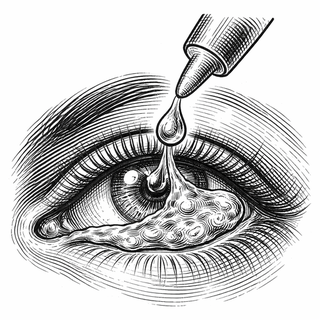
The system starts as a liquid. You instill it like ordinary eye drops - easy application, no discomfort beyond what drops normally cause. But here is where it gets interesting: when the formulation contacts the ions present in tear fluid, it undergoes a phase transition and transforms into a gel. It solidifies, in effect, right on the surface of the eye.
This ion-activated gelation is not new as a concept, but the implementation here is thoughtful. The gel is mucoadhesive - it sticks to the mucin layer of the tear film, the sticky glycoprotein coating that covers the eye surface. This dramatically reduces clearance. The drug is no longer racing against a drainage timer. It sits there, adhering, releasing its payload in a controlled fashion.
But the researchers did not stop at the gel. They also tackled the corneal penetration problem separately, with nanostructured lipid carriers - NLCs, in the shorthand.
Nano-Sized Trojan Horses
NLCs are nanoparticles built from a mixture of solid and liquid lipids. They are roughly spherical, absurdly small, and well-suited to carrying hydrophobic drugs. The lipid shell is chemically compatible with the cornea's outer layers, and the nanoparticle architecture keeps the drug protected and concentrated until it reaches its target.
Think of them as tiny delivery vehicles optimized for a specific route. Where regular terbinafine might struggle to cross corneal barriers, terbinafine packaged inside NLCs has an easier time of it. The lipid surface facilitates uptake. The particle size - typically in the range of a few hundred nanometers - is small enough to penetrate the tight junctions of corneal epithelium through pathways that larger formulations cannot use.
By loading the NLCs into the ion-activated gel, the research team combined two complementary strategies. The gel handles the retention problem. The NLCs handle the penetration problem. Each addresses a different step in the delivery chain.
The results, according to the published data, show improved corneal drug levels compared to conventional terbinafine eye drops, along with extended retention time on the ocular surface. In models of fungal keratitis, the combination formulation outperformed standard treatment.
Why This Matters Beyond the Lab Bench
Fungal keratitis is not a problem that gets a lot of research attention relative to its global impact. It is concentrated in populations with less access to specialized ophthalmology care, and the diagnostic window between "something is wrong with my eye" and "permanent damage has occurred" is unforgivingly short.
Better drug delivery does not solve every aspect of this - you still need diagnosis, you still need access to medication, you still need follow-up care. But if a more effective topical formulation can clear infections faster and with less drug, that is a meaningful improvement. Less drug used per treatment also means lower cost and lower systemic exposure, which matters for a medication that patients may need to apply for weeks.
The platform technology here - ion-activated gel plus lipid nanoparticles - is also theoretically adaptable. The same architecture could in principle carry other drugs for other ocular conditions. Antifungals today, antivirals tomorrow, anti-inflammatory agents next year. Platforms that solve fundamental delivery problems tend to be generative.
The Unglamorous Work of Drug Delivery
There is a category of biomedical research that never makes the mainstream news because it lacks narrative drama. No one is editing genomes. No one is growing organs in bioreactors. The researchers are just trying to get a drug to stay where you put it.
This is, in many ways, the less glamorous end of medicine. But the unglamorous work is often where the practical gains live. Improved delivery of existing drugs, better targeting, longer retention - these advances can transform a treatment from marginal to effective without discovering a single new molecule.
Turning a liquid into a sticky, drug-laden gel on contact with tears is, when you think about it, a quietly elegant piece of chemistry. Your eye tries to kick the medication out. The medication decides to anchor itself instead.
The bouncer metaphor only goes so far. Eventually, the gel wins.
This blog post discusses research findings and should not be taken as medical advice. If you have concerns about eye infections or vision changes, please consult an ophthalmologist or healthcare provider. Research discussed here represents ongoing scientific investigation and clinical validation is still in progress.
All images used in this post are decorative illustrations only and do not represent or reflect the accuracy, reality, or correctness of the referenced research.
Primary Source: Ion-activated mucoadhesive in situ gel incorporating terbinafine-loaded NLCs promotes ocular penetration and retention for enhanced fungal keratitis therapy. PubMed. PMID: 41867499