
What is a medicine, really? Is it just a chemical with a job description, or does the future version also need a GPS, a flashlight, and decent timing? Biology, being biology, tends to reward the second option.
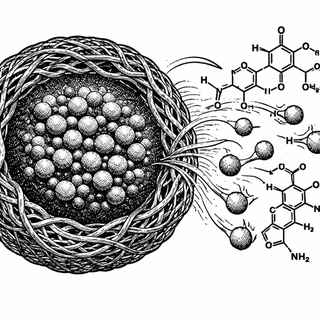
That is why this new research on β-glucan hydrogel nanoparticles embedded with gold-silver nanoclusters for traceable drug delivery caught my attention. The idea is almost suspiciously elegant. Take β-glucan, a natural polysaccharide known for biocompatibility and helpful biological properties. Turn it into tiny hydrogel nanoparticles. Load those particles with doxorubicin, a well-known chemotherapy drug. Then add fluorescent gold-silver nanoclusters so the whole package can be tracked without needing an extra labeling step. In one system, you get drug delivery, imaging, and smart release behavior. For nanomedicine, that is a very efficient little résumé.
Why this is interesting
A lot of cancer drug delivery research comes down to a frustrating math problem. You want enough drug to reach tumor cells to do real damage, but you do not want the rest of the body acting as collateral paperwork. Traditional chemotherapy can be effective, but it is not famous for subtlety.
The numbers in this paper are what make the concept more than just a nice sketch on a whiteboard. The researchers report a doxorubicin loading capacity up to 13.8%. In plain English, that means these nanoparticles are not just decorative packaging. A meaningful fraction of the particle mass is actual drug cargo. In delivery systems, loading matters. If the truck is all truck and no cargo, you have not solved much.
Even better, the system is pH-responsive. That means the drug release speeds up in acidic conditions, which are relevant to the tumor microenvironment. Tumors often have a more acidic local environment than normal tissues. So instead of releasing the drug at the same pace everywhere, the nanoparticles behave more like they have situational awareness. Not full consciousness, thankfully. Just enough chemistry to know when they have wandered into rougher neighborhood conditions.
The neat trick: built-in tracking
One of the more appealing features here is the use of gold-silver nanoclusters to provide intrinsic fluorescence. That phrase matters. “Intrinsic” means the tracking ability is built into the system itself. Researchers do not have to attach a separate fluorescent label just to see where the particles go.
That sounds technical, but it solves a very practical problem. In drug delivery, it is useful to know whether your particles are actually entering cells, where they accumulate, and how they behave once inside. Otherwise, you are stuck in the scientific equivalent of mailing a package and hoping for the best.
According to the study, confocal microscopy and quantitative fluorescence analysis showed enhanced cellular uptake and effective intracellular tracking. That is a strong combination. The particles are not only carrying drug, they are also visible enough for researchers to follow them inside cells. It is hard not to appreciate the efficiency of a drug carrier that basically says, “I brought the medicine, and yes, I checked in at the destination.”
Why β-glucan is doing more than just standing there
β-glucan is not a random material choice. It is a naturally derived polysaccharide with reported biocompatibility, antioxidant activity, and immunomodulatory properties. That makes it attractive as a biological material. The paper also points out that, compared with other polysaccharide systems, β-glucan has been underexplored as a multifunctional nanoscale platform with built-in tracking.
That underexplored angle is worth noticing. In biomedical research, mature fields often improve by small increments. Interesting leaps sometimes come from asking whether a familiar material has been underestimated. β-glucan may be one of those cases. It is not just acting as a passive shell here. It is the structural matrix that helps encapsulate drug while supporting the embedded fluorescent nanoclusters.
From a systems perspective, that is the appealing pattern: one biological polymer doing multiple jobs at once. Materials that can carry, protect, respond, and cooperate tend to earn repeat invitations to the nanomedicine party.
The anticancer performance question
Of course, clever design is not enough. If a delivery system makes the drug less effective, the engineering polish does not matter much.
Here, the study reports that the nanoparticle formulation maintained anticancer efficacy comparable to free doxorubicin in in vitro cytotoxicity assays. That is a meaningful result. “Comparable” may not sound flashy, but in drug delivery, preserving the original drug’s killing power while adding trackability and pH-responsive behavior is a solid outcome.
Think of it this way: if free doxorubicin is the benchmark, then matching it while also gaining imaging capability and controlled release is like keeping the same batting average and suddenly becoming excellent at defense too. Different sport, same statistical respect.
What problem this research is trying to solve
This study addresses a recurring challenge in cancer therapy: how to make drug delivery more precise, more monitorable, and potentially less wasteful. An ideal nanocarrier should do at least four things well:
- Carry enough drug to matter.
- Release it under the right conditions.
- Reach and enter target cells.
- Let researchers verify that all of the above actually happened.
This β-glucan-based system appears to check those boxes at the preclinical laboratory level. High loading capacity helps with efficiency. Acid-sensitive release supports selective behavior in tumor-like conditions. Fluorescence enables tracking. Cellular uptake data suggest the particles can get where they need to go.
That combination is exactly why this paper is intriguing. It does not just improve one axis of performance. It tries to stack several useful functions into one nanoscale package without turning the whole thing into an overengineered science fair project.
What could this mean in the real world?
If follow-up development goes well, platforms like this could help push cancer drug delivery toward a more measurable form of precision. In the long run, a traceable nanocarrier could support better optimization of dose, timing, and distribution. Researchers might be able to learn faster which formulations actually reach tumor cells effectively and which ones mostly wander around looking busy.
That said, this is still an early-stage research story. The results described here are promising, but they are not the same thing as clinical proof in humans. Laboratory performance, even good laboratory performance, still has to survive the obstacle course of scale-up, reproducibility, safety testing, biodistribution studies, and eventual clinical validation. Biology has a long tradition of humbling confident PowerPoint slides.
Still, the pattern here is worth watching. When a naturally derived material like β-glucan can be turned into a drug carrier that is loaded, responsive, and self-reporting, the design starts to look less like a single experiment and more like a blueprint.
The human body is complicated enough already. Medicines that can arrive on time, release on cue, and leave a visible trail behind them might be one of the few kinds of overachievement we should actively encourage.
This blog post discusses research findings and should not be taken as medical advice. If you have concerns about cancer treatment, please consult a healthcare provider. Research discussed here represents ongoing scientific investigation and clinical validation is still in progress.
All images used in this post are decorative illustrations only and do not represent or reflect the accuracy, reality, or correctness of the referenced research.
Primary Source: β-Glucan hydrogel nanoparticles embedded with gold-silver nanoclusters for traceable drug delivery. PubMed record 42025060. PubMed: https://pubmed.ncbi.nlm.nih.gov/42025060/