
A glorified ball of synthetic melanin loaded with silver and a plant pigment cleared 97% of the bacteria in an infected rat cornea, while the standard antibiotic eye drops managed 77.4%. That is the headline number from a recent study, and it is the kind of result that makes a device engineer put down their coffee and squint.
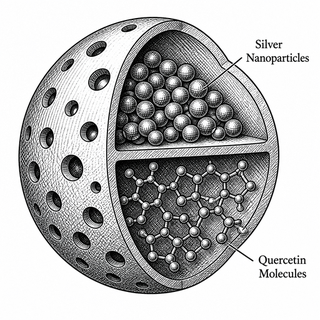
Let me back up, because "mesoporous polydopamine loaded with silver nanoparticles and quercetin" is a mouthful that sounds less like medicine and more like a recipe a very ambitious chemist scrawled on a napkin.
The disease nobody wants on their dinner plate
Bacterial keratitis is an infection of the cornea, the clear front window of your eye. It is exactly as unpleasant as it sounds. Bacteria set up shop, the cornea gets cloudy and swollen, inflammation arrives like an uninvited relative, and then comes the truly nasty part: corneal neovascularization. That is the body's misguided attempt to fix the problem by sprouting new blood vessels into tissue that is supposed to stay perfectly transparent. Imagine plumbing a new water line straight through your living room window. The window no longer works as a window.
This is a leading cause of infectious blindness worldwide, and it moves fast. Clinicians need to act quickly, which is why the standard play has been antibiotic eye drops, usually a fluoroquinolone like Levofloxacin.
The trouble is that antibiotic drops do one job: kill bacteria. They do nothing about the rogue blood vessels. So even when the infection clears, the patient can be left with a scarred, vascularized cornea and lousy vision. You won the battle and the window is still ruined.
The nanoparticle as a well-organized kitchen
Here is where the engineering gets clever. The research team built a carrier out of mesoporous polydopamine, or MPDA. Polydopamine is a synthetic cousin of melanin, the same pigment that colors your skin and hair, and it happens to be wonderfully sticky and biocompatible. "Mesoporous" just means it is riddled with tiny pores, like a sponge or, if you prefer, a very accommodating block of swiss cheese.
That porous structure is the whole point. It gives you enormous surface area to load up with cargo. Think of it as a tiny prep station with a hundred little compartments, each one ready to hold an ingredient.
Onto this scaffold they loaded two things:
Silver nanoparticles, the antibacterial heavy. Silver has been killing microbes since long before anyone knew what a microbe was, and it does so through several mechanisms at once, which makes it genuinely hard for bacteria to develop resistance. It is the broad-spectrum salt of the antimicrobial world.
Quercetin, a plant flavonoid you have eaten if you have ever enjoyed an onion, an apple, or a glass of red wine. Quercetin is the anti-angiogenic specialist here, the ingredient brought in specifically to shut down that runaway blood vessel construction project.
The finished product, charmingly abbreviated Q/AMP, is a single particle that does two jobs that previously required two completely different strategies. Polydopamine itself is no slouch either; it mops up reactive oxygen species, which helps tamp down the inflammation. So really it is a three-for-one, and unlike most three-for-one deals, this one appears to deliver.
What actually happened in the lab
In the dish, they tested Q/AMP against human umbilical vein endothelial cells, which are the standard stand-in for studying blood vessel growth. These are the cells that build new vasculature, and the composite stopped them from proliferating, migrating, and forming tubes. In plain terms, it told the construction crew to stop showing up, stop walking to the job site, and stop assembling the scaffolding. Every step of vessel-building got jammed.
The antibacterial testing showed the broad-spectrum punch you would expect from silver. But the in vivo numbers are where it earns its keep. In the rat model of bacterial keratitis, Q/AMP hit that 97.0% antibacterial rate against Levofloxacin's 77.4%. The corneal opacity score, which is basically a cloudiness grade where lower is clearer, dropped from 2.5 under Levofloxacin to 0.8 with Q/AMP. That is the difference between a frosted shower door and something you can almost read a newspaper through.
And the biocompatibility checked out both in vitro and in vivo, which is the unglamorous box you absolutely must tick. Plenty of things kill bacteria beautifully. Bleach kills bacteria beautifully. The trick is killing bacteria without also killing the patient's eye, and a silver-loaded particle has to thread that needle carefully, because silver at the wrong dose is toxic to your cells too. The mesoporous carrier helps here by metering out the cargo rather than dumping it all at once.
The part where the skeptic clears their throat
Before anyone reaches for the champagne, the usual caveats apply, and they apply hard. This is a rat study. Rat corneas are not human corneas, and the leap from rodent eye to clinical product is where a great many promising nanocomposites have quietly gone to die. There is no data here on long-term safety, on what happens to silver that lingers in eye tissue over months, on shelf stability, on manufacturing at scale, or on how you turn this into something a pharmacist can hand a patient. Regulators tend to have pointed questions about heavy-metal nanoparticles in something you put directly on your eyeball, and rightly so.
There is also the small matter of dosing, formulation, and whether the dual-function advantage holds up against the messier reality of human infections. The lab is a controlled kitchen. The clinic is a food truck during a lunch rush.
Still, the underlying idea is the genuinely interesting bit. Most treatments pick one lane. This work asks why a single platform cannot tackle the infection and the vascular damage and the inflammation together, since in real keratitis those three problems show up as a package deal. Building a carrier that addresses the whole package, rather than mailing three separate solutions, is the sort of integration thinking that tends to pay off down the line, even if this specific recipe never makes it to a shelf.
For now, file it under "promising proof of concept." The window analogy holds: this is research aimed not just at evicting the bacteria, but at keeping the glass clear once they are gone. That is a goal worth chasing, onions and all.
This blog post discusses research findings and should not be taken as medical advice. If you have concerns about eye infections or vision changes, please consult a healthcare provider promptly. Research discussed here represents ongoing scientific investigation and clinical validation is still in progress.
All images used in this post are decorative illustrations only and do not represent or reflect the accuracy, reality, or correctness of the referenced research.
Primary Source: Mesoporous polydopamine loaded with silver nanoparticles and quercetin for bacterial keratitis treatment through antibacterial and anti-angiogenic mechanisms. PubMed. 2026. PMID: 41558272