
Atherosclerosis is the disease equivalent of a kitchen drain that's been slowly clogging for thirty years because nobody wanted to deal with it. Fatty plaques build up in your arteries, the walls get inflamed, smooth muscle cells start multiplying like they're auditioning for a horror film, and eventually something ruptures. The current treatment menu reads like a steakhouse where every entree is a statin - effective, sure, but about as targeted as seasoning your entire kitchen when only the soup needs salt. So when a research team shows up claiming they've built a nanoparticle that can park itself at the plaque, calm the inflammation, and tell those overenthusiastic muscle cells to sit down, the engineering side of my brain perks up while the skeptical side reaches for the salt shaker.
The Recipe: Tea Extract, Copper, and a Bovine Protein Coat
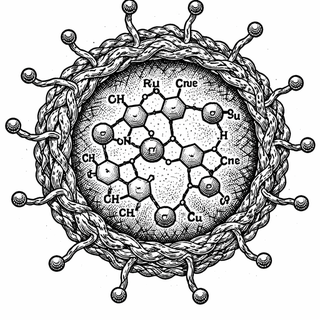
Here's what the researchers cooked up. They took epicatechin gallate (ECG) - a polyphenol you'd recognize as one of the active compounds in green tea - and combined it with copper ions through metal-phenolic coordination chemistry. Think of it as molecular mise en place: the ECG provides the antioxidant firepower, and the copper ions serve as the structural scaffolding that holds the whole nanoparticle together. The result is what they call ECG-Cu NPs.
But raw nanoparticles injected into the bloodstream tend to get gobbled up by the immune system faster than free samples at Costco. So the team wrapped these particles in bovine serum albumin (BSA), creating the final product: BSA@ECG-Cu NPs. BSA isn't just a garnish here. It serves a dual purpose - it exploits the enhanced permeability and retention (EPR) effect that lets nanoparticles slip through the leaky vasculature around inflamed plaques, and BSA itself has an inherent affinity for inflammatory sites. It's the nanoparticle equivalent of a delivery driver who already knows the neighborhood.
Why Smooth Muscle Cells Are the Problem Child
To understand why this matters, you need to appreciate the role of vascular smooth muscle cells (VSMCs) in atherosclerosis. Under normal conditions, VSMCs sit quietly in the arterial wall, doing their job of maintaining vessel tone. But in an atherosclerotic environment - flooded with oxidative stress and inflammatory signals - these cells start proliferating and migrating into the plaque like uninvited guests crashing a dinner party. This overgrowth contributes directly to plaque growth and instability. It's one of the central mechanisms that turns a manageable fatty streak into a cardiovascular event waiting to happen.
Most therapeutic approaches focus upstream on cholesterol or downstream on clot prevention. Going after VSMC proliferation directly is like fixing the leak in the pipe instead of just putting a bucket under it.
The Mechanism: Turning Down the Burner on Three Fronts
The researchers didn't just show that their nanoplatform works - they dug into the why. In VSMC cultures, BSA@ECG-Cu NPs significantly reduced excessive reactive oxygen species (ROS) generation. Less oxidative stress, fewer alarm bells ringing in the cell.
The mechanistic story involves three major signaling pathways: TLR4, MAPK, and NF-kB. For the non-molecular-biology crowd, think of these as three separate burners on a stove that are all cranked to high during atherosclerosis. TLR4 is the danger sensor that kicks off the inflammatory cascade. MAPK is the pathway that translates stress signals into cellular action. NF-kB is the master switch for inflammatory gene expression. The nanoparticles modulate all three, essentially turning down each burner from "scorching" to "simmer."
With oxidative stress dialed back, the downstream effects on cell cycle regulation followed logically. The team showed changes in the expression and phosphorylation of Cyclin D1, p-Rb, and E2F1 - the molecular gatekeepers that decide whether a cell divides or stays put. By altering these regulators, BSA@ECG-Cu NPs effectively told the VSMCs to stop their frantic multiplication. It's a cascade effect: calm the inflammation, and the cells stop panicking and overproducing.
From Petri Dish to Mouse: The ApoE Knockout Test
Cell culture results are encouraging, but they're also the appetizer course. The real test came in ApoE-knockout mice, the standard animal model for atherosclerosis research. These mice lack the apolipoprotein E gene, which means they develop atherosclerotic plaques on a high-fat diet with impressive reliability - they're basically the lab equivalent of a person who eats nothing but cheeseburgers.
The abstract indicates the nanoparticles were tested in this model, and while the full results require reading beyond what's summarized here, the combination of targeted delivery (via BSA's inflammatory homing), antioxidant activity (via ECG), and anti-proliferative effects (via cell cycle modulation) represents a multi-pronged approach that's more interesting than most single-mechanism therapies.
The Engineering Perspective: What Makes This Worth Watching
From a device and delivery standpoint, the metal-phenolic coordination approach is elegant in its simplicity. You're not dealing with complex polymer synthesis or expensive biologics manufacturing. Polyphenols are abundant and cheap. Copper is copper. BSA is one of the most well-characterized proteins in biomedical research - it's literally the flour in every lab's pantry.
The real question, as always, is scalability and translational viability. Can you manufacture these particles at consistent quality? What's the shelf stability? How does the copper component behave over longer treatment periods? Copper is essential in trace amounts but toxic in excess - the therapeutic window matters, and the paper's short-term mouse data won't answer that fully.
There's also the broader question of whether targeted nanoparticle delivery to atherosclerotic plaques - a concept that's been promising for two decades - will finally produce something that survives clinical trials. The graveyard of "works in mice" nanomedicines is extensive. But each iteration teaches us something, and the biomimetic BSA coating strategy paired with a multi-pathway mechanism of action is a more sophisticated recipe than many of its predecessors.
The Bottom Line
This research represents a thoughtful approach to a hard problem: getting a therapeutic agent to the right place, at the right dose, to address the right biological mechanism. The combination of green tea polyphenols, copper coordination chemistry, and albumin-based targeting is the kind of practical, ingredients-you-already-have-in-the-kitchen engineering that might actually have legs. Whether it survives the long march from mouse aorta to human clinic remains the billion-dollar question, but the foundation here is solid and the mechanistic story is well-supported.
Sometimes the best dishes are the ones made from simple ingredients, assembled with care.
This blog post discusses research findings and should not be taken as medical advice. If you have concerns about atherosclerosis or cardiovascular disease, please consult a healthcare provider. Research discussed here represents ongoing scientific investigation and clinical validation is still in progress.
All images used in this post are decorative illustrations only and do not represent or reflect the accuracy, reality, or correctness of the referenced research.
Primary Source: Bovine Serum Albumin-Coated Metal-Phenolic Nanoplatform for Atherosclerosis Therapy via Targeted Delivery and Inhibition of Vascular Smooth Muscle Cells Proliferation. PubMed. 2025. PMID: 42034129