
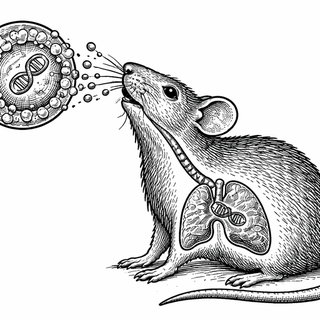
Cystic fibrosis mice breathed in nanoparticles, and their broken CFTR gene started working again. Not partially. Not "we saw a trend toward significance." The chloride channels - the exact molecular machinery that cystic fibrosis destroys - flickered back to life. And the gene editor that did it? It was riding inside a tiny fat bubble made from amino acids. I need you to understand how wild this is.
The Lung Problem Nobody Could Crack
CRISPR gene editing has been on an absolute tear lately. We've seen it go after sickle cell disease, hereditary blindness, high cholesterol - the hits keep coming. But lungs? Lungs have been the stubborn holdout. The reason is brutally simple: getting gene-editing cargo into lung cells is really, really hard.
Think about what the lung is designed to do. It's basically a fortress optimized over millions of years of evolution to keep foreign particles OUT. There's a thick mucus barrier that traps invaders. There are immune cells on patrol. The epithelial cells lining the airways are packed tight like bricks in a wall. Every defense mechanism that keeps you from dying of pneumonia is also, inconveniently, the same defense mechanism that blocks therapeutic nanoparticles from reaching their target.
Previous attempts to deliver gene editors to the lung mostly involved viral vectors (which trigger immune responses and have cargo size limits) or lipid nanoparticles that worked great for the liver but basically shrugged when asked to transfect lung tissue. The lung just wasn't having it.
960 Lipids Walk Into a Lab
Here's where this team did something genuinely clever. Instead of tweaking existing lipid nanoparticle formulas and hoping for the best, they went full combinatorial chemistry. They took the building blocks of proteins - amino acids, both the standard 20 your body uses and some exotic non-proteinogenic ones - and used them as chemical scaffolds to synthesize an absolutely bonkers library of 960 different ionizable lipids.
Why amino acids? Because they're modular (you can snap different chemical groups onto them like LEGO bricks), they're biocompatible (your body already knows what to do with amino acid metabolites), and they're biodegradable (no worrying about toxic accumulation). It's one of those ideas that sounds obvious in retrospect but required serious chemical creativity to execute.
They then ran high-throughput screening on this massive library, testing which lipids could actually form nanoparticles capable of delivering mRNA to cells. Out of 960 candidates, one stood out: a cyclohexyl amino acid-derived lipid they named CHCha-10. And wait, it gets better.
The Mucus Whisperer
CHCha-10 didn't just deliver cargo to cells in a dish. When formulated into nanoparticles and administered intratracheally (fancy way of saying "squirted into the windpipe"), these particles did something remarkable: they punched through lung mucus.
This is a big deal. Mucus is the bane of pulmonary drug delivery. It's a sticky, tangled mesh of glycoproteins that catches and immobilizes most nanoparticles before they ever reach the underlying epithelial cells. CHCha-10 nanoparticles, though, penetrated this barrier and specifically transfected epithelial cells - the exact cell type you'd want to target for cystic fibrosis therapy.
And they didn't just test this in mice. They confirmed mucus penetration and epithelial-specific delivery in ferrets, which have airways that are much more similar to human lungs in terms of size, structure, and mucus composition. When researchers break out the ferret model, you know they're serious about translation.
Editing Genes With Every Breath
Now for the main event. The team loaded their CHCha-10 nanoparticles with two things: adenine base editor mRNA and a guide RNA targeting the CFTR G542X mutation. This is one of the nonsense mutations that causes cystic fibrosis - it introduces a premature stop codon that prevents the CFTR protein from being fully made. No functional CFTR means no working chloride channels, which means thick, sticky mucus buildup, chronic infections, and progressive lung damage.
Adenine base editing is elegant because it doesn't cut the DNA double strand (reducing the risk of unwanted insertions or deletions). Instead, it chemically converts one DNA base into another - in this case, swapping the mutation back to the correct sequence. It's like using a pencil eraser and rewriting a single typo instead of ripping the page out and taping in a new one.
The results were striking across three different model systems. In human airway epithelial cells carrying the G542X mutation, CFTR expression came back. In mouse-derived intestinal organoids (mini-gut structures grown from stem cells), chloride channel function was restored - they could actually measure the organoids swelling in response to forskolin, which only happens when CFTR is working. And in the lungs of cystic fibrosis mice carrying the G542X mutation, inhaled nanoparticles achieved functional base editing in vivo.
Why This Matters Beyond Cystic Fibrosis
Let's zoom out for a second. What this team really built is a platform. The 960-lipid library and the structure-function relationships they mapped out aren't just useful for one disease. They've essentially created a design framework for building lung-targeted nanoparticles. Need to deliver a different base editor? A different guide RNA? An mRNA therapeutic that isn't CRISPR-related at all? CHCha-10 nanoparticles could potentially carry any of those.
There are roughly 2,000 known CFTR mutations, and CF is just one of many genetic lung diseases. Alpha-1 antitrypsin deficiency, primary ciliary dyskinesia, surfactant protein deficiencies - the list goes on. A modular, inhalable delivery system that can get gene editors into lung epithelial cells opens the door to all of these.
The Caveats (Because Science)
Before anyone starts planning victory laps, some perspective is warranted. This is preclinical work. Mice and ferrets are not humans, and the G542X mutation was studied in specific model systems, not in a clinical trial with actual CF patients. The efficiency of base editing in vivo, while functional, will need to be higher and more durable for therapeutic relevance. Repeat dosing, long-term safety, immune responses to repeated nanoparticle inhalation, and manufacturing scalability are all open questions.
But honestly? The fact that they went from a rational chemical design framework to a 960-compound library to in vivo functional gene correction in the lung - all in one paper - is a flex. This is the kind of work that makes you put down your coffee, re-read the abstract, and immediately forward it to three people.
The era of inhaled gene therapy might actually be arriving. And it's riding in on a tiny bubble made of amino acids.
This blog post discusses research findings and should not be taken as medical advice. If you have concerns about cystic fibrosis or genetic lung diseases, please consult a healthcare provider. Research discussed here represents ongoing scientific investigation and clinical validation is still in progress.
All images used in this post are decorative illustrations only and do not represent or reflect the accuracy, reality, or correctness of the referenced research.
Primary Source: Amino acid-derived ionizable lipids enable inhaled base editing for therapeutic gene correction in the lung. PubMed. 2026. PMID: 41922838