
Meanwhile, in a laboratory, someone looked at the longstanding habit of tossing vancomycin powder into a surgical wound and asked a perfectly reasonable question: why are we still seasoning deep spinal incisions like a cast-iron skillet? That image is unfair to skillets, which at least have the decency to be flat. Surgical wounds are not flat. They are narrow, irregular, and full of corners where bacteria would love to rent a studio apartment. So this paper takes a familiar infection-prevention drug and packages it in a propellant-free foam, with the goal of coating the wound more evenly and making the whole maneuver less messy.
Why anybody cares
Surgical site infections are one of those complications that make surgeons, patients, and hospital administrators equally miserable, which is rare enough to qualify as team building. In spine surgery, the stakes are especially high. These operations often involve deep incisions and implanted hardware. Once bacteria get cozy around metal, the situation can go downhill fast - more pain, more procedures, more antibiotics, and a longer road back than anyone signed up for.
Vancomycin powder placed directly into the wound has become a widely used strategy to lower that risk. The logic is simple enough: put antibiotic where the trouble is likely to start. But the delivery system has always had some obvious flaws. Raw powder does not automatically spread itself with grace and dignity. In small or awkwardly shaped spaces, it can clump, settle unevenly, and leave behind solid residue. It can also create airborne particles during application, which is not ideal in an operating room where everyone is already busy enough.
What this study actually built
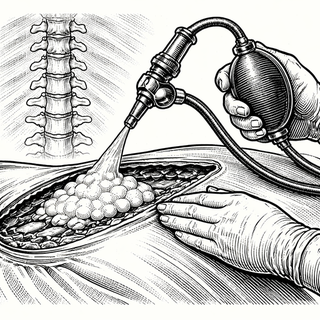
The researchers developed an aqueous, surfactant-based vancomycin foam designed for intrawound use in spine surgery. The key detail here is that it is propellant-free and dispensed through a pump device. That matters because the point is not to create some theatrical burst of hospital whipped cream. The point is controlled delivery, better coverage, and keeping the antibiotic where it belongs.
According to the study summary, this foam improved vancomycin solubility compared with water alone. That may sound like dry chemistry housekeeping, but it is the kind of housekeeping that decides whether a treatment spreads smoothly or behaves like wet drywall dust. Better solubility means the drug can be distributed more evenly through the foam rather than sitting around in stubborn little crystals.
The authors also report that the foam left no solid residues behind. That is not trivial. In surgery, fewer leftovers are generally better unless we are discussing coffee.
How they tested it
This was not a human clinical trial. The researchers used a rat model of spinal implant-associated Staphylococcus aureus infection. In plain English, they created a setup meant to mimic the kind of infection risk spine surgeons worry about most - a wound, implanted foreign material, and a common troublemaking bacterium.
They evaluated two main things:
- Whether the blank foam itself was biocompatible.
- Whether the vancomycin-loaded foam could prevent infection as well as standard vancomycin powder.
The foam was applied to the dorsal spine wound bed using the pump device. For the antimicrobial testing, the animals underwent dorsal spine exposure, foreign body implantation, and bacterial inoculation, then were compared across treated and untreated groups.
That is the research version of a stress test. If your shiny new delivery method falls apart under those conditions, better to find out in the lab than in a patient.
What they found
The headline result is that the vancomycin foam performed about as well as vancomycin powder in this rat model at controlling infection. That may sound modest, but it is actually the whole point. If you can match the antimicrobial effect of the current approach while improving delivery, coverage, and handling, that is a meaningful upgrade.
Just as important, the study found no observed soft tissue damage or systemic toxicity from the foam. In medicine, "it worked and did not seem to hurt anything" is not glamorous language, but it pays the bills. A prophylactic treatment has to clear that bar before anyone should get excited.
So the foam did three useful things at once:
- It delivered vancomycin more uniformly.
- It avoided solid residue.
- It matched the infection-fighting performance of powder in the animal model.
That is a tidy package for a field that often advances through small practical improvements rather than fireworks.
Why the foam idea is interesting
The clever part here is not inventing a new antibiotic. It is solving a delivery problem that has been hiding in plain sight. Medicine does this all the time. We focus on the molecule, then later realize the real bottleneck was how we got the molecule to the right place without making a mess of the neighborhood.
A deep spinal wound is not a countertop. It is more like trying to paint the inside of a narrow, irregular cave while wearing gloves and trying not to contaminate anything. A foam can creep into spaces powder may miss, stick around better, and avoid turning part of the job into an unintentional dust event. That is the sort of unglamorous engineering fix that can end up mattering a great deal in the real world.
There is also a workflow angle. If a propellant-free pump reliably applies foam with minimal fuss, that could make the intervention easier and more reproducible. Surgeons tend to appreciate tools that work the same way every time and do not require interpretive dance.
What this does not prove
Before we all start engraving victory plaques, a few brakes are still attached to this train.
This was an animal study, not a human trial. Rat models are useful, but rats do not have billing departments, consent forms, or the same wound biology as people undergoing complex spine surgery. We also do not know from this summary how the foam would perform across different surgical settings, bacterial loads, dosing strategies, or patient populations.
There is also the larger issue of antibiotic stewardship. Any local antibiotic strategy has to be considered in the context of resistance, microbiology patterns, and broader infection-prevention protocols. A better delivery system is promising, but it does not magically exempt anyone from the usual rules of smart antibiotic use.
So the right takeaway is not "problem solved." It is "this looks like a practical improvement worth testing further."
The bottom line
I like this paper because it tackles a very surgeon-shaped problem with a very surgeon-friendly solution. It does not pretend to reinvent infection prevention from scratch. It takes an existing tactic, notices where it is clumsy, and tries to make it cleaner and more controlled.
If future studies in humans back this up, intrawound antibiotic foam could become a useful alternative to vancomycin powder in spine surgery - especially where wound geometry and hardware make even coverage a real concern. Sometimes progress in medicine is a moonshot. Sometimes it is getting the drug to stop behaving like baby powder in a machine shop. Both count.
This blog post discusses research findings and should not be taken as medical advice. If you have concerns about surgical site infections or spine surgery, please consult a healthcare provider. Research discussed here represents ongoing scientific investigation and clinical validation is still in progress.
All images used in this post are decorative illustrations only and do not represent or reflect the accuracy, reality, or correctness of the referenced research.
Primary Source: Propellant-free intrawound antibiotic foam for intraoperative antimicrobial prophylaxis. PubMed. https://pubmed.ncbi.nlm.nih.gov/42050315/