
A graduate student stares at a crystal growing in a glass vial, and honestly, it doesn't look like much. A tiny translucent speck. But zoom in a few million times, and you'd see something wild: an elaborate honeycomb of organic molecules linked together not by the sturdy covalent bonds you learned about in high school chemistry, but by hydrogen bonds - the same gentle, sticky forces that hold water molecules together and keep DNA's double helix from unraveling. It seems almost reckless, like building a skyscraper out of Velcro. Yet this fragile-sounding architecture is turning out to be one of the most exciting platforms in biomedical materials science.
Welcome to the world of hydrogen-bonded organic frameworks, or HOFs.
So What Exactly Are These Things?
Think of a framework material as molecular Lego. You snap together building blocks into a repeating 3D structure full of precisely sized pores - tiny tunnels and chambers at the nanoscale. Metal-organic frameworks (MOFs) and covalent organic frameworks (COFs) have been the cool kids in this space for years, using strong metal-ligand or covalent bonds as their "snap" mechanism. HOFs take a radically different approach: they rely on hydrogen bonds.
Now, hydrogen bonds are comparatively weak. Your body breaks and reforms trillions of them every second just by existing. That sounds like a terrible engineering choice, right? Except it comes with a superpower: reversibility. Because hydrogen bonds break and reform so easily, HOFs can be dissolved and recrystallized, tuned and reassembled, in ways that their tougher cousins simply can't. They're synthesized under mild conditions (no extreme heat, no toxic metal catalysts), and they can be designed with almost absurd precision.
It's like choosing to build with magnetic tiles instead of superglue. Less permanent? Sure. But way more flexible, and you can always rearrange the pieces.
Enter the Biocatalysts
A comprehensive new review published in 2025 pulls together the latest advances in combining HOFs with biological catalysts - enzymes, proteins, and other bioactive molecules - to create hybrid materials that are greater than the sum of their parts (DOI: 10.1016/j.ccr.2025.216588).
Here's the basic idea: enzymes are nature's catalysts. They speed up chemical reactions with jaw-dropping efficiency and specificity. The problem? Free-floating enzymes in solution are divas. They degrade quickly, they're sensitive to temperature and pH, and they're a pain to recover and reuse. Scientists have been trying to "immobilize" enzymes - essentially giving them a stable home - for decades.
HOFs turn out to be spectacularly good homes.
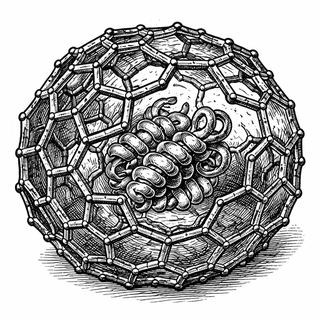
Their ordered pore structures can be tailored to fit specific enzymes like a molecular glove. The mild synthesis conditions mean you can build the framework around the enzyme without cooking it to death (a real problem with some MOF approaches). And the hydrogen-bonding networks can actually stabilize the enzyme's structure, keeping it active longer than it would survive on its own.
The result: biocatalytic composites that are more stable, more efficient, and more reusable than either component alone.
What Could This Actually Do?
The review highlights several areas where HOF-based biocatalysts are already showing promise:
Biomedical engineering - Imagine enzyme-loaded HOF particles that can be delivered to a specific site in the body, catalyze a therapeutic reaction (like breaking down a toxic metabolite or activating a prodrug), and then be safely cleared. The biocompatibility of all-organic, metal-free frameworks is a real advantage here. No one wants leftover heavy metals hanging around in their liver.
Biosensing - HOFs loaded with oxidase enzymes can detect glucose, lactate, or other biomarkers with high sensitivity. The porous structure concentrates analytes near the enzyme active sites, boosting the signal. Think of it as giving the sensor a built-in funnel.
Environmental cleanup - Enzyme-HOF composites can break down pollutants in water, from pesticides to pharmaceutical residues. The reusability factor is huge here. Instead of using an enzyme once and watching it fall apart, you get a catalytic material that keeps working through multiple treatment cycles.
The "Yeah, But..." Section
No honest science story gets to skip the challenges, and this field has a few doozies.
The stability paradox. HOFs are held together by weak bonds. That's their charm and their Achilles' heel. Making them stable enough for real-world use - especially in the warm, wet, mechanically aggressive environment of the human body - without sacrificing the gentle conditions that make them biocompatible in the first place? That's a tightrope walk. Researchers are exploring strategies like interpenetrated networks (frameworks woven through each other for mutual support) and post-synthetic modifications to toughen things up without losing the essential character.
Multifunctional integration. The dream is a single HOF composite that can sense, respond, and treat simultaneously. Getting multiple functional components to play nicely together inside one framework without interfering with each other is, to put it mildly, non-trivial. It's like trying to run a restaurant kitchen where every chef insists on using the same burner.
Long-term biosafety. This is the big question mark. HOFs are relatively new, and we simply don't have long-term data on what happens when these materials hang out in biological systems for extended periods. Do they degrade into harmless components? Do fragments accumulate? The review flags this as a priority area for future research, and rightly so.
Why This Matters Now
Materials science often feels abstract until someone turns a clever crystal into something that saves a life. HOFs are still in that exciting, messy, early phase where the fundamental science is being mapped out and the first real applications are just beginning to peek over the horizon. But the trajectory is promising.
The fact that these frameworks can be assembled from simple organic molecules under gentle conditions, customized at the molecular level, loaded with biological machinery, and then potentially dissolved and rebuilt - that's a uniquely powerful combination. It's the kind of flexibility that tends to matter enormously once you start dealing with the chaotic complexity of actual human bodies.
We're not at clinical trials yet. We're at the "wow, look what this can do in a test tube" stage. But for a class of materials held together by the chemical equivalent of a polite handshake, HOFs are punching remarkably above their weight.
This blog post discusses research findings and should not be taken as medical advice. If you have concerns about conditions mentioned here, please consult a healthcare provider. Research discussed here represents ongoing scientific investigation and clinical validation is still in progress.
All images used in this post are decorative illustrations only and do not represent or reflect the accuracy, reality, or correctness of the referenced research.
Primary Source: Biocatalytic hydrogen-bonded organic frameworks: Design and biomedical applications. Coordination Chemistry Reviews. 2025. PubMed: 41005079