
Dolphins do it. Octopuses do it. Now we're learning how to do it too. What exactly? Build incredibly sophisticated structures using nothing but the gentlest of molecular handshakes - hydrogen bonds. While marine creatures have spent millions of years perfecting their biological architectures, materials scientists are finally catching up, and the results are nothing short of spectacular.
What Are These Fancy Frameworks Anyway?
Hydrogen-bonded organic frameworks, or HOFs (pronounced like you're Santa Claus with a cold), represent one of the most exciting developments in materials science. Picture a molecular-scale Lego set where all the pieces snap together through hydrogen bonds - those same weak-but-mighty interactions that hold DNA together and give water its quirky properties.
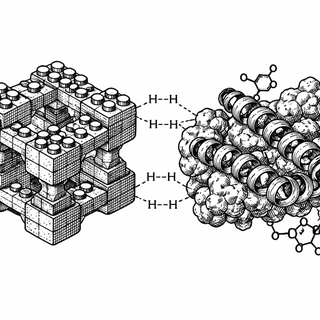
Unlike their more rigid cousins, metal-organic frameworks (MOFs), HOFs are the flexible yoga instructors of the porous materials world. They're crystalline, meaning their atoms are arranged in beautiful, repeating patterns. They're porous, riddled with tiny channels and cavities that can trap, store, or transport other molecules. And here's the really clever bit - they're tunable. Scientists can adjust the strength and arrangement of those hydrogen bonds like turning dials on a mixing board, creating materials with precisely the properties they need.
When Frameworks Meet Biology: A Beautiful Partnership
The real magic happens when researchers combine these elegant structures with bioactive components. Think enzymes, proteins, or other biological molecules that actually do things in living systems. The result? Hybrid materials that are greater than the sum of their parts.
A recent comprehensive review published in 2025 systematically examines this emerging field, highlighting how HOFs-based biocatalytic composites are positioning themselves as next-generation materials for biomedical applications. The structural stability these frameworks provide acts like a protective suit of armor for delicate biological molecules, while the porous architecture ensures reactants can still access the active sites where catalysis occurs.
Why does this matter for patients? Consider enzyme therapies, where getting therapeutic enzymes to work effectively inside the body has always been a challenge. Enzymes are notoriously finicky - too hot, too acidic, too much jostling, and they fold up like origami and stop working. By nestling enzymes within HOF structures, researchers are finding ways to keep these molecular workhorses stable and active far longer than they'd survive on their own.
The Modular Assembly Advantage
One aspect that makes HOFs particularly appealing is their modular assembly strategy. Rather than requiring harsh chemical conditions or high temperatures to build, these frameworks essentially self-assemble. The organic building blocks recognize each other and click together through those signature hydrogen bonds, often under mild conditions that won't destroy sensitive biological cargo.
This is a bit like the difference between building a house by welding steel beams versus snapping together interlocking blocks. Both can create sturdy structures, but one approach is significantly gentler on anything already inside the construction zone.
The review details various strategies researchers are using to enhance catalytic performance in these systems. Some teams are engineering the pore sizes to concentrate substrates near active sites. Others are incorporating multiple types of catalytic centers that work in sequence, like a molecular assembly line. The creativity on display is genuinely impressive.
Beyond Medicine: Environmental Applications
While biomedical applications grab headlines, HOFs-based biocatalysts are also making waves in environmental science. Imagine deploying these materials to break down pollutants, capture carbon dioxide, or clean up contaminated water - all using enzymatic processes that operate under mild conditions and produce minimal waste.
The intersection of green chemistry and advanced materials science feels particularly relevant right now. As we collectively grapple with environmental challenges, having tools that harness biological efficiency while offering the stability of synthetic materials seems like exactly the kind of technological breakthrough we need.
The Challenges That Remain
No emerging technology exists without growing pains, and HOFs-based biocatalysts are no exception. The review honestly addresses several dilemmas facing the field.
First, there's the stability-activity trade-off. Making a framework more stable often means restricting molecular movement, but biological catalysts frequently need some wiggle room to function. It's the materials science equivalent of trying to protect a dancer by putting them in a suit of armor - technically safer, but not great for the pirouettes.
Second, multifunctional integration remains tricky. Combining multiple capabilities in a single material system without them interfering with each other requires careful molecular choreography. Getting all the components to play nicely together is more art than science at this stage.
Third, and perhaps most significant for clinical translation, are long-term biosafety concerns. How do these materials behave after weeks or months in biological environments? Do they degrade safely? Could breakdown products cause problems? These questions need answering before HOFs-based therapeutics can move from lab bench to bedside.
Looking Forward
Despite these challenges, the trajectory of this field feels optimistic. The review outlines strategic research directions that could accelerate progress, from developing better computational tools to predict framework properties, to establishing standardized testing protocols for biocompatibility assessment.
What strikes me most about this area of research is its inherently interdisciplinary nature. Progress requires chemists who understand hydrogen bonding, biologists who understand enzyme function, engineers who understand device design, and clinicians who understand patient needs - all working together. That kind of collaborative science tends to produce unexpected breakthroughs.
Will hydrogen-bonded organic frameworks revolutionize medicine? It's too early to say definitively. But watching researchers learn to build with the same gentle molecular touches that nature has perfected over evolutionary time scales? That's the kind of biomimicry that gives this clinical researcher genuine hope for what's coming next.
After all, if dolphins and octopuses figured it out, surely we can too.
This blog post discusses research findings and should not be taken as medical advice. If you have concerns about any medical condition, please consult a healthcare provider. Research discussed here represents ongoing scientific investigation and clinical validation is still in progress.
All images used in this post are decorative illustrations only and do not represent or reflect the accuracy, reality, or correctness of the referenced research.
Primary Source: Biocatalytic hydrogen-bonded organic frameworks: Design and biomedical applications. PubMed. 2025. DOI: https://pubmed.ncbi.nlm.nih.gov/41005079/