
A patient hears that a tumor has stopped responding. A lab team stares at cancer cells that keep finding inventive new ways not to die. Somewhere in the background, mitochondria are doing their little power-plant routine while the endoplasmic reticulum is trying to keep the cellular assembly line from flying apart. Cancer, as usual, is running a highly unethical startup.
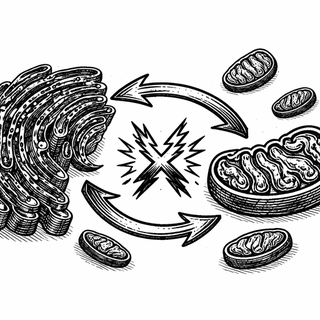
That is why this paper caught my eye. It takes aim at a particularly interesting partnership inside the cell: the back-and-forth between the endoplasmic reticulum, or ER, and the mitochondria. These two structures are not merely roommates. They are more like co-conspirators sharing messages across a thin wall. When that communication is manipulated in exactly the wrong way for the cancer cell, the result may be a coordinated collapse.
Two Ways to Make a Cancer Cell Very Uncomfortable
The study, titled Activation of Synergistic Ferroptosis and Apoptosis by a Cu(II) Complex through Concurrent Amplification of Endoplasmic Reticulum Stress and Mitochondrial Dysfunction, describes a copper-containing compound designed to push cancer cells toward not one, but two forms of death.
Most people have heard of apoptosis, even if they have not used the term at brunch. It is the cell's orderly self-destruct program, the biological equivalent of shutting down a malfunctioning factory according to protocol.
Ferroptosis is less famous but increasingly interesting in cancer research. It is a distinct form of cell death linked to iron-dependent lipid damage. In plain English, the cell's membranes suffer oxidative injury until the whole system becomes unsalvageable. Apoptosis is tidy. Ferroptosis is more like discovering the wiring is smoking and the walls are melting.
Why go after both? Because cancer cells are masters of evasive maneuvers. If one death pathway is blocked, another may still be available. A therapy that can activate more than one lethal program has a certain appeal, rather like locking the front door and the back door instead of trusting a single flimsy latch.
Why the ER and Mitochondria Matter
The paper focuses on the crosstalk between the ER and mitochondria. That phrase can sound like grant-application wallpaper, but the idea is straightforward. The ER helps fold proteins, manage calcium, and maintain cellular order. Mitochondria generate energy and help regulate survival and death signals. They communicate constantly, and cancer cells often exploit that communication to keep themselves alive under stress.
Researchers have been interested in this ER-mitochondria axis for years because it is a genuine vulnerability. If you stress the ER hard enough, or disrupt mitochondrial function deeply enough, a cell may tip into death. Doing both at the same time, and doing it in a synchronized way, is the hard part. Cells are annoyingly adaptive. Biology rarely waits politely for your therapeutic strategy to unfold.
According to the summary provided, this study addresses that challenge with a pyridine-hydrazone-derived Cu(II) complex. The concept is to disrupt the interorganelle network with enough precision and enough force that ER stress and mitochondrial dysfunction amplify one another. That amplification appears to be the point. One insult alone might provoke compensation. Two linked insults can turn compensation into collapse.
Why Copper?
Copper is an interesting choice. In everyday life, copper is plumbing and old pennies. In cell biology, metals can be much more dramatic. Transition metals participate in redox chemistry, influence reactive oxygen species, and can alter the balance of oxidative stress inside cells. That makes them potentially useful, but also potentially tricky. A metal-based anticancer agent is not new as a category, yet each new compound has to prove it can be potent without becoming a biochemical bull in a china shop.
This paper suggests that the copper complex is not simply causing generic damage. The more intriguing idea is that it is steering damage into a specific cellular weak spot: the ER-mitochondria connection. That makes the work more than another "we made cancer cells unhappy in a dish" story. It is an attempt at mechanism-driven design, which is a far more serious enterprise.
What Makes This Interesting
The headline feature here is synergy. Not just ferroptosis. Not just apoptosis. Not just ER stress. Not just mitochondrial dysfunction. The study appears to propose that these events reinforce one another in a coordinated cascade.
That matters because cancer therapy often fails at the level of redundancy. Tumor cells can rewire metabolism, mute one death pathway, buffer oxidative stress, or simply endure more cellular chaos than seems decent. A compound that drives several connected failure points at once may have a better chance of overwhelming that resilience.
There is also a nice irony here. Cancer cells are famous for being adaptable and resourceful. The very interconnectedness that helps them survive stress may also create an Achilles' heel. Build too many backup systems, and eventually those systems become a shared electrical grid waiting for one well-placed short circuit.
What This Could Mean in the Real World
If future work supports these findings, the implications could be meaningful. A therapy built to trigger synchronized ferroptosis and apoptosis might help tackle tumors that resist standard approaches. It could also inspire combination strategies, where such compounds are paired with treatments that further weaken oxidative defenses or stress-management pathways.
That said, there is a wide and very familiar gulf between an elegant laboratory concept and a treatment that helps actual patients. Many compounds look persuasive in preclinical studies and then lose their charm once issues like selectivity, toxicity, dosing, metabolism, and delivery arrive to ruin the party.
For a copper-based complex, those questions become even more pressing. Does it preferentially harm tumor cells over healthy tissue? Can it reach the right cellular compartments consistently? Does the mechanism hold up across different cancer types, or only in specific settings? Those are not small technicalities. They are the whole ballgame.
The Bigger Research Trend
This paper also fits a larger shift in oncology research. For years, the field has searched for ways to target cancer not just by blocking growth signals, but by exploiting the altered stress biology of malignant cells. Tumors often live close to the edge already. They juggle metabolic strain, protein-folding pressure, oxidative stress, and genomic instability. Push in the right place, and their adaptability becomes a liability.
That is what makes the ER-mitochondria axis such a compelling target. It sits at the crossroads of metabolism, calcium handling, redox balance, and cell death. In other words, it is exactly the sort of crowded intersection where a bad traffic signal can create a spectacular pileup.
Final Thoughts
What I like about this study is its lack of timidity. Rather than nudging one pathway and hoping for the best, it aims to choreograph a coordinated failure across two organelles and two death programs. That is ambitious, mechanistically rich, and very much in line with where smarter cancer-drug design is heading.
What I do not want to do is oversell it. This is research, not a clinic-ready breakthrough wrapped in optimistic headlines. But as a concept, it is a strong one: use a copper complex to intensify ER stress and mitochondrial dysfunction at the same time, and in doing so drive both ferroptosis and apoptosis. Cancer cells thrive on contingency plans. This strategy appears designed to cancel several of them at once.
This blog post discusses research findings and should not be taken as medical advice. If you have concerns about cancer, please consult a healthcare provider. Research discussed here represents ongoing scientific investigation and clinical validation is still in progress.
All images used in this post are decorative illustrations only and do not represent or reflect the accuracy, reality, or correctness of the referenced research.
Primary Source: PubMed Record 42010867. Activation of Synergistic Ferroptosis and Apoptosis by a Cu(II) Complex through Concurrent Amplification of Endoplasmic Reticulum Stress and Mitochondrial Dysfunction. https://pubmed.ncbi.nlm.nih.gov/42010867/