
If a flexible wearable sensor were a household object, it would be the loyal kitchen sponge: soft, slightly damp, willing to bend into disgraceful shapes, and somehow expected to perform useful work after being squeezed half to death. The hydrogel described in this new PubMed-indexed study is a much more elegant version of that idea, though I suspect it would object to being compared with dishware.
The paper, “Highly stretchable polyacrylamide/silk fibroin double network self-adhesive hydrogel for flexible wearable sensors,” reports a soft, sticky, conductive material designed to monitor human movement in real time. In plain terms, the researchers built a gel that can stretch, cling to skin, conduct electrical signals, and survive repeated motion without giving up like an old laboratory rubber band.
That combination matters. Wearable sensors are only useful if they can stay attached, move with the body, and report meaningful signals. Anyone who has worn a peeling adhesive patch, a slipping electrode, or a fitness tracker with the temperament of a Victorian corset will appreciate the challenge.
Why Silk Is in the Laboratory Again
Silk fibroin, the protein that gives silk much of its strength and structure, has been a favorite of biomaterials scientists for years. I remember when silk first began appearing seriously in tissue engineering discussions. Some of us old professors raised an eyebrow, then quietly admitted that nature had been doing polymer science long before our grant committees discovered it.
Silk fibroin is attractive because it is biocompatible, biodegradable, and chemically versatile. It can form hydrogels, films, fibers, and scaffolds. In wearable sensor materials, it brings a pleasant biological friendliness to the table.
But silk has a personality. Its molecular chains like to organize into beta-sheet structures. That organization can provide strength, but too much of it makes the material less stretchable and less adhesive. A pure silk fibroin hydrogel may be respectable, but not always nimble. It is a bit like a brilliant senior colleague who refuses to use email: impressive, but hard to integrate into modern workflows.
The Double-Network Trick
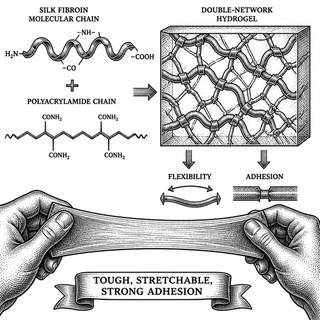
To solve this, the researchers introduced polyacrylamide, often abbreviated PAM, into the silk fibroin system. PAM is a flexible polymer, and here it helps form what is called a double-network hydrogel.
A hydrogel is mostly water held inside a polymer network. A double-network hydrogel contains two interwoven polymer systems. One network can provide structure, while the other contributes flexibility, toughness, or other useful traits. The result can be stronger and stretchier than either material alone.
In this case, PAM appears to regulate the excessive beta-sheet crystallization of silk fibroin through intermolecular interactions. That is a tidy way of saying the PAM chains help persuade silk not to over-organize itself into stiffness. The hydrogel’s internal architecture changes, and with that change come better tensile and adhesive properties.
The numbers are striking. The optimized hydrogel, called PTSG-4 in the study, reached a maximum tensile stress of 221.65 kPa and a fracture elongation of 1467.36%. That means it could stretch more than fourteen times its original length before breaking. I have known graduate students who stretched deadlines less impressively.
Making the Gel Conductive
A wearable strain sensor needs more than softness and stretch. It must also convert motion into an electrical signal. For that, the researchers added tannic acid-modified reduced graphene oxide, or TA-rGO.
Graphene oxide and reduced graphene oxide are carbon-based materials often used to provide conductivity. Tannic acid, a plant-derived polyphenol familiar to anyone who has over-steeped tea, helps modify the material and improve adhesion. Here, TA-rGO gives the hydrogel its electrical sensing capability while also strengthening its ability to stick.
The study notes that after in-situ reduction, some oxygen-containing functional groups remain in the graphene oxide. That detail matters because completely stripping away such groups could disrupt compatibility with the hydrogel network. Keeping some of them helps preserve the integrity of the material while still improving conductivity.
Materials science often sounds like cooking at molecular scale: add enough structure to hold together, enough flexibility to avoid snapping, enough conductivity to sense motion, and enough stickiness to stay put. Then try not to burn the soufflé.
Why Adhesion Matters
The hydrogel achieved an adhesion strength of 32.48 kPa on pigskin, a standard model for evaluating skin-like adhesion. For wearable sensors, adhesion is not a decorative feature. It determines whether the device can stay in contact long enough to collect reliable data.
A sensor that lifts off the skin during motion is not measuring the body very well. It may simply be measuring its own escape attempt.
Self-adhesive hydrogels could reduce the need for separate glues, tapes, or straps. That is attractive for monitoring joints, facial expressions, hand motion, breathing, or rehabilitation exercises. A soft sensor that conforms closely to curved, moving surfaces can pick up subtle strain changes that rigid devices might miss.
Sensitivity and Range
The strain sensor based on this hydrogel showed a gauge factor of 9.43. Gauge factor is a measure of sensitivity: how strongly the electrical signal changes when the material is stretched. A higher value generally means the sensor can detect smaller or more meaningful deformations.
The reported measurement range reached 1350%, and the sensor remained stable through 500 cycles at 60% strain. That cycling test is especially relevant because bodies do not move once for the convenience of engineers. Elbows bend repeatedly. Knees complain repeatedly. Fingers tap, grip, flex, and occasionally point accusingly at malfunctioning equipment.
A wearable sensor must survive that repetition. Stability across hundreds of cycles suggests that this hydrogel has promise for repeated movement monitoring, though longer-term testing would be needed before anyone should start imagining commercial devices.
What This Could Mean
If future work confirms durability, safety, scalability, and performance in real-world settings, materials like this could support next-generation flexible electronics. Possible applications include rehabilitation monitoring, athletic performance tracking, soft robotics, human-machine interfaces, and health-related motion sensing.
For patients recovering from injury, a soft adhesive sensor could help clinicians monitor range of motion outside the clinic. For older adults, it might contribute to systems that detect movement patterns related to fall risk. For researchers, it offers another route toward electronics that feel less like gadgets strapped to the body and more like temporary, responsive second skin.
Still, this is early-stage materials research. The study demonstrates impressive mechanical and sensing performance, but clinical use would require much more evidence. Skin tolerance over time, sweat resistance, manufacturing consistency, signal interpretation, storage stability, and regulatory pathways all remain part of the road ahead. The laboratory bench is a fine starting line, but it is not the finish.
A Small Silk Thread in a Larger Story
The charm of this work lies in its combination of old and new. Silk, one of humanity’s ancient materials, meets graphene-based conductivity and modern hydrogel engineering. That is the sort of scientific pairing I have always enjoyed: part textile history, part polymer chemistry, part wearable electronics, with just enough stickiness to make everyone pay attention.
The study does not claim to have solved wearable sensing forever, and we should not pretend it has. But it offers a thoughtful material design: control silk’s crystallization, reinforce it with a flexible polymer network, add conductive TA-rGO, and tune the formulation until stretch, adhesion, and sensing begin to cooperate.
After decades watching biomedical materials rise, stumble, and occasionally astonish us, I find that kind of incremental cleverness deeply satisfying. Science rarely arrives wearing a cape. More often, it shows up as a gel sample, a tensile tester, and someone in the lab saying, “Try stretching this one.”
This blog post discusses research findings and should not be taken as medical advice. If you have concerns about wearable sensors, rehabilitation monitoring, or movement-related health issues, please consult a healthcare provider. Research discussed here represents ongoing scientific investigation and clinical validation is still in progress.
All images used in this post are decorative illustrations only and do not represent or reflect the accuracy, reality, or correctness of the referenced research.
Primary Source: Highly stretchable polyacrylamide/silk fibroin double network self-adhesive hydrogel for flexible wearable sensors. PubMed Record ID 41570710. PubMed