
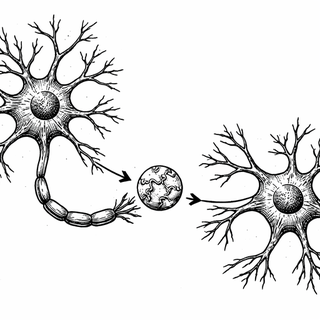
Your neurons run a logistics network that would make Amazon weep with envy. Every second, brain cells are packaging up proteins, RNA snippets, and molecular instructions into impossibly tiny bubbles - we're talking 30 to 150 nanometers, roughly a thousand times smaller than a red blood cell - and firing them off to neighboring cells like biological text messages. No Wi-Fi required. No monthly subscription. Just billions of years of evolution building the most sophisticated same-day delivery system in the known universe, all happening inside your skull while you argue about pizza toppings.
These little bubbles are called small extracellular vesicles (sEVs), and a sweeping new review just laid out the commercial case for why they might be the next billion-dollar platform in neuroscience therapeutics.
The FedEx of the Brain (That Sometimes Delivers Bombs)
Here's where it gets interesting from a business perspective: sEVs are double agents. On one hand, they're the brain's native communication infrastructure, helping neurons, astrocytes, microglia, and other neural cells coordinate everything from immune responses to synaptic plasticity. They maintain brain homeostasis the way a good operations team keeps the lights on.
On the other hand, these same vesicles can go rogue. In Alzheimer's disease, sEVs become unwitting couriers for toxic amyloid-beta and tau proteins, spreading pathology from cell to cell like a franchise model for neurodegeneration. In Parkinson's disease, they shuttle misfolded alpha-synuclein across brain regions. The disease essentially hijacks the brain's own postal service.
This dual nature - helper and villain - is precisely what makes them so commercially fascinating. If you can understand the delivery system, you can potentially reprogram it.
Why Neural Cell-Derived Vesicles Are the Premium Tier
Most of the sEV research in therapeutics has focused on mesenchymal stem cell-derived vesicles. Think of those as the generic, off-the-shelf option. They work, they've been tested in dozens of preclinical models, and they've gotten a lot of press. But the new review makes a compelling argument that sEVs derived specifically from neural cells - neurons, astrocytes, microglia, oligodendrocytes, neural stem cells, and brain endothelial cells - are the premium product.
Why? Three reasons that should make any biotech investor sit up straight:
Brain targeting built in. Neural cell-derived sEVs come pre-loaded with surface proteins that the brain already recognizes. They don't need a fake passport to cross the blood-brain barrier (BBB) - they've got a native one. The BBB is notoriously the graveyard of CNS drug candidates; roughly 98% of small molecules and nearly 100% of large biologics can't cross it (Pardridge, 2005). Having a delivery vehicle that treats the BBB like a revolving door? That's a product-market fit worth billions.
Disease-relevant cargo profiles. Each neural cell type packages different molecular cargo into its sEVs. Astrocyte-derived vesicles carry neuroprotective factors. Microglial vesicles carry immune-modulatory signals. This cell-type specificity means you can potentially match your therapeutic cargo to the right delivery vehicle, like choosing the right truck for the right freight.
Functional superiority in preclinical models. Early data suggests neural cell-derived sEVs outperform their mesenchymal stem cell counterparts in brain-specific therapeutic outcomes. They're not just getting to the brain - they're doing more useful things once they arrive.
The Engineering Playground
Now here's where the startup opportunity really explodes. Researchers aren't just using sEVs as-is. They're engineering them. The review catalogs two broad strategies:
Endogenous engineering involves modifying the parent cell - the factory - so it produces vesicles with enhanced properties. You can genetically program a neural stem cell to overexpress certain surface ligands, essentially customizing the shipping label so the vesicle homes in on a specific brain region or cell type.
Exogenous engineering works on the vesicles after they've been produced. Think of it as post-production editing: loading therapeutic drugs, siRNAs, or CRISPR components into pre-formed vesicles using electroporation, sonication, or chemical methods. Several groups have demonstrated that you can stuff these nano-bubbles with cargo they'd never naturally carry, turning them into programmable drug delivery drones (Luan et al., 2017).
The combination of natural brain-homing capability plus engineered therapeutic payload is, frankly, the kind of platform technology that gets term sheets signed.
The Hard Problems (a.k.a. Why This Isn't a Product Yet)
Let's pump the brakes for a moment, because intellectual honesty is good for business plans too.
Manufacturing scale. Neural cells don't exactly grow on trees. Producing clinical-grade sEVs from neurons or astrocytes at the volumes needed for therapy is a manufacturing nightmare that nobody has fully solved. Mesenchymal stem cells are easier to culture at scale, which is partly why they've dominated the field.
Standardization. Every batch of sEVs is slightly different. Cargo composition varies with cell passage number, culture conditions, and the phase of the moon (okay, not literally, but the variability is real). Regulatory agencies like the FDA want consistency, and sEVs are currently more artisanal than industrial.
Characterization. We still don't have a complete picture of what's inside these vesicles. Proteomics and transcriptomics have revealed thousands of molecules per vesicle type, but understanding which ones are therapeutically active versus just along for the ride requires more work (Théry et al., 2018).
Clinical translation. Nearly all the exciting data is preclinical - mice and rats. The jump from rodent brain to human brain is long, expensive, and littered with the wreckage of therapies that worked beautifully in animals and flopped in people.
The Bottom Line for the Commercially Curious
Neural cell-derived sEVs represent something rare in biotech: a platform technology that's both biologically elegant and practically versatile. They're the brain's own communication system, repurposed as a drug delivery network. The science is real, the preclinical data is encouraging, and the engineering possibilities are wide open.
If I were building a company in this space today, I'd be laser-focused on solving the manufacturing problem. Whoever cracks scalable, reproducible production of neural cell-derived sEVs with consistent cargo profiles will own the picks-and-shovels layer of the entire neuro-nanomedicine market.
The brain has been running its own nanotechnology program for millions of years. It's about time we learned to speak its language.
This blog post discusses research findings and should not be taken as medical advice. If you have concerns about neurodegenerative diseases, please consult a healthcare provider. Research discussed here represents ongoing scientific investigation and clinical validation is still in progress.
All images used in this post are decorative illustrations only and do not represent or reflect the accuracy, reality, or correctness of the referenced research.
Primary Source: Small Extracellular Vesicles from Neural Cells: Physiological and Pathological Roles, and Potential in Neurodegenerative Therapy. PubMed. 2026. PubMed ID: 41937703