
Here's a fun paradox for you: your body and your brain apparently can't agree on when you're sleeping terribly after knee replacement surgery. A new study strapped wearable devices onto 93 patients and discovered that what people feel about their sleep and what's actually happening with their sleep are on completely different timelines. As a parent who spends half my life wondering if my kid's complaints match reality, this research speaks to me on a spiritual level.
The Great Sleep Disconnect
Researchers recently published a fascinating study tracking sleep patterns in patients undergoing total knee arthroplasty (TKA) - that's the full knee replacement for those of us who don't speak fluent orthopedic surgeon. They used both the Pittsburgh Sleep Quality Index (PSQI), which is basically a questionnaire asking "how's your sleep going?" and objective measurements from wearable devices that don't care about your feelings.
Here's where it gets interesting. The wearable devices - those unbiased little gadgets strapped to wrists everywhere - detected the worst sleep during the first week after surgery. Makes sense, right? You just had your knee rebuilt. Of course week one is rough.
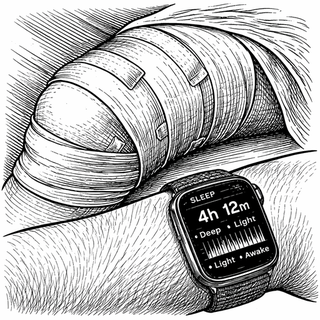
But when researchers asked patients how they felt about their sleep? Peak misery hit during weeks two through four. The patients perceived their worst sleep happening two to three weeks after the actual worst sleep occurred.
Why Does This Matter For Your Family?
If you've ever had a family member undergo major surgery (or been the one on the operating table yourself), you know the recovery timeline matters enormously for planning. Who's taking time off work? When can grandma stop staying over to help? When should we expect the patient to be functional enough to, say, make their own sandwich?
This study suggests we've been thinking about post-surgical sleep disruption all wrong. Medical teams and families tend to prepare heavily for that first week - and they should - but the research indicates that the perceived suffering peaks later. Those weeks two through four might be when patients need the most emotional support, even as their bodies are technically improving.
It's like when my kid insists they feel worse on day three of a cold than day one, even though their fever was higher initially. The experience of suffering doesn't always match the biological measurements of suffering.
The Pain Connection
Perhaps the most useful finding for practical planning: there's a direct, statistically significant relationship between pain levels and perceived sleep quality. For every one-point increase on the Visual Analog Scale (VAS) pain score, patients experienced a 0.33-point increase in their PSQI scores (meaning worse perceived sleep).
Translation: manage the pain, help the sleep. This gives families and caregivers a concrete lever to pull. If your post-surgical loved one is complaining about terrible sleep, pain management might be the intervention that helps most - even if it seems like a sleep problem rather than a pain problem.
The researchers were clear that this relationship held throughout the six-week study period. Pain and sleep perception walked hand in hand the entire time.
What About Sleep History?
Here's something that surprised me: whether patients had a history of sleep disorders or not made no significant difference in their post-surgical sleep outcomes. People who already struggled with sleep didn't fare notably worse than champion sleepers. The knee replacement was apparently the great equalizer.
Similarly, opioid consumption patterns didn't differ significantly between groups. This challenges some assumptions about who might struggle more during recovery.
The Wearable Revolution in Surgical Recovery
This study represents a growing trend in medical research - using consumer-grade wearable technology to collect objective health data outside of clinical settings. These aren't fancy medical devices; they're the same type of trackers many of us wear daily.
The ability to continuously monitor patients at home rather than relying solely on periodic check-ins or patient recall opens up new possibilities for understanding recovery. Your memory of how you slept last week is notoriously unreliable (ask any new parent), but a wearable device records everything without bias.
For parents evaluating whether this research applies to their family members considering knee surgery, the practical takeaway is clear: prepare for a longer emotional recovery timeline than the physical one might suggest. The body bounces back faster than the perception of wellness.
Planning Around the Reality
If someone in your household is heading toward knee replacement, this research suggests a few practical strategies:
Week One: Expect the objectively worst sleep. The body is dealing with surgical trauma. This is when wearables would show the biggest decline in sleep scores.
Weeks Two Through Four: This is when the patient will likely feel like their sleep is at rock bottom, even as measurements might show improvement. Don't dismiss their experience - it's real, even if the data doesn't fully support it.
Pain Management: Work closely with the surgical team on pain control. The research shows a direct mathematical relationship between pain scores and sleep perception. Better pain control likely means better perceived sleep.
Week Six: Things should be trending toward normalcy, though the study showed sleep scores still hadn't fully returned to baseline even at this point.
The Bigger Picture
This kind of research - tracking the gap between objective measurements and subjective experience - matters beyond knee surgery. It reminds us that how people feel about their health doesn't always match what their bodies are doing, and neither perspective is "wrong."
For those of us trying to support family members through medical procedures, understanding this disconnect helps us provide better care. We can validate someone's experience of suffering while also reassuring them that the objective measurements suggest things are improving. Both realities can coexist.
And honestly? If my kid's smartwatch could tell me when they were going to have a bad night before they knew it themselves, I'd consider that worth the price of admission alone.
This blog post discusses research findings and should not be taken as medical advice. If you have concerns about knee surgery, sleep disturbances, or post-operative recovery, please consult a healthcare provider. Research discussed here represents ongoing scientific investigation and individual outcomes may vary.
All images used in this post are decorative illustrations only and do not represent or reflect the accuracy, reality, or correctness of the referenced research.
Primary Source: Sleeping Patterns in Patients Undergoing Total Knee Arthroplasty: A Prospective Study Using a Wearable Device. 2025. PMID: 41933603