
This research paper is about to be the most shared study in biomaterials science, and honestly, it deserves to go viral. A team of researchers just created a hydrogel that stretches like taffy, heals itself like Wolverine, resists freezing, and is see-through. Oh, and the main ingredient? Tragacanth gum - a natural resin that's been oozing out of Middle Eastern shrubs since biblical times. If you're a materials science investor and you're not paying attention right now, you might want to sit down.
The Three-Ingredient Startup That Could Disrupt Wound Care
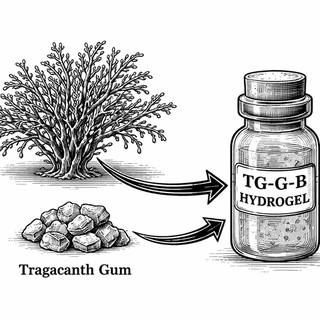
Here's the pitch deck version: take tragacanth gum (TG), mix it with glycerol and borax, and you get a three-dimensional dynamically cross-linked hydrogel that does pretty much everything you'd want a biomedical material to do. The researchers behind this study engineered what they call a TG-G-B hydrogel, and the spec sheet reads like it was designed by someone who just kept saying "yes" when asked if the material could do more things.
Stretchability? It elongates up to 480%. That's not a typo. You could stretch this stuff to nearly five times its original length before it gives up. For context, most conventional hydrogels tap out well before 200%. This thing makes rubber bands feel insecure about their elasticity.
Swelling ratio? Approximately 300%, meaning it can absorb a tremendous amount of fluid relative to its own weight. If you're thinking "wound exudate management," congratulations - you're already thinking like a product manager.
The Self-Healing Trick That Makes This Actually Investable
Lots of hydrogels can stretch. Some can even stick to things. But self-healing? That's where the real money lives, and the TG-G-B hydrogel delivers. When you cut or damage this material, it autonomously reforms into a continuous structure. No external trigger needed. No heat gun. No UV lamp. It just... fixes itself.
The magic behind this comes from the dynamic borax cross-linking. Borax creates reversible bonds with the tragacanth gum chains, and glycerol acts as both a plasticizer and a hydrogen-bonding partner. When the material breaks, those dynamic bonds simply re-form at the damage site. Think of it like a molecular zipper that re-zips itself after being pulled apart.
From a commercial standpoint, self-healing is a game-changer. Imagine a wound dressing that doesn't need to be replaced every time a patient moves the wrong way, or an electronic skin sensor that survives the daily abuse of being worn on a human body. The reduction in material waste alone could make CFOs very happy.
Transparency, Anti-Freeze, and a Water Vapor Stat That Wound Care Companies Will Love
The hydrogel's transparency increases with borax concentration, hitting 132% at optimal ratios (measured relative to a reference, before anyone starts questioning the physics). Why does transparency matter? Because clinicians like being able to see wounds healing without removing dressings. Every time you peel off a bandage to check a wound, you risk disrupting the healing process. A transparent dressing that stays put and lets you monitor visually? That's a real clinical value proposition.
Then there's the anti-freezing capability, courtesy of glycerol. Standard hydrogels are mostly water, which means they become useless hockey pucks in cold environments. The glycerol in this formulation depresses the freezing point, keeping the hydrogel flexible and functional even in sub-zero conditions. For wearable health devices, cold-chain logistics for medical supplies, or military field applications, this is a feature that solves actual problems.
And the water vapor transmission rate (WVTR) of 2,324 g/m² is right in the sweet spot for wound healing. Too low, and you create a soggy mess that breeds bacteria. Too high, and the wound dries out. This hydrogel sits in a range that maintains a moist wound environment while still allowing excess moisture to escape. Wound care product developers, take note.
Why Natural Ingredients Are the Smart Bet
There's a growing market preference for biocompatible, naturally-derived materials in medical applications, and this hydrogel checks every box. Tragacanth gum has been used in pharmaceuticals and food products for centuries. Glycerol is a standard pharmaceutical excipient. Borax, while it sounds scary, is used at low concentrations as a cross-linker and has a well-documented safety profile in biomedical contexts.
Compare this to synthetic hydrogels that require complex polymerization chemistry, organic solvents, and multi-step purification processes. The TG-G-B system is essentially three ingredients mixed together with a dynamic cross-linking mechanism. The manufacturing simplicity is a massive advantage for scaling production. Fewer processing steps means lower costs, fewer failure modes, and a faster path to regulatory approval.
The Addressable Market Is Enormous
Let's talk TAM for a second. The global wound care market is projected to exceed $25 billion by 2027. Wearable medical devices? North of $30 billion. Electronic skin research is still early-stage, but the flexible electronics market is racing toward $50 billion. A material platform that could serve all three markets with minor formulation tweaks? That's the kind of platform technology that venture capitalists write large checks for.
The adhesion properties mean it sticks where you put it. The self-healing means it lasts longer. The transparency means better clinical outcomes. The anti-freezing means it works in environments where competitors fail. And the natural ingredient profile means the regulatory pathway is smoother than most synthetic alternatives.
What Comes Next
This is still a lab-stage material, and the road from "cool hydrogel in a paper" to "FDA-cleared medical product" is long, expensive, and littered with the remains of promising technologies that didn't make it. Biocompatibility studies, long-term stability testing, sterilization validation, clinical trials - the checklist is extensive.
But the fundamentals here are strong. The material performs well across multiple relevant metrics simultaneously, it's made from cheap and readily available ingredients, and it targets markets with genuine unmet needs. If a team can nail the manufacturing scale-up and navigate the regulatory pathway, this tragacanth gum hydrogel could genuinely disrupt how we think about wound care, wearable devices, and beyond.
Sometimes the best startups are built on the oldest ingredients. Tree sap, soap mineral, and glycerin walk into a lab - and the punchline might just be a billion-dollar biomaterial.
This blog post discusses research findings and should not be taken as medical advice. If you have concerns about wound care or biomedical materials, please consult a healthcare provider. Research discussed here represents ongoing scientific investigation and clinical validation is still in progress.
All images used in this post are decorative illustrations only and do not represent or reflect the accuracy, reality, or correctness of the referenced research.
Primary Source: Dynamic borax-crosslinked transparent and antifreezing tragacanth gum-glycerol hydrogel for biomedical use. PubMed. 2026. PMID: 41317604