
When I saw this study title - "Customized ultra-flexible and adhesive spinal cord stimulation electrode for chronic pain management" - I rolled my eyes. I've read approximately 400 papers with "customized" and "novel" in the title that turned out to be marginal tweaks on existing tech. Then I read this one. The engineering here is genuinely clever, and the numbers back it up in ways that made me sit up straighter.
The Problem With Zapping Your Spine (Currently)
Epidural spinal cord stimulation (SCS) is one of those treatments that sounds like science fiction but has been around for decades. The basic idea: place an electrode near the spinal cord, deliver carefully calibrated electrical pulses, and intercept pain signals before they reach the brain. For people living with chronic pain - and we're talking about an estimated 1.5 billion people worldwide - it can be genuinely life-changing.
Here's the catch, though. Current SCS electrodes have a relationship problem with your body. They're rigid. Your spine is not. Every time you bend, twist, or do literally anything a human does during the course of a day, those electrodes shift. They delaminate (that's the fancy word for "the metal peels off the substrate like a bad bumper sticker"). The tissue around them gets inflamed. And over time, their effectiveness drops off a cliff.
Studies have shown that up to 30-40% of SCS patients experience diminished pain relief within just a few years, with electrode migration and tissue scarring being major culprits. That's a pretty rough failure rate for a device that requires surgery to implant.
Chemistry to the Rescue: The Two-Trick Polymer
This is where the new research gets interesting, and where my inner data scientist perked up. The team didn't just make a more flexible electrode (plenty of groups have tried that). They re-engineered the substrate material itself using a modified polydimethylsiloxane (PDMS) - which is basically a fancy silicone - with two chemical modifications that each solve a distinct failure mode.
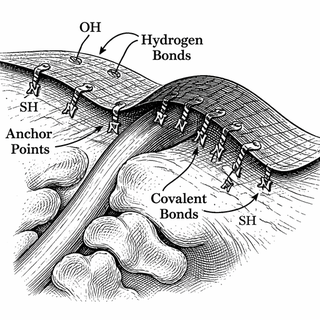
Trick one: hydroxyl groups. These are -OH groups grafted onto the PDMS surface. They form hydrogen bonds with surrounding biological tissue, essentially making the electrode sticky to your body from the inside. Think of it as the difference between laying a Post-it note on a surface versus just dropping a piece of regular paper. The electrode grips the tissue, reducing migration and displacement.
Trick two: thiol (sulfur) anchor points. On the other side of the substrate, sulfur-containing groups form strong covalent bonds with the metal circuit layer. This tackles the delamination problem directly. Instead of relying on physical adhesion between the metal traces and the polymer (which degrades over time), you get actual chemical bonds. It's the difference between gluing two surfaces together and literally welding them at the molecular level.
The Numbers That Actually Matter
Here's where I stopped being skeptical and started paying attention to the data.
Stability: 6+ weeks of functional integrity in vivo. For context, many experimental flexible electrodes in the literature start showing degradation within 2-3 weeks. Six weeks with "minimal inflammatory responses" is a genuinely strong result in the mouse model context.
Efficacy across multiple pain models. This is the part that impressed me most. The team didn't test their electrode against just one type of chronic pain. They validated it across three distinct models:
- Spinal cord injury pain
- Sciatic nerve injury (neuropathic pain)
- Diabetic neuropathic pain
Getting robust analgesic effects across all three is significant because these conditions involve different pathological mechanisms. It suggests the electrode's performance isn't dependent on a narrow set of conditions - it's genuinely versatile.
Post-stimulation duration: 1.5+ hours. The pain relief didn't disappear the moment the stimulation stopped. The analgesic effects persisted for over 90 minutes after the device was turned off. That's a meaningful window that hints at sustained neuromodulatory effects, not just temporary signal masking.
Why Flexible Matters More Than You Think
The broader context here matters. The field of bioelectronic medicine - using electrical interfaces with the nervous system to treat disease - is growing fast, with the global neuromodulation market projected to reach $13.3 billion by 2028. But nearly every device in this space runs into the same fundamental problem: biology is soft and squishy, and electronics are hard and rigid.
This mechanical mismatch drives chronic inflammation, tissue scarring, and eventually device failure. It's why cochlear implants degrade, why deep brain stimulation electrodes need repositioning, and why spinal cord stimulators lose efficacy. Any advance in creating electronics that genuinely integrate with biological tissue has implications well beyond chronic pain.
The local field potential recordings from this study are worth noting too. The electrode maintained stable neural signal recording quality throughout the testing period, which means it wasn't just delivering stimulation effectively - it was also reliably reading the neural response. That bidirectional capability is the foundation for closed-loop neuromodulation systems, where the device adjusts its output based on real-time neural feedback. That's the future of this entire field.
The Caveats (Because There Are Always Caveats)
Let's be clear about what this is and isn't. This is a mouse study. Mice are not humans (hot take, I know). The spinal anatomy, the mechanical loads, and the timescales are all different. Six weeks in a mouse is promising, but humans need devices that last years, not weeks.
Scaling from a mouse-sized electrode to a human-sized one introduces manufacturing challenges. And regulatory approval for a novel implantable material is a multi-year journey involving extensive biocompatibility testing, mechanical fatigue analysis, and clinical trials.
That said, the underlying chemistry - using dual-functional surface modifications to solve both tissue adhesion and metal delamination simultaneously - is elegant and potentially translatable to other bioelectronic devices. The approach addresses root causes rather than symptoms of device failure, which is exactly what the field needs.
The Bottom Line
This study represents a thoughtful piece of materials engineering applied to a real clinical problem. The dual-modification strategy is smart, the multi-model validation is thorough, and the stability data is encouraging. If these results hold up as the work progresses toward larger animal models and eventually human trials, we might be looking at a meaningful step toward spinal cord stimulators that actually maintain their effectiveness over the long haul.
For the hundreds of millions of people living with chronic pain who've either tried neuromodulation and watched it fade, or been told it's not reliable enough to try - that would be a very big deal.
This blog post discusses research findings and should not be taken as medical advice. If you have concerns about chronic pain management or spinal cord stimulation, please consult a healthcare provider. Research discussed here represents ongoing scientific investigation and clinical validation is still in progress.
All images used in this post are decorative illustrations only and do not represent or reflect the accuracy, reality, or correctness of the referenced research.
Primary Source: Customized ultra-flexible and adhesive spinal cord stimulation electrode for chronic pain management. PubMed. 2026. PMID: 41884511