
Living with COPD is a bit like having a cell phone with terrible battery life - you're constantly monitoring your levels, adjusting your behavior, and worrying about running out of juice at the worst possible moment. Except instead of missing a phone call, you're missing... well, oxygen. Kind of a bigger deal.
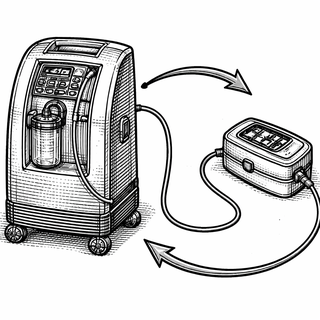
For millions of people on long-term oxygen therapy, life involves a constant negotiation with their oxygen concentrator. Walking to the kitchen? Maybe turn up the flow. Sitting and watching TV? Turn it back down. Sleeping? Good luck figuring out what setting keeps your blood oxygen stable through the night without accidentally blasting yourself with too much O2.
Enter the clinical trial NCT06153485 and the beautiful concept of automated oxygen titration - essentially giving your oxygen machine a brain so it can adjust itself. Because honestly, in 2024, if my thermostat can learn my temperature preferences, why shouldn't my medical equipment be just as smart?
The Problem with Fixed-Flow Oxygen
Here's the dirty secret of traditional home oxygen therapy: it's basically guesswork dressed up in medical clothing.
Your doctor prescribes a flow rate - say, 2 liters per minute at rest, 4 liters with activity. These numbers are based on testing done during a single clinic visit, maybe on the treadmill, maybe not. Then you take that prescription home and try to apply it to your actual life, which involves a million variables that didn't exist in the controlled clinic environment.
What happens when you're climbing stairs? When you're anxious? When you have a cold? When you're sleeping and your breathing patterns change? The fixed flow rate doesn't care about any of that. It just keeps pumping out the same amount of oxygen whether you need it or not.
Studies using continuous oxygen monitoring have revealed the scope of the problem. COPD patients demonstrate a "surprising frequency" of desaturation below the recommended target SpO2 of 90%, averaging approximately 25% of recording time, with some patients spending up to 67% of their time below target.
Let that sink in: people who are supposed to be receiving adequate oxygen therapy are spending up to two-thirds of their time with inadequate oxygen levels. That's not optimal treatment - that's barely treatment at all.
The Goldilocks Zone of Oxygen Saturation
Before we get into the solution, let's talk about why oxygen levels matter so much.
Your blood oxygen saturation - SpO2, measured by those little clips on your finger - ideally stays between 94-98% for healthy adults. For COPD patients on supplemental oxygen, the target range is typically 92-96%, sometimes 88-92% depending on the individual.
Too low (hypoxemia) means your organs aren't getting enough oxygen, leading to fatigue, confusion, heart strain, and in severe cases, organ damage. Too high (hyperoxemia) in COPD patients can actually suppress the respiratory drive - your brain stops telling your lungs to breathe because it thinks everything's fine. Neither extreme is good.
The goal is to stay in the Goldilocks zone: not too low, not too high, just right. And fixed-flow oxygen is about as good at achieving this as I am at parallel parking - technically possible, but rarely executed smoothly.
NCT06153485: The Smart Oxygen Revolution
The clinical trial NCT06153485, titled "Effectiveness of Automated Titration for Home Oxygen Therapy," is testing something elegantly simple: a closed-loop system that automatically adjusts oxygen flow based on real-time SpO2 measurements.
Here's how it works:
- A pulse oximeter continuously monitors your blood oxygen levels
- An algorithm analyzes the data and determines what flow rate you need
- The oxygen concentrator automatically adjusts to maintain target saturation
- Repeat, continuously, 24/7
It's the same basic concept as cruise control in your car. Instead of constantly pressing and releasing the accelerator to maintain speed, you set a target and the system handles the adjustments. Except here, the target is "enough oxygen to keep your organs happy" rather than "65 mph on the highway."
The trial is being conducted at West Park Healthcare Centre, where patients already using supplemental oxygen are exposed to alternating weeks of fixed-dose oxygen and automated titration in a crossover design. This lets researchers compare the same patients under both conditions - the gold standard for figuring out which approach actually works better.
The Data Is Pretty Compelling
We don't have to speculate about whether automated oxygen titration works - early studies have already shown remarkable results.
A randomized crossover feasibility trial studied 12 patients with COPD on long-term oxygen therapy. Each patient wore a wrist-mounted pulse oximeter and used a system that automatically adjusted oxygen flow to maintain target saturation. The system was able to automatically adjust oxygen for about 77 hours out of the study period - covering 83% of the time.
The results? Time within target SpO2 increased from 52% to 86% with automated titration. That's not a marginal improvement - that's nearly doubling the amount of time patients spend with appropriate oxygen levels.
But wait, there's more. The Clinical COPD Questionnaire (CCQ) score - a measure of symptoms and quality of life - improved by 0.74 points. The minimal clinically important difference is 0.4 points, meaning 11 out of 12 patients experienced meaningful symptom improvement just from getting the right amount of oxygen more consistently.
Why This Matters More Than You Might Think
COPD is the third leading cause of death worldwide. Over 65 million people have moderate to severe disease, and millions more are undiagnosed. Long-term oxygen therapy is one of the few interventions proven to improve survival in patients with severe COPD and chronic hypoxemia.
But here's the thing: oxygen therapy only works if you're actually getting the right amount of oxygen. And as we've established, fixed-flow systems are pretty bad at that.
The implications of automated titration extend beyond just comfort. Chronic hypoxemia strains the heart, particularly the right ventricle, leading to pulmonary hypertension and cor pulmonale. Better oxygen control could potentially slow or prevent these complications.
Sleep quality is another huge factor. Many COPD patients have terrible sleep because their oxygen levels fluctuate wildly during the night, triggering arousals and fragmented rest. An automated system that maintains stable oxygen levels could mean actually waking up feeling rested - a luxury many COPD patients haven't experienced in years.
The Technical Details (For Those Who Love Gadgets)
The closed-loop systems being tested aren't just simple on-off switches. They use sophisticated algorithms to balance responsiveness with stability.
Oxygen delivery has inherent delays - it takes time for inhaled oxygen to reach the bloodstream and show up on the pulse oximeter. A naive system that just cranks up oxygen whenever SpO2 drops and cuts it whenever SpO2 rises would oscillate wildly, overshooting and undershooting constantly.
Good algorithms incorporate predictive elements and damping to achieve smooth, stable control. They also need to handle artifacts - motion, poor sensor placement, or ambient light interference can all cause false readings that shouldn't trigger flow changes.
The flow rate range required is also substantial. In the feasibility study, automated titration required the ability to adjust flow across a wide range to accommodate different activity levels and respiratory states. This means the oxygen source needs to be capable of delivering variable flow, which has implications for equipment design and home oxygen infrastructure.
The Future: Breathing Without Thinking About It
If trials like NCT06153485 confirm the benefits of automated oxygen titration, we could see a significant shift in how home oxygen therapy is delivered.
Imagine a future where:
- COPD patients sleep through the night with stable oxygen levels
- Activity isn't limited by fear of desaturation
- Hospital admissions for hypoxemic episodes decrease
- Quality of life improves simply because the technology got smarter
The researchers themselves acknowledge that larger, longer trials are needed to confirm the preliminary positive effects on health outcomes like hospitalization and mortality. But the early signals are promising enough that continued investigation is clearly warranted.
The Bigger Picture
Automated oxygen titration is part of a broader trend toward personalized, responsive medical technology. We're seeing similar developments in insulin pumps that adjust to glucose levels, blood pressure medications that respond to activity, and countless other closed-loop systems.
The underlying philosophy is that fixed doses and fixed settings are inherently limited because human physiology isn't fixed. We're dynamic systems that change constantly - minute to minute, day to day. Our treatments should be equally dynamic.
For COPD patients who've spent years manually adjusting their oxygen flow and watching their pulse ox like a hawk, the idea of a system that just handles it automatically must sound almost too good to be true. But based on the research emerging from trials like NCT06153485, it might just become reality.
And really, is there anything more futuristic than a machine that automatically keeps you breathing optimally? That's not just medical technology - that's practically science fiction made real. Except instead of flying cars, we got smart oxygen machines. I'll take it.
Disclaimer: This blog post is for educational and entertainment purposes only and does not constitute medical advice. Clinical trial information was sourced from ClinicalTrials.gov (NCT06153485). Never adjust oxygen therapy settings without consulting your healthcare provider. Always follow prescribed oxygen therapy protocols. Images and graphics are for illustrative purposes only and do not depict actual medical devices, procedures, mechanisms, or research findings from the referenced studies.
References:
- ClinicalTrials.gov. NCT06153485: Automated Titration for Home Oxygen Therapy
- Hansen EF, et al. (2018). Automated oxygen control with O2matic during admission with exacerbation of COPD. Int J Chron Obstruct Pulmon Dis. DOI: 10.2147/COPD.S183762
- Lellouche F, L'Her E. (2020). Automated Home Oxygen Delivery for Patients with COPD and Respiratory Failure: A New Approach. COPD. DOI: 10.1080/15412555.2020.1713842
- International Journal of COPD. (2025). Automated Oxygen Delivery in Home Setting for Patients with COPD on Long-Term Oxygen Therapy. DOI: 10.2147/COPD.S546748