
Somewhere in a research lab, a neuroscientist stares at a brain signal readout that looks less like clean data and more like the static on a TV from Poltergeist. The electrodes are doing their best, but the signal-to-noise ratio is garbage, the implant is slowly corroding, and the patient's immune system has already started treating the device like an uninvited dinner guest. For decades, this has been the fundamental headache of brain-computer interfaces: we can talk to the brain, but hearing it talk back clearly? That's been the hard part. Now, a class of two-dimensional nanomaterials called MXenes might be handing us the Rosetta Stone we need.
What Even Is a MXene?
If you haven't heard of MXenes (pronounced "Maxenes," like the name Max with an "-een" at the end), buckle up. These are ultra-thin, two-dimensional materials first synthesized in 2011 by selectively etching aluminum layers out of a parent compound called a MAX phase. Think of it like pulling the cream out of an Oreo, except the remaining cookie layers are made of transition metal carbides and nitrides, and they happen to be extraordinarily good at conducting electricity.
What makes MXenes special in the neural interface world comes down to a killer combination: they're highly conductive (we're talking metallic-level conductivity), their surface chemistry is tunable (you can bolt on different functional groups like snapping LEGO pieces), and they're thin enough to conform to the wrinkly terrain of brain tissue without the rigidity problems that plague traditional metal electrodes. It's basically the material equivalent of getting a character in a video game with maxed-out stats in every category.
The Brain-Computer Interface Problem
Brain-computer interfaces, or BCIs, have come a long way since their early sci-fi reputation. Companies and research labs worldwide are developing systems that let paralyzed patients control robotic arms, type on screens with their thoughts, or even restore some degree of sensory feedback. If you've seen any coverage of neural implant trials in the last few years, you know the field is moving fast.
But here's the thing nobody puts in the highlight reel: current electrode materials have serious limitations. Traditional options like platinum, gold, and silicon work, but they're stiff. Your brain is roughly the consistency of firm Jell-O, and jamming rigid electrodes into it is about as gentle as parking a tank on a waterbed. Over time, the body mounts an immune response, scar tissue forms around the implant, and signal quality degrades. It's the neural interface equivalent of your phone slowly losing battery health - except you can't just swap it out at the Apple Store.
This is where the recent review on MXene integration into neural devices gets genuinely exciting. The authors lay out a comprehensive case for why these materials could leapfrog the current generation of BCI electrodes.
Why MXenes Could Be the Vibranium of Neural Interfaces
Okay, maybe calling them Vibranium is a stretch (we're not absorbing kinetic energy here), but the parallels to a fictional wonder-material aren't entirely off base. The review highlights several properties that make MXenes remarkably well-suited for neural applications.
Signal quality is way up. MXene-based electrodes demonstrate excellent charge storage capacity and low impedance at the electrode-tissue interface. In plain English: they pick up brain signals more clearly and with less electrical noise. Imagine upgrading from a walkie-talkie to a studio-grade microphone - that's the kind of fidelity jump we're talking about.
They play nice with biology. Early in vitro and in vivo studies suggest that MXene materials show promising biocompatibility. Neurons seem to tolerate them well, which is step one for anything you plan to leave sitting on or inside someone's brain. The tunable surface chemistry helps here too - researchers can modify the material's surface to reduce inflammatory responses, almost like giving the electrode a diplomatic passport that tells the immune system to stand down.
Real-time signal decoding is on the table. The review discusses cognitive rehabilitation investigations that explore MXene electrodes' ability to decode neural signals in real time. This matters enormously for closed-loop BCIs - systems that not only read brain activity but respond to it, like a conversation rather than a monologue. Think of it as the difference between sending a letter and having a phone call. For patients undergoing cognitive therapy after stroke or traumatic brain injury, that real-time feedback loop could be transformative.
The Challenges (Because Nothing Is Ever Simple)
Before we start planning the MXene-powered future from The Matrix, the review is refreshingly honest about the hurdles that remain.
Material stability is still a question mark. MXenes can oxidize when exposed to water or air, which is, you know, a problem when your application involves being submerged in cerebrospinal fluid indefinitely. Researchers are exploring encapsulation strategies and surface modifications to improve long-term stability, but this remains an active area of investigation. Nobody wants an electrode that works brilliantly for six months and then turns into an expensive piece of rust.
Miniaturization isn't trivial. Getting these materials into electrode arrays small enough and dense enough to capture the full complexity of neural circuits requires some serious engineering. We're talking about devices that need to interface with individual neurons or small clusters, at a scale where manufacturing tolerances are measured in micrometers. It's like trying to build a city on the head of a pin, except the city also needs to be waterproof and last for years.
The clinical translation gap is real. Lab results and animal models are promising, but the road from "this works in a dish" to "this is FDA-approved and in a patient's head" is long, expensive, and paved with regulatory requirements. The review acknowledges that rigorous long-term biocompatibility studies and standardized manufacturing processes are still needed.
Why This Matters Beyond the Lab
The potential applications extend well beyond the obvious use case of helping paralyzed patients control devices. High-fidelity neural recording with MXene electrodes could advance our understanding of neurological disorders like epilepsy, Parkinson's disease, and depression. Better signal quality means better data, and better data means better science. It's a virtuous cycle that could accelerate research across the entire field of neuroscience.
Cognitive therapy stands to benefit significantly too. Imagine a rehabilitation system that reads a stroke patient's neural activity in real time and adjusts its therapeutic protocols on the fly - essentially a personal trainer for your brain that actually understands what your neurons are doing, not just what your face looks like when you're struggling.
The Bottom Line
MXenes aren't going to give us Westworld-level neural interfaces tomorrow. But this review makes a compelling argument that they represent one of the most promising material platforms for next-generation BCIs. The combination of high conductivity, tunable chemistry, mechanical flexibility, and emerging biocompatibility data puts MXenes in a category that few other materials can match.
The field is still early. The challenges are real. But if the trajectory holds, we might look back on MXene neural electrodes the way we look back on the transition from cathode ray tubes to flat screens - an upgrade so fundamental that it's hard to imagine going back.
And honestly? In a world where we're still basically taping metal wires to brains and hoping for the best, that kind of materials revolution can't come soon enough.
This blog post discusses research findings and should not be taken as medical advice. If you have concerns about neurological conditions or brain-computer interfaces, please consult a healthcare provider. Research discussed here represents ongoing scientific investigation and clinical validation is still in progress.
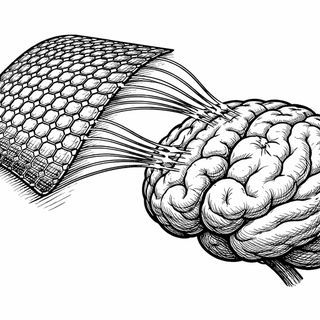
All images used in this post are decorative illustrations only and do not represent or reflect the accuracy, reality, or correctness of the referenced research.
Primary Source: MXene Nanomaterial Interfaces: Pioneering Neural Signal Recording for Brain-Computer Interfaces and Cognitive Therapy. PubMed. 2026. PMID: 41940909