
Somewhere between the sushi counter and the pharmaceutical lab, an unassuming herb just quietly crossed a line that most billion-dollar drug candidates never reach. Perilla frutescens - the leafy green you've been wrapping around Korean barbecue or tearing into Vietnamese spring rolls - turns out to contain complex sugar polymers that can lower blood lipids, regulate blood sugar, fight oxidative stress, and modulate immune responses. The garnish, it seems, has been moonlighting as a medicine cabinet.
The Plant That Refused to Pick a Lane
Perilla (also known as shiso in Japanese cuisine) belongs to the Lamiaceae family, the same botanical neighborhood as basil, mint, and rosemary. It's one of those rare natural plants formally recognized in traditional medicine systems as both food and medicine - a dual classification the Chinese call "food-medicine homology." Think of it as the engineering equivalent of a component that's rated for both consumer and military spec. Same part number, wildly different applications.
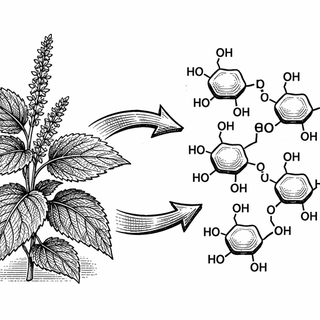
For centuries, perilla has been the utility player of East Asian herbalism: ornamental, culinary, medicinal. But while everyone was busy admiring its purple leaves and adding it to soups, researchers started zeroing in on one particular class of bioactive compounds hiding inside - polysaccharides.
Polysaccharides: The Supply Chain Nobody Talks About
Polysaccharides are high-molecular-weight sugar polymers found in essentially every living thing. They're the unglamorous structural backbone of biology - if proteins are the flashy executive team, polysaccharides are the logistics department actually keeping the operation running.
A comprehensive new review published in 2025 pulls together the latest research on Perilla frutescens polysaccharides (PFPs), covering everything from how to extract them to what they actually do once you've got them isolated. The pharmacological highlight reel is genuinely impressive for a compound you can grow in a window box:
- Hypolipidemic activity - PFPs help reduce blood lipid levels, which is the body's equivalent of cleaning grease out of the plumbing before it backs up.
- Antioxidant effects - They scavenge free radicals, those molecular wrecking balls that accelerate aging and tissue damage.
- Hypoglycemic properties - Blood sugar regulation, the holy grail for the hundreds of millions of people managing diabetes worldwide.
- Immunomodulatory action - They can tune the immune system up or down depending on context, like a thermostat rather than just an on/off switch.
And here's the kicker: the toxicity profile is remarkably low. In drug development terms, that's like finding a recipe that tastes great AND doesn't set off the smoke detector.
Extraction: Getting the Good Stuff Out
If polysaccharides are the prize, extraction is the cooking technique that determines whether you end up with a Michelin-star reduction or burned sugar water. The review catalogs multiple extraction methods - hot water extraction, ultrasound-assisted, enzyme-assisted, and microwave-assisted approaches - each with trade-offs in yield, purity, and structural integrity.
This is where the engineering brain kicks in. Hot water extraction is the slow braise of the polysaccharide world: reliable, well-understood, but time-consuming and not always efficient. Ultrasound-assisted extraction is more like a pressure cooker - faster, higher yields, but you need to control parameters carefully or you'll degrade the very molecules you're trying to isolate. The review notes that optimizing these processes remains an open challenge, which is a polite academic way of saying "we haven't nailed the recipe yet."
Structure-Activity Relationships: Reading the Blueprint
Perhaps the most scientifically interesting angle here is the work on structure-activity relationships (SARs). In pharmaceutical development, understanding why a molecule works - not just that it works - is the difference between a lucky observation and a scalable drug platform.
PFPs aren't single molecules. They're complex, branching polymer chains with varying molecular weights, monosaccharide compositions, and glycosidic linkages. The review examines how structural modifications (tweaking the sugar composition, changing branching patterns, altering molecular weight) affect biological activity. It's like understanding why sourdough fermented for 18 hours behaves differently than a 4-hour quick rise - same basic ingredients, radically different outcomes based on process and structure.
The honest assessment? Researchers are still in the early chapters of this structural story. Higher-order structural characterization - understanding the three-dimensional architecture of these polysaccharides and how that shape drives function - remains largely unexplored. The review explicitly flags this as a gap, which I appreciate. Nothing builds credibility like a paper that tells you what it doesn't know.
The Bigger Picture: Food as Functional Medicine
There's a broader trend here worth noting. As healthcare systems globally buckle under the weight of chronic disease management, the idea of "food-medicine homology" - deriving therapeutic benefit from dietary sources rather than relying exclusively on synthetic pharmaceuticals - is gaining serious traction. It's not about replacing your statin with a salad. It's about recognizing that the line between nutrition and pharmacology has always been blurrier than the regulatory framework suggests.
PFPs fit neatly into this narrative. Low toxicity, good biocompatibility, multiple pharmacological activities, and sourced from a plant that's already in the food supply. From a product development standpoint, the regulatory pathway for a food-derived bioactive is often more navigable than for a novel chemical entity. The ingredient already has a safety history measured in centuries, not clinical trial phases.
What's Still Cooking
Let's temper the enthusiasm with some realism. Most of the pharmacological data on PFPs comes from in vitro and animal studies. The jump from "works in a petri dish" to "works in a person" has claimed more promising compounds than I can count. Extraction standardization remains inconsistent across studies, making it difficult to compare results. And the structural characterization work is, by the review's own admission, still shallow.
But the ingredients are there - pun fully intended. A well-characterized bioactive compound class, a growing body of mechanistic data, a favorable safety profile, and a global shift toward food-derived therapeutics. The recipe just needs more time in the oven.
Sometimes the most interesting drug candidates aren't synthesized in a clean room. Sometimes they've been sitting on the cutting board all along, waiting for someone to look at them through the right lens.
This blog post discusses research findings and should not be taken as medical advice. If you have concerns about metabolic health, immune function, or dietary supplements, please consult a healthcare provider. Research discussed here represents ongoing scientific investigation and clinical validation is still in progress.
All images used in this post are decorative illustrations only and do not represent or reflect the accuracy, reality, or correctness of the referenced research.
Primary Source: Food-medicine homologous polysaccharides from Perilla frutescens: extraction, structure, pharmacological activities and structure-activity relationships. PubMed. 2025. PMID: 41962706