
Dear past scientists, you probably did not know it at the time, but this was one of those quietly useful turning points. The sort that does not arrive with fireworks, just better catheters, smarter sensors, and fewer material tantrums. Years later, people would look back at this work on silicone rubber and say: right, that was when a famously water-avoiding material finally agreed to cooperate. Rather like convincing a housecat to enjoy bath time, only much more productive.
Silicone rubber has long been the dependable workhorse of medical materials. It is flexible, durable, and generally gets along well with the body. That is why it shows up in everything from implants to interventional devices. But it comes with a stubborn personality trait: it is hydrophobic. In plain English, it dislikes water and does not readily mix with more polar, water-loving chemical partners. For engineers trying to make silicone surfaces slippery, antibacterial, or sensor-friendly, that is a problem with the persistence of a gum wrapper on a shoe.
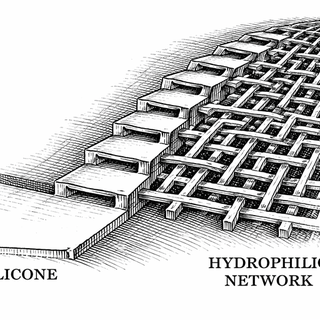
A new study, titled Integrated Hydrophilic Interdigitated Network for Silicone Rubber via a Gradient Polarity Modification Strategy, tackles that exact problem with an elegant idea. Instead of trying to force a strongly hydrophilic material directly onto hydrophobic silicone, the researchers built what is essentially a chemical stepping-stone path between them. They call it a gradient polarity modification strategy. The result is not just a coated surface, but an integrated hydrophilic network that reaches from the surface into the bulk of the silicone rubber.
Why Silicone Needed a Translator
This matters because silicone rubber is already excellent in ways that medical engineers love. It bends without complaint. It resists fatigue. It plays nicely with living tissue. Those are not minor virtues in a world of catheters, implants, and wearable electronics.
The problem is that many useful upgrades come from polar or strongly hydrophilic molecules, including quaternary ammonium compounds and zwitterionic materials. These molecules can help create surfaces that stay wet, reduce friction, resist bacterial buildup, or interact better with biological environments. Unfortunately, standard silicone and strongly polar modifiers are not natural dance partners. One wants oil-slick comfort. The other wants water everywhere.
That mismatch usually leads to shallow, unstable modifications. You may get some effect on the surface, but not enough durability or depth. In a device that needs to keep working in wet, dynamic conditions, that is not ideal.
The Gradient Trick
The cleverness of this study lies in refusing to make silicone jump straight from hydrophobic to hydrophilic. Instead, the researchers created a polarity transition ladder. Each rung helps bridge the gap between silicone rubber and the strongly polar molecules they want to introduce.
That may sound abstract, but the principle is easy enough: if two materials are too different to bond well, give them intermediates. Think of it less as smashing together enemies at a dinner party and more as seating them beside a mutual friend.
Using this in situ strategy, the team built what they describe as a hydrophilic interdigitated silicone rubber network. "Interdigitated" here means the modified components are not just sitting on top like frosting. They are integrated into the structure, interwoven from the surface inward. That is a much sturdier arrangement, and it helps explain why the material keeps its hydrophilic behavior over time.
What the New Material Can Actually Do
The paper reports a strong combination of properties that usually do not come bundled together so neatly.
First, the modified silicone shows persistent bulk hydrophilicity. That is a big deal. Not temporary wetness. Not a surface trick that disappears after a rinse. A more lasting water-friendly character throughout the material.
Second, it offers remarkable aqueous lubrication. In medical settings, lower friction can be extremely valuable. A slippery catheter, for instance, may move more smoothly through tissue or fluid-filled pathways, potentially reducing irritation and improving handling.
Third, the silicone keeps its mechanical robustness. This is where many fancy material modifications run into trouble. Improve one property, and another one sulks in the corner. Make something more hydrophilic and you may weaken it. Make it lubricious and it may lose durability. Here, the researchers report that the silicone retains the strength and flexibility that made it useful in the first place.
That combination is the real story. Not just "we made silicone wetter," but "we made it wetter without wrecking the part people needed."
Catheters, Bacteria, and Longer-Lasting Slipperiness
The team demonstrated the approach by fabricating a lubricative, antibacterial catheter. That example helps anchor the chemistry in the real world. Catheters need flexibility, biocompatibility, and good surface behavior. They also operate in exactly the kind of environment where friction and bacterial contamination are unwelcome guests.
The researchers also created a long-lasting lubrication meniscus, which is a rather polished way of saying they showed the material can maintain a stable lubricating aqueous layer. If that performance holds up in broader testing, it could be useful for devices that need to stay slick over extended periods rather than for one impressive afternoon in the lab.
This is one reason the paper stands out. It is not just describing a material with pretty measurements. It is pointing to a modification strategy that can be applied directly to pre-formed silicone rubber devices. That practical angle matters. Medical manufacturing is rarely eager to throw out well-established materials and start over from scratch.
A Quiet Opening for Smarter Sensors
One of the more intriguing details in the study is the material's responsiveness, confirmed through motion capture. That suggests potential in sensing applications, especially in flexible electronics or soft biointegrated systems.
This is where the story gets broader. Hydrophilic flexible materials are increasingly interesting not just for passive medical devices, but for active ones. Devices that sense motion. Materials that respond dynamically. Surfaces that stay functional in messy biological environments, which, to be fair, includes nearly all of biology.
If silicone rubber can be modified in a stable, designable way from surface to bulk, it becomes a more versatile platform. Not merely a soft tube or structural substrate, but a foundation for devices that lubricate, resist microbes, and perhaps even detect movement or changing conditions.
The Bigger Challenge This Research Addresses
At its core, this paper tackles a familiar materials problem: how do you keep the strengths of a proven material while giving it entirely new abilities?
Silicone rubber is already a medical favorite. Replacing it outright would be expensive, slow, and probably accompanied by several regulatory headaches. Modifying it effectively is a far more appealing route. The trouble has always been the chemistry gap between silicone and water-loving functional molecules.
This study offers a general strategy for crossing that gap. "Universal" is a strong word, and science is usually wise to use it carefully, but the concept here does feel broadly useful. Build a polarity gradient. Create compatibility in stages. Integrate, rather than merely coat. It is one of those ideas that seems obvious only after somebody has already done the hard part.
There is still work ahead, of course. Lab demonstrations are not the same thing as widespread clinical adoption. Devices will need long-term testing, manufacturing validation, and safety evaluation in relevant use cases. Biology, as ever, enjoys keeping engineers humble.
Still, the direction is promising. Flexible electronics, implantable devices, interventional tools, and advanced sensors all benefit from materials that can survive motion, coexist with tissue, and stay wettable when needed. Silicone was already most of the way there. This strategy may have given it the last useful nudge.
This blog post discusses research findings and should not be taken as medical advice. If you have concerns about medical devices, implants, or interventional procedures, please consult a healthcare provider. Research discussed here represents ongoing scientific investigation and clinical validation is still in progress.
All images used in this post are decorative illustrations only and do not represent or reflect the accuracy, reality, or correctness of the referenced research.
Primary Source: Integrated Hydrophilic Interdigitated Network for Silicone Rubber via a Gradient Polarity Modification Strategy. PubMed. https://pubmed.ncbi.nlm.nih.gov/42003779/