
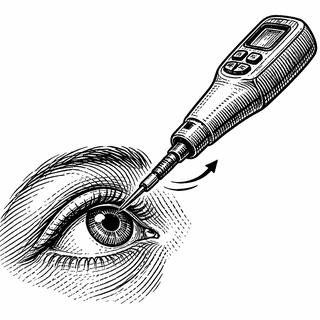
Let me tell you about the most satisfying piece of medical equipment I've ever encountered. It's called a rebound tonometer, and it works by shooting a tiny probe at your eyeball so fast that you barely feel it. The probe bounces back, the machine calculates your eye pressure, and the whole thing takes about half a second. Boop. Done. No eye drops. No bright lights. No that-thing-from-A-Clockwork-Orange vibes.
Clinical trial NCT07156630 is studying iCare's Quick Measure feature on two of their tonometers - the handheld IC200 and the slit lamp-mounted ST500. And while measuring eye pressure might not sound like the sexiest corner of medical technology, stick with me here. This stuff is quietly saving people's vision, one boop at a time.
Glaucoma: The Sneak Thief of Sight
First, some context. Glaucoma is the second leading cause of blindness worldwide, affecting about 80 million people globally. It's called "the sneak thief of sight" because it typically has no symptoms until significant, irreversible vision loss has already occurred. By the time you notice something's wrong, you've already lost peripheral vision you're never getting back.
The primary risk factor for glaucoma is elevated intraocular pressure (IOP) - that's the pressure of the fluid inside your eyeball. Too much pressure damages the optic nerve over time, like a garden hose slowly crushing a delicate flower. Catch the elevated pressure early, treat it with drops or surgery, and you can often prevent or slow the damage. Miss it, and the flower is toast.
This is why eye pressure measurement is a standard part of every comprehensive eye exam. It's also why making that measurement easier, faster, and more accessible is a genuinely worthy goal. Which brings us back to our friendly boop machines.
The Traditional Way: Applanation Tonometry (AKA The Air Puff of Doom)
If you've had an eye exam in the past few decades, you probably know the drill. The technician tells you to hold very still, you see a blue light getting closer, you try not to blink, and then - PUFF - a blast of air hits your eyeball and you jump out of your chair. That's non-contact tonometry, and while it works, it's nobody's favorite part of the eye exam.
The gold standard, though, is Goldmann Applanation Tonometry (GAT). This involves numbing your eye with anesthetic drops, applying a small probe to your cornea, and measuring how much force is needed to flatten a specific area. It's accurate, but it requires training, specialized equipment, and physical contact with the eye. Try doing that on a squirming three-year-old.
These limitations have kept comprehensive IOP screening from reaching many people who need it - particularly children, patients with cognitive impairments, and those in settings without access to trained technicians or specialized equipment.
Enter Rebound Tonometry: The Technology Behind the Boop
The Finnish company iCare revolutionized the game in the early 2000s with rebound tonometry. The concept, first described in detail in 1997, is elegantly simple:
A tiny 1.8-millimeter plastic-tipped probe on a stainless steel wire is held in place by an electromagnetic field. Push a button, and a spring propels the probe forward at the cornea. When it hits, it bounces back - faster if the eye pressure is high (because the eye is harder), slower if the pressure is low (because the eye is softer). The device measures the deceleration and rebound pattern to calculate IOP.
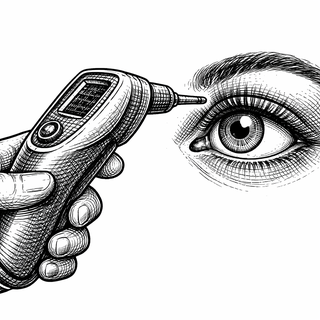
The whole measurement takes a fraction of a second. It's fast enough that you don't really feel it - patients often ask "Did you do it yet?" after the measurement is already complete. No anesthetic drops needed. No intense air puffs. Just... boop.
Studies have shown excellent reproducibility and concordance with Goldmann applanation tonometry. Over 100,000 iCare devices have been sold globally across more than 100 countries. They've become particularly valuable in pediatric ophthalmology and for glaucoma screening in non-clinical settings.
The iCare Family: IC200 vs ST500
iCare now makes several tonometer models for different use cases. The trial NCT07156630 focuses on two:
The iCare IC200 is a handheld device that can measure IOP with the patient sitting, standing, or lying down. It's the updated version of the IC100 and operates on rebound tonometry principles. Point it at the eye, press the button, get a result. Its portability makes it ideal for screening, pediatrics, and situations where patients can't be positioned at a slit lamp.
The iCare ST500 is the world's first slit lamp-mounted rebound tonometer. It combines the quick, comfortable measurement of rebound tonometry with the stability and magnification of a slit lamp examination. For ophthalmologists and optometrists who are already examining eyes at the slit lamp, it means they can get a pressure reading without switching instruments or breaking their workflow.
A comparative study published in 2024 evaluated both devices against Goldmann applanation tonometry in 157 participants. The median IOP with the IC200 was 17.1 mmHg, with the ST500 was 16.5 mmHg, and with GAT was 17.0 mmHg. The measurements weren't statistically different from each other, and the intraclass correlation coefficient values (0.97-0.98) showed excellent agreement. Translation: these devices measure eye pressure just as accurately as the gold standard.
Quick Measure: Because Six Is Sometimes Too Many
Here's where NCT07156630 comes in. Standard rebound tonometry takes six individual measurements and averages them for each result. That's already pretty fast, but iCare developed a feature called Quick Measure that gets results from just two or three rapid measurements.
The question being studied: Is Quick Measure as accurate and reliable as the standard six-measurement approach? If so, it could make screening even faster - particularly valuable in high-volume settings like community health fairs, pediatric clinics, or busy optometry practices.
For context, even a few seconds saved per measurement adds up when you're screening hundreds of patients at a health fair or trying to examine a child whose attention span is measured in single-digit seconds. Getting a reliable IOP reading from two measurements instead of six could meaningfully improve throughput without sacrificing accuracy.
Why This Matters Beyond the Eye Doctor's Office
The democratization of IOP measurement has real public health implications. Glaucoma prevalence increases dramatically with age, and many older adults don't get regular eye exams. Community screening programs can catch elevated IOP in people who would otherwise go undiagnosed until they've lost significant vision.
In 2017, the FDA approved the iCare HOME tonometer for patient self-monitoring - essentially a version of the rebound tonometer that patients can use at home to track their own eye pressure. This is huge for glaucoma management because IOP fluctuates throughout the day. A single measurement at your noon appointment might miss the pressure spikes that happen at 6 AM or 11 PM.
Self-monitoring studies have found the iCare HOME to be safe, reliable, and usable by the majority of patients. Self-monitoring can provide more information about IOP characteristics and impact glaucoma management in meaningful ways.
The Bigger Picture: Technology Making Medicine More Human
What I find compelling about rebound tonometry isn't just the engineering - it's how the technology changes the patient experience. Anyone who's had the air puff test knows the anxiety of that moment before the puff. Kids dread it. Adults grit their teeth. Some patients refuse it entirely.
making the measurement virtually imperceptible, iCare has removed that barrier. Patients don't fear the boop. Toddlers don't squirm away from the boop. Elderly patients with dementia can be measured during the boop without even realizing what happened.
This is what good medical device design looks like: taking a necessary but unpleasant procedure and making it simple, comfortable, and accessible. Not every innovation needs to be a breakthrough cure. Sometimes innovation means finding a better way to measure eye pressure so more people actually get measured.
Looking Ahead
NCT07156630 continues the refinement process. If Quick Measure proves reliable across diverse patient populations, it becomes another tool in the fight against preventable vision loss. Faster screening means more people screened. More people screened means more elevated pressures caught. More elevated pressures caught means more people who get treated before glaucoma steals their sight.
It's not flashy work. Nobody's going to win a Nobel Prize for reducing the number of probe bounces from six to three. But somewhere, a child is going to have their eye pressure measured without tears, an elderly patient is going to get screened at a health fair who wouldn't have otherwise, and someone's glaucoma is going to get caught early enough to save their vision.
That's what good medical device research looks like. One boop at a time.
This article discusses clinical trial NCT07156630. For more information, visit clinicaltrials.gov. Reference studies include the comparative study of IC200 and ST500 with GAT (doi: 10.1016/j.ogla.2024.07.013).
Disclaimer: This blog post is for informational purposes only and does not constitute medical advice. Clinical trials are ongoing research studies, and outcomes may vary. Always consult with qualified eye care professionals regarding glaucoma screening and treatment. Images and graphics are for illustrative purposes only and do not depict actual medical devices, procedures, mechanisms, or research findings from the referenced studies.