
For $1,000 - what medical innovation just changed the game for early cancer detection? If you guessed "a biosensor built from gold nanorods, mesoporous carbon, and a splash of Tylenol chemistry," congratulations, you've either been reading cutting-edge nanotechnology journals or you have genuinely alarming intuition. Either way, let's talk about it.
I spent the better part of thirty years in a lab coat, and I can tell you that the history of cancer diagnostics is essentially the history of people squinting harder at biology. We went from "does the patient look pale?" to biopsies, then blood markers, then genomics. Each leap brought us closer to catching cancer earlier, when it's still whispering instead of shouting. The latest whisper-catcher? An electrochemical biosensor designed to detect telomerase activity with remarkable sensitivity.
Wait, What's Telomerase Again?
Allow me a brief professorial detour. Your chromosomes have protective caps on their ends called telomeres - think of them like the plastic tips on shoelaces. Every time a cell divides, those caps get a little shorter. Eventually, the cell gets the biological equivalent of a retirement notice and stops dividing. This is perfectly normal and, frankly, rather elegant.
Cancer cells, however, are terrible at following rules. Most of them reactivate an enzyme called telomerase, which rebuilds those protective caps indefinitely. It's like giving a worn-out shoelace brand new tips every single time. The cell never gets the memo to stop dividing. This makes telomerase something of a smoking gun - it's active in roughly 85-90% of human cancers but mostly silent in normal adult cells (Kim et al., 1994). If you can detect telomerase activity reliably, you've got yourself a powerful early warning system.
The challenge, of course, is that telomerase doesn't exactly announce itself with a bullhorn. The amounts present in early-stage tumors are vanishingly small. You need a detection method that's both incredibly sensitive and stubbornly specific. Which brings us to the new kid on the biosensor block.
Gold Nanorods, Carbon Cages, and a Familiar Painkiller
A research team has developed an electrochemical biosensor that detects telomerase activity using a rather ingenious layered approach. Let me walk you through it, because the engineering here is genuinely clever.
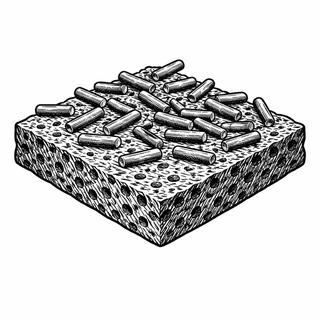
First, the sensor surface is built with ordered mesoporous carbon (OMC) - a material riddled with tiny, uniform pores that dramatically increase the available surface area. If you've ever marveled at how a sponge can hold far more water than a solid block of the same size, you've grasped the basic principle. More surface area means more places for electrochemical reactions to happen, which means a stronger signal.
On top of this carbon scaffold, the team deployed monodispersed gold nanorods (Au NRs). These aren't just decorative - gold at the nanoscale has extraordinary electrocatalytic properties. The nanorods amplify the electrochemical signal generated by the oxidation of acetaminophen. Yes, that acetaminophen - the active ingredient in Tylenol. It turns out that this common painkiller molecule makes an excellent electrochemical reporter when paired with the right catalytic surface (Fan et al., 2021).
The truly elegant bit involves the biological recognition system. When telomerase is present in a sample, it extends a primer sequence on the electrode surface - essentially doing what it does best, building telomeric repeats. This extension enables signal probes labeled with gold nanorods to latch onto the surface. No telomerase? No extension. No signal probes. No signal. It's a beautifully simple on/off switch at the molecular level.
To sharpen this switch, the researchers incorporated dideoxycytidine - a chain terminator that prevents non-specific extension - and cobalt ions to regulate the sequence-building process. Together, these components ensure that only genuine telomerase activity triggers the cascade. Background noise gets politely shown the door.
Why Should We Care?
I've seen a lot of biosensor papers cross my desk over the decades - enough to fill a small library and bore a large dinner party. What makes this one worth discussing is the combination of sensitivity, specificity, and stability. The sensor doesn't just detect telomerase; it does so reliably across repeated tests, which is the unsexy but absolutely essential quality that separates a lab curiosity from a potential diagnostic tool.
Current methods for detecting telomerase, like the TRAP assay (telomeric repeat amplification protocol), require PCR amplification and can be finicky with false positives (Shay & Wright, 2019). An electrochemical approach that skips PCR entirely and delivers results through a simple electrical readout could be faster, cheaper, and more practical for point-of-care settings - think a doctor's office rather than a specialized research lab.
The potential implications for early cancer screening are significant. Imagine a routine blood draw that flags elevated telomerase activity before a tumor is even visible on imaging. We're not there yet, but this biosensor represents a meaningful step in that direction.
The Honest Caveats
Now, as any professor worth their chalk dust will tell you, there's always a "however." And this paper, to its credit, is refreshingly upfront about the limitations.
Real biological samples are messy. Blood, serum, and tissue extracts contain thousands of interfering molecules that can gum up even the most elegant sensor design. What works beautifully with purified cancer cell extracts in a lab may throw tantrums when confronted with actual patient samples.
There's also the manufacturing question. Nanoscale sensors with precise gold nanorod placement and carefully controlled mesoporous carbon structures are not the sort of thing you can churn out on an assembly line just yet. Scaling from "works on the bench" to "available at your local clinic" is a journey that has humbled many a promising technology (Soleymani & Li, 2017).
Looking Forward
Still, I find myself cautiously optimistic - which, for a retired academic, is practically euphoric. The fundamental science here is sound. The detection strategy is creative. And the growing toolkit of nanomaterials, from gold nanorods to mesoporous carbons, gives researchers an increasingly rich palette to work with.
If the next few years bring successful validation in clinical samples and progress toward scalable fabrication, this telomerase biosensor could join the ranks of technologies that genuinely moved the needle on early cancer detection. For now, it's a compelling proof of concept, and in the long arc of diagnostic medicine, those are exactly the sparks that eventually light the way.
I've watched enough of these sparks over the decades to know that some fizzle and some catch fire. This one, I think, has real warmth to it.
This blog post discusses research findings and should not be taken as medical advice. If you have concerns about cancer screening or telomerase-related diagnostics, please consult a healthcare provider. Research discussed here represents ongoing scientific investigation and clinical validation is still in progress.
All images used in this post are decorative illustrations only and do not represent or reflect the accuracy, reality, or correctness of the referenced research.
Primary Source: Telomerase-driven dual-end amplification for sensitive electrochemical biosensing of telomerase activity. PubMed. 2025. PMID: 42030774