
Forecast for food safety diagnostics: breakthrough with a chance of controversy. A team of researchers just figured out how to detect E. coli O157:H7 using CRISPR, gold nanoparticles, and - I kid you not - a microwave. And if that sounds like someone raided three different labs and a kitchen appliance store, well, the results are kind of spectacular.
The Problem with Finding Tiny Terrorists
Escherichia coli O157:H7 is one of those pathogens that makes food safety scientists lose sleep. It causes hemorrhagic colitis, hemolytic uremic syndrome, and all sorts of nasty outcomes, especially in children and the elderly. The infectious dose can be absurdly low - we're talking fewer than 100 cells. So detecting it fast and accurately isn't just nice to have; it's a public health necessity.
Traditional detection methods? They work, but they're slow. Culture-based approaches can take days. PCR-based methods need expensive equipment and trained personnel. And while CRISPR-based biosensors have been gaining traction as a next-gen detection platform, they've come with their own baggage.
The Gold Standard (Literally) Had a Problem
Here's where gold nanoparticles (AuNPs) enter the story. These tiny metallic particles have a neat trick: they're red in solution, but when they clump together (aggregate), they turn blue or purple. This color change is visible to the naked eye, which makes them perfect for "look at the tube and know your answer" diagnostics.
Previous CRISPR-AuNP assays relied on gold nanoparticles that were pre-functionalized with thiol-modified DNA probes. Think of it like gluing tiny molecular hats onto each nanoparticle before the experiment even starts. The problem? Those thiol modifications are expensive. They introduce steric hindrance that slows down the CRISPR enzyme (Cas12a). And the whole conjugation process adds complexity that makes field deployment a headache.
Wait, it gets better.
Flip the Script: Let CRISPR Work First, Conjugate Later
The research team behind this new platform (published on PubMed) had a beautifully simple insight: what if you stop trying to make CRISPR cut probes that are already stuck to gold nanoparticles? What if you let CRISPR do its thing on free-floating, unmodified DNA probes first, and then introduce the gold nanoparticles after?
That's exactly what they did, and the elegance of it is almost annoying.
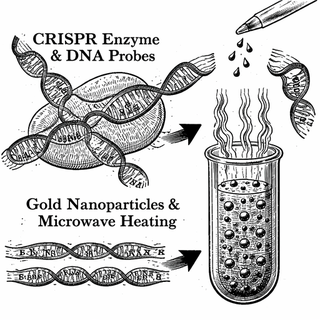
Here's the workflow. The system uses a mismatched catalytic hairpin assembly (MCHA) to amplify the target signal with low background noise. When E. coli O157:H7 DNA is present, the MCHA amplification activates CRISPR/Cas12a, which goes into its well-documented "collateral cleavage" frenzy - chopping up single-stranded DNA probes in the vicinity.
Now here's the clever bit. After CRISPR has had its moment, you add bare, unmodified AuNPs and zap the mixture with microwave-assisted dry heating. The intact (uncleaved) probes have a high-affinity domain that rapidly conjugates to the naked gold nanoparticles, forming a protective corona. This molecular shield prevents salt-induced aggregation. The solution stays red. No target, no problem.
But if the target was present? CRISPR already shredded those probes. The chopped-up fragments can't protect the AuNPs. Add salt, and the nanoparticles clump together like commuters on a rush-hour subway. The solution turns blue. Boom - visible detection.
The Microwave Trick
Okay, I have to talk about the microwave part because it's genuinely wild. Conventional probe-AuNP conjugation methods can take hours. Salt aging protocols, freeze-thaw cycles, pH adjustments - it's a whole production. This team used microwave-assisted heating to drive probe conjugation in minutes. The rapid, localized heating accelerates the interaction between the DNA probe's high-affinity domain and the gold surface, achieving what normally takes forever in a fraction of the time.
It's the scientific equivalent of realizing you can melt cheese faster in a microwave than an oven. Sometimes the simple solutions are the best ones.
Solving the Chemistry Conflict
One genuinely tricky problem the team tackled was the conflicting ionic requirements of CRISPR and AuNP stability. CRISPR/Cas12a needs magnesium ions to function properly, but unmodified AuNPs are sensitive to ionic strength - too many ions and they aggregate prematurely, giving you false positives.
The researchers addressed this using barium hydroxide (Ba(OH)₂) precipitation to selectively remove interfering ions after the CRISPR reaction but before AuNP introduction. It's a small detail, but the kind of practical problem-solving that separates a cool concept from something that actually works on the bench.
Why This Matters Beyond the Lab
The beauty of this system is the combination of simplicity and performance. No expensive thiol-modified probes. No pre-functionalized nanoparticles. No fluorescence readers or sophisticated instruments. The readout is a color change you can see with your eyes.
For food safety testing in resource-limited settings - think field testing at farms, processing plants, or in regions without access to well-equipped laboratories - this kind of platform could be transformative. Foodborne pathogen outbreaks cause an estimated 600 million illnesses and 420,000 deaths globally each year, according to the WHO. Faster, cheaper, and simpler detection means faster response times, fewer contaminated products reaching consumers, and ultimately fewer people getting sick.
And because the platform uses CRISPR's programmable targeting, it's not locked into E. coli detection. Swap out the guide RNA and MCHA components, and you could potentially retarget this system toward Salmonella, Listeria, norovirus, or really any pathogen with a known genetic sequence.
The Fine Print
This is still early-stage work, and like all biosensor platforms, it'll need extensive validation across real-world sample types - ground beef, lettuce, water sources - before anyone should get too excited about deployment. Sensitivity and specificity in complex matrices are always harder than in clean buffer conditions. The microwave step, while clever, also needs standardization for field use (not everyone has the same microwave, as anyone who's tried to reheat pizza knows).
But as a proof of concept? This is the kind of lateral thinking that moves diagnostic science forward. Taking the constraints of an existing system, flipping the order of operations, and ending up with something simpler, faster, and cheaper. That's just good science.
This blog post discusses research findings and should not be taken as medical advice. If you have concerns about foodborne illness or food safety, please consult a healthcare provider or your local public health authority. Research discussed here represents ongoing scientific investigation and clinical validation is still in progress.
All images used in this post are decorative illustrations only and do not represent or reflect the accuracy, reality, or correctness of the referenced research.
Primary Source: CRISPR/Cas12a-mediated aggregation of unmodified AuNPs via microwave-assisted heating-dry for label-free detection of Escherichia coli O157:H7. PubMed: 41962435