
Somewhere right now, a patient on chemotherapy is getting their blood drawn for the fourth time this week so a lab can figure out whether their liver is actually processing the drugs they're being given. They're sitting in a vinyl chair, watching a vial fill up, wondering if there's a less medieval way to do this. Turns out, a team of researchers just built something that might make those repeat stabbings obsolete - and ironically, it involves even tinier needles.
The Problem with Flying Blind
Here's a thing I learned running calls as a paramedic that stuck with me: the body doesn't send you a push notification when an organ starts failing. Kidneys and livers are especially sneaky about it. By the time conventional blood markers like creatinine or liver enzymes wave the red flag, you've often already lost significant function. It's like getting a check engine light only after the engine has caught fire.
This matters enormously for patients on drugs with what pharmacologists call a "narrow therapeutic index" - medications where the difference between "helping you" and "hurting you" is razor thin. Chemotherapy drugs, certain antibiotics, immunosuppressants. Get the dose wrong because a patient's kidneys aren't clearing the drug like you expected, and you're in trouble. The current system relies on periodic blood draws, lab processing times, and a fair amount of educated guessing. Think of it like trying to manage a basketball game but only getting the score update every six hours.
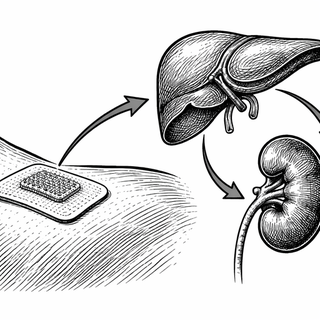
Enter the RNB: A Patch That Eavesdrops on Your Organs
A new study published in 2025 introduces something called the Resilient Nanostructured Bioelectrode, or RNB - a microneedle-based wearable sensor that continuously monitors how your body processes drugs in real time (DOI: 10.1038/s41551-025-01384-5).
If you've ever seen those tiny adhesive patches used for continuous glucose monitoring in diabetes, you've got the general idea. But instead of just tracking sugar levels, this device tracks drug concentrations in the interstitial fluid - the stuff that bathes your cells just below the skin's surface. And from those readings, it can tell you how well your liver and kidneys are actually doing their jobs.
The "microneedle" part is key. These aren't the needles you're imagining. They're microscopic projections that barely penetrate the skin's surface - painless, minimally invasive, and designed to sit there working for days without causing tissue damage.
Why Previous Attempts Fell Short
Wearable biosensors aren't a brand-new concept, but earlier versions had some embarrassing limitations. Low sensitivity meant they could barely detect drugs at the concentrations that actually matter clinically. And tissue abrasion - basically, the body's mechanical forces grinding against the sensor - would degrade them quickly. Imagine buying a fitness tracker that stops working every time you move your wrist. Not ideal.
The RNB team approached this differently. Instead of treating the electrode as just a passive sensing surface, they re-engineered it from the ground up using a bilayer fabrication process. A micrometer-thick gold adhesion layer strengthens the electrode, while a controlled dealloying process creates a nanocavity-textured surface that resists corrosion and fouling. The result is a sensor that's stable across a wide electrochemical potential window, immune to the kind of mechanical abuse that killed its predecessors, and capable of high signal-to-noise ratio measurements even in stiff tissue environments.
In non-engineer terms: they built the Nokia 3310 of biosensors. It just keeps working.
Six Days on a Rat (and the Rat Didn't Seem to Mind)
The team validated the RNB in freely moving rats - not sedated, not restrained, just regular rats doing regular rat things. The sensors lasted six days of continuous pharmacokinetic monitoring. For context, that's like a fitness study participant wearing a heart rate monitor for almost a week without it drifting, glitching, or falling off during their morning jog.
Using a mathematical framework that accounts for the equilibrium between blood and interstitial fluid, the researchers could derive blood-equivalent drug levels from the skin-surface readings. This is the critical leap. You're not just measuring something in the skin and hoping it correlates with blood levels - you're using a validated model to translate between the two compartments accurately.
Catching Liver Damage Before the Lab Does
In one set of experiments, the team used the RNB to track irinotecan, a chemotherapy drug metabolized primarily by the liver. In rats with induced liver damage, the sensor detected delayed drug clearance - the drug was hanging around longer than it should have been because the liver wasn't breaking it down efficiently.
This is the kind of finding that makes a pharmacologist's ears perk up. In clinical settings, catching delayed clearance early could mean adjusting a chemo dose before toxicity sets in, rather than after the patient shows up with severe side effects. It's the difference between a weather forecast and a weather report.
Kidneys Under the Microscope Too
The renal studies were equally impressive. The RNB tracked antibiotic pharmacokinetics across varying severities of chronic kidney disease in the rat models. The sensor readings correlated with blood-level drug measurements, and here's the kicker: the RNB detected renal impairment earlier than conventional biomarker thresholds would have flagged it.
Earlier detection through drug clearance quantification rather than waiting for creatinine to cross an arbitrary line. That's not incremental improvement - that's a fundamentally different approach to organ function monitoring. The device even captured kidney recovery under therapeutic intervention, essentially providing a real-time movie of organ function instead of a series of still photographs.
What This Could Mean (Eventually)
Let's pump the brakes slightly and acknowledge this is preclinical work - rats, not humans. The jump from rodent studies to clinical application involves regulatory hurdles, human trials, manufacturing scale-up, and about a thousand other steps that tend to take years. I've seen enough promising preclinical results during my career to know that "works in rats" and "works in your grandmother" are separated by a very long road.
That said, the implications are genuinely exciting. Imagine a world where patients on narrow therapeutic index drugs - transplant recipients on immunosuppressants, cancer patients on chemo, ICU patients on antibiotics - wear a small patch that continuously reports whether their organs are handling the medication properly. Dose adjustments could happen in real time rather than after the next blood draw comes back from the lab. Organ dysfunction could be caught at the whisper stage rather than the shouting stage.
For those of us who spent years in emergency medicine watching patients arrive with drug toxicity that could have been prevented with better monitoring, this kind of technology feels like it's pointed in exactly the right direction.
The Bottom Line
The RNB represents a meaningful step forward in wearable biosensor technology - not because it does one thing better, but because it solves several problems simultaneously: durability, sensitivity, antifouling, and accurate blood-level derivation from interstitial fluid. It's the kind of multi-pronged engineering solution that might actually survive contact with the messy reality of clinical medicine.
Whether it ultimately makes it to your local hospital is a story still being written. But for the first time, the idea of a wearable patch that watches your organs process drugs in real time feels less like science fiction and more like an engineering timeline.
This blog post discusses research findings and should not be taken as medical advice. If you have concerns about kidney or liver function, drug dosing, or organ health monitoring, please consult a healthcare provider. Research discussed here represents ongoing scientific investigation and clinical validation is still in progress.
All images used in this post are decorative illustrations only and do not represent or reflect the accuracy, reality, or correctness of the referenced research.
Primary Source: Resilient nanostructured bioanalytic microneedle longitudinally monitors preclinical renal and hepatic drug clearance and dysfunction. Nature Biomedical Engineering. 2025. DOI: PubMed 41920968