
Crunch.
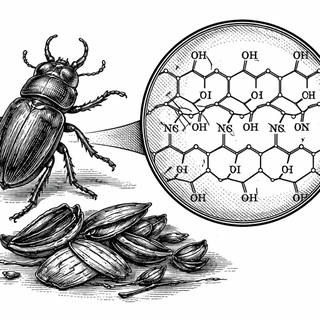
That is the sound of a beetle shell doing what beetle shells do best: being stubborn, shiny, and oddly useful. Usually, the leftovers from edible insects do not get much glamour. Exuviae, cuticle scraps, frass. Not exactly red-carpet material. But a new review on coleopteran insect side-streams argues that these cast-off remains may deserve a second act, this time as a source of chitin and chitosan for industrial and biomedical use.
And yes, this is one of those stories where trash starts looking suspiciously like treasure.
The part of the beetle nobody invited to dinner
Beetles belong to the order Coleoptera, a vast group with armored bodies and an enviable commitment to wearing natural outerwear at all times. In the edible insect industry, the main attraction is protein. But after processing comes a heap of side-stream material: shed exoskeletons, cuticle residues, and insect droppings. Glamorous, no. Chemically promising, very much yes.
The review highlights that these leftovers are rich in chitin, a structural biopolymer found in insect exoskeletons, crustacean shells, and fungal cell walls. Chitin is tough, biodegradable, and biocompatible. Modify it a bit, mainly by removing acetyl groups, and you get chitosan, a related material with its own long list of uses.
Scientists like these molecules for good reason. They can be shaped into films, fibers, scaffolds, coatings, and particles. They show up in wound dressings, drug delivery systems, tissue engineering research, water treatment, food packaging, and agricultural applications. Not bad for something that starts life as beetle leftovers.
Why bother with beetles when crabs already exist?
Chitin is not new. Traditionally, it comes from crustacean waste such as shrimp and crab shells. That supply chain already exists, and industry knows how to handle it. So why invite beetles to the party?
Because beetle side-streams offer a different kind of opportunity.
First, they fit neatly into the logic of a circular bioeconomy. If edible insect farming is growing for sustainable protein, then its waste streams should not be ignored. Using those side-streams for chitin production means squeezing more value out of the same biological system. Economists call that resource efficiency. The rest of us call it common sense with a lab coat.
Second, insect-derived chitin may come with structural features that differ from crustacean sources. And in biomaterials, structure matters. A lot. Small differences in crystallinity, purity, polymer chain arrangement, or surface chemistry can affect how a material behaves in a dressing, scaffold, or delivery system. Biology loves details. Chemistry loves details even more.
Not all chitin is built the same
One of the more intriguing parts of the review is its discussion of chitin polymorphs: alpha, beta, and gamma chitin. These forms differ in how their polymer chains are arranged. Think of it as the same building blocks stacked in different ways, with different consequences for strength, packing, and reactivity.
Coleopteran insects appear to exhibit these polymorphic forms, which gives researchers a useful reminder: “insect chitin” is not one tidy thing. It is a family of materials with varying structural personalities. Some are tightly packed and rigid. Some may be more accessible to chemical modification. Some may behave better in one application than another.
That matters if you want to scale beyond vague promises and into actual products.
A wound dressing does not care that your sustainability pitch is excellent. It cares whether the material performs. A drug carrier is similarly unromantic.
Extraction is where chemistry gets sweaty
Of course, getting chitin out of insect leftovers is not as simple as rinsing off a beetle wing and declaring victory. The review takes a hard look at extraction methods, which usually involve removing proteins, minerals, pigments, and other hitchhiking components.
This is where the chemistry gets serious. Different extraction routes can change the final material's properties. Harsh chemical treatment may improve purity but alter structure. Gentler approaches may preserve features better but be harder to scale. Efficiency, cost, environmental burden, and product quality all start arguing in the same room.
Nobody leaves that meeting fully happy.
That tension is one reason the paper is interesting. It does not just celebrate beetle-derived chitin as a nice idea. It points out the bottlenecks. Standardization is still limited. Structural characterization needs more consistency. Extraction methods need optimization for industrial reality, not just laboratory elegance. Scale-up remains a real hurdle.
That is science at its most honest. Excitement with paperwork.
Why the biomedical world is paying attention
For biomaterials, chitin and chitosan bring an appealing set of traits. They are biodegradable, generally biocompatible, and chemically modifiable. That combination is catnip for researchers designing materials that interact with living tissue.
Potential applications include wound care materials, tissue-engineering scaffolds, antimicrobial coatings, and delivery platforms for therapeutic compounds. Chitosan in particular often gets attention for its film-forming ability and its useful surface chemistry.
The review also notes nutritional and bioactive functionalities associated with chitin from coleopteran sources. That broadens the conversation beyond “can we extract it?” to “what can this material actually do?” If these side-stream-derived polymers can be tailored reliably, they could support new business models around insect farming, waste valorization, and sustainable biomaterial manufacturing.
That is the dream, anyway. Industry enjoys a dream, provided it comes with reproducible data and a spreadsheet.
The real takeaway: this field is early, but not imaginary
What makes this review stand out is not that it invents chitin. Nature handled that long ago. It is that it pulls attention toward an overlooked feedstock and asks a practical question: if we are already raising edible beetles and producing biologically rich waste, why are we not taking that material more seriously?
The answer, for now, is that the science is promising but still uneven. More work is needed to map structural differences across beetle species, refine extraction chemistry, compare products head-to-head, and show that scale-up can happen without wrecking either quality or economics.
Still, the direction is compelling. A field built around side-streams has a certain quiet elegance to it. Less waste. More value. Better use of biological materials we already produce. The kind of innovation that does not always shout, but tends to stick around.
Beetles, in other words, may be doing more for future biomaterials than anyone expected. Not bad for a group best known for being hard to squish.
This blog post discusses research findings and should not be taken as medical advice. If you have concerns about wound care materials, biomaterial-based treatments, or related health questions, please consult a healthcare provider. Research discussed here represents ongoing scientific investigation and clinical validation is still in progress.
All images used in this post are decorative illustrations only and do not represent or reflect the accuracy, reality, or correctness of the referenced research.
Primary Source: Critical insights into coleopteran insect side-streams derived chitin and chitosan: extraction chemistry, structural features and multifunctional applications. PubMed. https://pubmed.ncbi.nlm.nih.gov/41679859/