
In the time it takes you to read this sentence, your lungs just completed about 50 gas exchanges across a membrane thinner than a soap bubble, your macrophages gobbled up a few dozen cellular debris particles, and somewhere in a research lab in China, a nanoparticle just convinced an angry immune cell to calm down. Two of those three things happen every day. The third one might change how we treat acute lung injury.
When Your Immune System Forgets How to Chill
Acute lung injury (ALI) is what happens when your immune system, specifically your macrophages, decides that the best way to deal with a lung insult is to burn the house down to kill the spider. These white blood cells shift into an aggressive "M1" state, pumping out inflammatory cytokines like TNF-alpha, IL-1-beta, and IL-6 with the enthusiasm of a broken fire hydrant. The resulting cascade of inflammation and oxidative stress damages the delicate alveolar tissue, floods the lungs with fluid, and can rapidly progress to acute respiratory distress syndrome (ARDS) - a condition with mortality rates that would make any intensivist lose sleep.
The irony? Your body actually has the machinery to resolve this. Macrophages can switch to an anti-inflammatory "M2" phenotype that promotes tissue repair instead of destruction. The problem is convincing them to flip that switch while they're in full berserker mode.
Quercetin: The Right Drug, Wrong Delivery
Enter quercetin, a plant flavonoid found in onions, apples, and basically every "superfood" listicle you've ever scrolled past. This compound has legitimate anti-inflammatory and antioxidant properties that could theoretically reprogram those rampaging M1 macrophages into gentler M2 healers. There's just one small hitch: quercetin dissolves in water about as well as a cat enjoys a bath. Its poor bioavailability and potential systemic toxicity have kept it firmly in the "promising but impractical" category of pharmacology for years.
So researchers did what nanomedicine researchers do best - they built a better delivery vehicle.
Building a Smarter Nanoparticle (With Ingredients That Actually Do Something)
A team recently published work on what they call a "bioactive co-assembly" nanomicelle platform with the catchy name Qu@PSA-VES/diT-VES. Before your eyes glaze over at the acronym soup, let me break down why this design is genuinely clever.
Most drug delivery nanoparticles are essentially tiny suitcases - inert containers that carry a drug and release it. This system is more like a suitcase where the suitcase itself is also medicine. The shell is made from polysialic acid (PSA), a sugar polymer that specifically recognizes the Siglec-1 receptor plastered all over the surface of inflamed macrophages. Think of it as a fake ID that gets the nanoparticle past the bouncer and into exactly the right cell.
The core is where things get really interesting. It's built from dimerized taurine-vitamin E succinate (diT-VES), a novel molecule that serves triple duty. First, the vitamin E succinate (VES) component creates a hydrophobic pocket that quercetin absolutely loves - molecular docking simulations showed exceptionally high binding affinity, meaning the drug actually wants to stay put during circulation instead of leaking out prematurely. Second, VES provides its own antioxidant activity. Third, the taurine component offers mitochondrial protection. So even the packaging is therapeutic.
The diT-VES also solved a common problem in nanomicelle design: falling apart too early. Through strengthened non-covalent interactions - primarily hydrophobic forces and hydrogen bonding - the dimerized taurine component keeps the micelles structurally stable as they circulate through the bloodstream. No premature disassembly, no drug dumped in the wrong neighborhood.
The Heist: Getting In, Getting Out, Getting to Work
Here's where the engineering elegance really shines. The nanoparticle journey works like a perfectly planned heist:
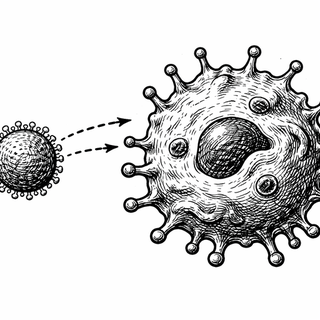
Step 1 - Entry: The PSA coating locks onto Siglec-1 receptors on inflammatory macrophages, triggering receptor-dependent endocytosis. The cell literally eats the nanoparticle, thinking it's something it should ingest.
Step 2 - Escape: Once inside the lysosome (the cell's acidic recycling center), the micelles encounter low pH and digestive enzymes that trigger a dual-responsive dissociation. The nanoparticle falls apart on cue, releasing quercetin.
Step 3 - Action: The freed quercetin, along with VES and taurine from the carrier itself, works synergistically to reprogram the macrophage from its inflammatory M1 state to the reparative M2 phenotype.
It's the immunological equivalent of sneaking into a bar fight, slipping a chill pill into the bouncer's drink, and watching the whole place calm down.
The Mouse Data (Because It's Always Mice First)
In a murine ALI model, the results were striking. The nanomicelle system demonstrated superior lung-targeting ability compared to free quercetin. Pro-inflammatory cytokines in bronchoalveolar lavage fluid dropped significantly. Pulmonary edema decreased. Neutrophil infiltration - another hallmark of ALI damage - was markedly reduced.
Most compellingly, under a lethal ALI challenge, the 72-hour survival rate in treated mice showed dramatic improvement. In acute lung injury research, keeping mice alive for 72 hours is the kind of result that makes reviewers sit up straighter.
The Honest Reality Check
Before anyone starts blending onion-quercetin smoothies, let's be clear about where this stands. This is preclinical work in mice. The distance between "mice survived longer" and "this helps ICU patients" is measured in years and hundreds of millions of dollars. We don't yet know about long-term toxicity, manufacturing scalability, or how these nanoparticles will behave in the considerably more complicated environment of human lungs.
That said, the design philosophy here is genuinely noteworthy. Building delivery vehicles whose components are themselves therapeutic - rather than inert scaffolding that adds complexity without benefit - represents a smart trend in nanomedicine. And the specific targeting of macrophage phenotype switching, rather than broad immunosuppression, addresses one of the fundamental challenges in ALI treatment: you need to stop the damage without disabling the immune response entirely.
For the millions of patients who develop ALI and ARDS each year, any progress toward targeted, effective therapy is welcome news. Even if it starts, as it always does, with mice.
This blog post discusses research findings and should not be taken as medical advice. If you have concerns about acute lung injury or respiratory conditions, please consult a healthcare provider. Research discussed here represents ongoing scientific investigation and clinical validation is still in progress.
All images used in this post are decorative illustrations only and do not represent or reflect the accuracy, reality, or correctness of the referenced research.
Primary Source: Bioactive co-assembly of PSA/diT-VES nanomicelles orchestrates macrophage reprogramming for acute lung injury therapy. PubMed. 2025. PMID: 42032391