
Your bloodstream has a secret, and scientists just figured it out. Or, more precisely, they may have figured out a better way to spot one very particular traveler moving through the biotech world: adeno-associated virus serotype 9, better known as AAV9. This is one of the viral delivery vehicles often used in gene therapy, and in the new study behind this post, researchers built a highly sensitive sensor to detect it. Think less “new superpower unlocked” and more “airport security finally got a better scanner for carry-on luggage the size of a dust mote.”
Why AAV9 gets so much attention
AAV9 is not the sort of thing most people discuss over lunch, which is probably for the best. But in gene therapy research, it is a familiar name. Scientists use AAVs as delivery tools, loading them with genetic material and sending them toward cells in hopes of treating disease. AAV9 is especially attractive because it can reach tissues that are hard to access, including muscle and parts of the nervous system.
That promise creates a practical headache. If you are developing or manufacturing an AAV9-based therapy, you need to detect and quantify the virus accurately. Not vaguely. Not “somewhere between a lot and a little.” You need dependable numbers for quality control, safety checks, and experimental consistency. A bad measurement here is like baking with a scale that sometimes confuses grams with vibes.
What this study built
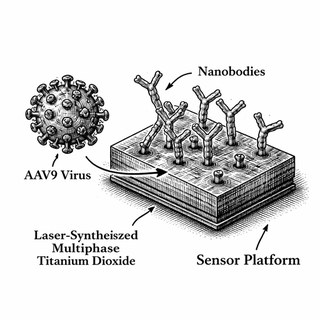
The researchers report a photoelectrochemical immunosensor designed specifically for AAV9 detection. That phrase sounds like it escaped from a grant application, so let’s translate it.
A sensor like this works by turning a biological recognition event into a measurable signal. In this case, the recognition piece is a nanobody, which is a small antibody-like molecule engineered to bind a target. The target is AAV9. The signal comes from a photoelectrochemical setup, meaning light helps drive an electrical response that can be measured.
At the center of the system is a laser-synthesized multiphase titanium dioxide material, or TiO2. Titanium dioxide shows up all over science and industry, and here it serves as part of the sensing platform. The “multiphase” detail matters because different crystal phases can change how charges move through the material, which can affect sensor performance. If engineered well, that can mean a stronger, cleaner signal.
The headline claim is that combining this TiO2 platform with AAV9-targeting nanobodies enabled highly sensitive and specific detection of the virus.
Why nanobodies are a smart choice
This is the part worth praising. Nanobodies are not just trendy molecular accessories. They can be very useful in sensor design because they are smaller and often more stable than conventional antibodies. That can help them pack densely onto a sensing surface and keep working under conditions that make larger proteins sulk.
For a virus detection platform, that is a reasonable and elegant choice. A smaller binding molecule can improve access to viral surface features and may help reduce some of the messiness that comes with bulkier recognition systems. If the team achieved strong specificity for AAV9, that is a meaningful technical step, especially in a field where similar viral particles can be annoyingly easy to mix up.
Why this matters beyond one paper
If this kind of sensor holds up under real-world testing, it could make gene therapy development more efficient. Better detection tools can help research labs characterize viral preparations faster and help manufacturing workflows catch problems earlier. In an area where timelines are long and production is expensive, even modest gains in analytical reliability matter.
This also speaks to a bigger issue in advanced therapeutics: the glamorous part is often the treatment concept, but the boring-sounding measurement tools are what keep the whole enterprise from drifting into chaos. No one puts “robust assay validation” on a movie poster, yet that is often where real progress earns its rent.
Pumping the brakes, respectfully
Now for the necessary skepticism.
A highly sensitive sensor in a research setting is not automatically a field-ready solution. Plenty of biosensors look excellent on paper and then run into the stubborn realities of complex biological samples, reproducibility, manufacturing scale, storage stability, or routine lab use by people who do not have the inventor standing nearby.
Specificity is another place where details matter. Detecting AAV9 is useful, but the real test is how well the sensor distinguishes AAV9 from other closely related viral serotypes, contaminants, and background biological material. “Specific” can mean several different things depending on how hard you try to break the assay.
There is also the question of benchmarking. A new sensor is interesting only relative to what already exists. How does it compare with standard methods in sensitivity, speed, cost, and ease of use? Does it require specialized equipment that limits adoption? Can it work consistently in samples that resemble the messy stuff used in manufacturing or clinical research? A sensor can be brilliant and still end up living its whole life inside a figure panel.
And then there is durability. Nanobody-functionalized materials sound terrific when freshly prepared in a controlled experiment. But can they be produced reproducibly, stored reliably, and used by others without performance drift? Science is full of devices that behave beautifully until someone else touches them.
The real reason this is interesting
Even with those caveats, I think this study is interesting for a simple reason: it targets a bottleneck that matters. Gene therapy does not move forward on ambition alone. It moves forward when researchers can measure the right thing, at the right sensitivity, with enough confidence to trust the result.
AAV9 is already a serious player in therapeutic development, so better tools to monitor it are not just academically neat. They could improve the plumbing behind an entire category of biomedical work. That is not flashy, but it is often how progress actually happens.
So no, this does not mean gene therapy suddenly became easy, solved, or ready to sprint into every clinic tomorrow. Science rarely works like that, despite the occasional headline acting like it had three espressos and no adult supervision. What this paper seems to offer is narrower and more believable: a potentially better detection method for an important viral vector.
That is enough to pay attention to.
What to watch next
The next questions are the ones that separate a promising prototype from a useful tool. Can the method be validated independently? Can it handle real production samples? Can it outperform or complement standard assays in terms of cost and workflow, not just laboratory elegance?
If the answer to those questions turns out to be yes, this sort of sensor could become part of the quiet infrastructure that helps gene therapy mature from a high-promise field into a more dependable one.
Until then, admiration is warranted. So is restraint.
This blog post discusses research findings and should not be taken as medical advice. If you have concerns about a condition being treated with gene therapy, please consult a healthcare provider. Research discussed here represents ongoing scientific investigation and clinical validation is still in progress.
All images used in this post are decorative illustrations only and do not represent or reflect the accuracy, reality, or correctness of the referenced research.
Primary Source: Highly sensitive detection of adeno-associated virus serotype 9 enabled by a nanobody-functionalized multiphase TiO2. PubMed record 42054861. Source