
Most people hear "biosensor" and assume the hard part is the chemistry. Fair enough. Fancy enzymes, glowing molecules, mysterious lab liquids - sounds like the chemistry team should be doing all the heavy lifting while the hardware just stands there holding the clipboard. But here's what actually happens: sometimes the chemistry is ready to go, and the real problem is that the device simply is not collecting enough light to notice what's going on.
That is the bottleneck this new PubMed study takes aim at. Researchers built a highly sensitive fluorometric acetone biosensor using a hemi-ellipsoidal mirror, which is a phrase that sounds like it was invented to scare undergrads. In plain English, they used a specially shaped mirror to gather much more of the fluorescent light produced inside the sensor. More captured light means a stronger signal. Stronger signal means you can detect smaller amounts of a target molecule. In this case, that molecule is acetone.
Why acetone matters at all
Acetone is not just something you smell in a nail salon or on the breath of someone who skipped breakfast and then made questionable life choices at the gym. It is a real metabolic signal. The body produces ketone bodies, including acetone, during fat metabolism. That makes acetone potentially useful as a marker in areas like metabolic monitoring and noninvasive health sensing.
Researchers have been interested in measuring acetone through the skin or in breath because it could someday offer a less invasive way to track metabolic states. That is the dream, anyway. The trouble is that acetone can show up at very low concentrations, and low concentrations are where sensors start acting like I used to at 4 a.m. on an ambulance shift: technically present, but not performing at peak levels.
The old problem with fiber-optic fluorescence sensors
Fluorescence-based biosensors work by exciting a fluorescent molecule with light and then measuring the emitted light that comes back. That sounds straightforward until physics strolls in with a folding chair.
Traditional fiber-optic systems collect light at the tip of the fiber, but their efficiency is limited by something called numerical aperture. You do not need to memorize that term. The practical point is simple: a lot of the emitted light escapes instead of being measured. If your target is abundant, maybe you can live with that. If your target is present in trace amounts, wasting light is like trying to catch rainwater with a spaghetti strainer.
That matters a lot for acetone sensing, where the signal can be faint to begin with.
The clever fix: use the geometry, not just the chemistry
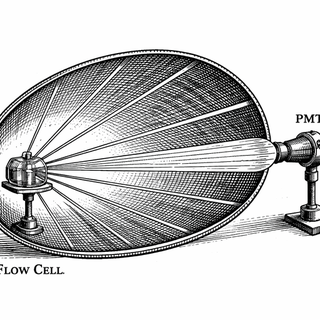
The researchers turned to an ellipse. An ellipse has two focal points, and light emitted from one focus reflects off the ellipsoidal surface and converges at the other focus. They used that basic optical principle to design a hemi-ellipsoidal mirror system.
Their setup placed a flow cell and a photomultiplier tube, or PMT, at the focal points. The PMT is a very sensitive detector for weak light signals. The mirror helps gather fluorescence that would otherwise be lost and redirects it toward the detector. So instead of hoping the sensor catches enough light by chance, the optics do some actual work for a living.
What makes this especially interesting is how accessible the build appears to be. The hemi-ellipsoidal mirror was fabricated from a 3D-printed shell, then manually polished and coated with commercially available mirror-finish spray paint. That is not exactly kitchen-table science, but it is much more practical than a lot of lab hardware that seems to require a machine shop, a grant renewal, and a pact with the procurement department.
How the sensor detects acetone
The biosensor uses secondary alcohol dehydrogenase, abbreviated S-ADH. This enzyme selectively reduces acetone and consumes NADH, a molecule that naturally fluoresces. NADH glows under excitation light at about 340 nm and emits fluorescence around 490 nm.
Here is the key move: when acetone is present, the enzymatic reaction uses up NADH. As NADH levels fall, the fluorescence signal decreases. So the sensor does not "see" acetone directly like a tiny optical bloodhound. It tracks the drop in fluorescence caused by the reaction.
That drop can then be translated into an acetone concentration. It is a neat bit of biochemical accounting. Less glow, more acetone.
What the team found
This is where the paper earns its keep. Using the hemi-ellipsoidal mirror setup, the researchers quantified NADH concentrations from 94 nM to 1 mM. They report a limit of quantification nine times lower than that of a conventional fiber-optic system.
That is a substantial gain. Lower limit of quantification means the device can reliably measure much smaller amounts than before.
When they integrated an S-ADH-immobilized membrane into the system, they were able to monitor the acetone reduction reaction in real time by observing the fluorescence decrease. For acetone itself, the dynamic range ran from 42 nM to 1 mM, with sensitivity reported as 14 times better than the fiber-optic comparison system.
That is not a minor tweak. That is the kind of improvement that changes whether a sensor concept is merely interesting or actually useful.
Why this is more than an optics nerd project
A lot of early-stage biosensor research lives or dies on one boring-sounding issue: signal collection. Not because the science is boring, but because weak signals are merciless. If your device cannot reliably detect low concentrations, it does not matter how elegant the chemistry looks in a figure legend.
This paper tackles that problem in a practical way. Instead of reinventing the biological reaction, the team improved the optical plumbing around it. That matters because better light collection could help many fluorescence-based biosensors, not just this acetone one.
From a real-world perspective, that is exciting. If follow-up development goes well, systems like this could help move metabolic sensing toward devices that are more sensitive, possibly less invasive, and better suited for continuous or near-real-time monitoring. That could eventually matter in settings where clinicians or patients want fast feedback without repeated needle sticks.
And yes, there is still a long road between a strong lab prototype and something used routinely in clinics or homes. Medical devices do not leap from bench to bedside like a sports movie montage. There are validation studies, reproducibility checks, robustness testing, interference questions, manufacturing concerns, and the occasional unpleasant surprise waiting in biological samples.
The catch, because there is always a catch
This study is promising, but it is still a sensor-platform paper. It shows a more sensitive detection method and demonstrates real-time monitoring of the acetone-linked reaction. That is valuable. It does not mean your smartwatch will start sniffing ketones next Tuesday.
A few practical questions remain. How stable is the mirror finish over time? How consistent is manual polishing from one device to another? How does the sensor behave outside controlled conditions? What happens when real-world biological noise barges in like a guy yelling over the game at a sports bar?
Those are not deal-breakers. They are the normal next questions. Good papers answer one hard question and hand the next five to everybody else.
The bigger takeaway
The smartest part of this work may be its simplicity. The researchers used a known property of ellipses, a 3D printer, mirror-finish coating, enzyme chemistry, and careful optical alignment to solve a sensitivity problem that standard fiber-optic collection struggled with.
That is the kind of engineering I tend to trust. Not flashy for the sake of flashy. Just a sharp solution to a real limitation.
If future studies can translate this into robust, practical sensing systems, acetone monitoring could become more feasible in applications where tiny concentrations matter. Sometimes progress in health tech is not about inventing a whole new universe. Sometimes it is about finally putting the mirror in the right place.
This blog post discusses research findings and should not be taken as medical advice. If you have concerns about metabolic health, ketone production, or related symptoms, please consult a healthcare provider. Research discussed here represents ongoing scientific investigation and clinical validation is still in progress.
All images used in this post are decorative illustrations only and do not represent or reflect the accuracy, reality, or correctness of the referenced research.
Primary Source: Highly Sensitive Fluorometric Acetone Biosensor Using Hemi-Ellipsoidal Mirror Optics for Efficient Light Collection. PubMed. Record 42024630.