
Fair warning: things are about to get weird. This story involves jelly-like biomaterials, tiny strands of genetic code, and a chemistry trick so small it sounds almost rude to brag about. But that tiny trick, swapping in a 2'-fluoro modification on short DNA or RNA pieces, appears to make a biosensor much better at spotting whether matching genetic material is actually there. Not slightly better, either. In this study, the modified DNA sensors were more than three times as sensitive as the unmodified version. That is the lab-equivalent of switching from old reading glasses to a telescope and suddenly acting like you meant to see all that detail the whole time.
As a former paramedic, I have a soft spot for anything that promises faster, simpler detection without adding three extra machines, four stickers, and a printer that jams the second you look at it wrong. That is part of what makes this paper interesting. The researchers built label-free, amplification-free biosensors using oligonucleotides bound to alginate hydrogels, then used circular dichroism spectroscopy, or CD spectroscopy, to detect hybridization. In plain English, they made a sensor that can tell when a target strand binds to its partner, without attaching flashy labels or copying the sample over and over.
What the researchers actually built
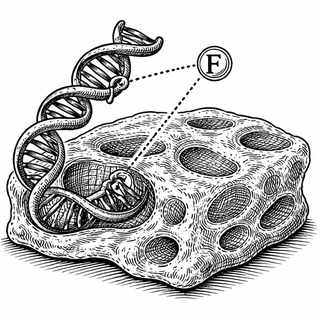
The core setup is elegant. The team attached short oligonucleotides, basically small pieces of DNA or RNA, to alginate hydrogels. Alginate is a polymer often derived from seaweed, and in this case it works like a soft scaffold that holds the sensing strands in place. When a complementary strand comes along and binds, the structure changes.
That structural change matters because CD spectroscopy is sensitive to the way molecules are arranged in space. It measures how a sample interacts with circularly polarized light, which sounds like something a physicist would say right before the rest of us quietly reach for coffee. But the takeaway is simple: if binding changes the shape or organization of the nucleic acids, CD can pick that up as a shift in the spectrum.
So instead of using fluorescent tags or PCR amplification, the sensor reads the binding event more directly. That is appealing for portable or rapid testing, especially in settings where simpler is better and fewer moving parts usually means fewer headaches.
Why add fluorine at all?
The paper focuses on 2'-fluoro modifications. That means a fluorine atom is introduced at a specific position on the sugar portion of the nucleic acid building blocks. Tiny chemical change, big behavioral difference.
These modifications can influence how the strands fold, how tightly they bind, and how stable the resulting duplex becomes. If that sounds like changing one lug nut and somehow making the whole wheel behave better, welcome to molecular biology. Small edits often have outsized effects.
In this study, fluorine-modified DNA-based biosensors showed more than a threefold increase in sensitivity compared with unmodified DNA. RNA-based sensors showed the same general trend, with 2'-fluoro modifications lowering the limit of detection. Lower limit of detection means the sensor can identify smaller amounts of target material. That is the difference between hearing a whisper in a quiet room and hearing it during halftime at a packed stadium.
Sensitivity is nice. Specificity is where things get interesting.
A biosensor that lights up for everything is not helpful. That is not a detector. That is a panic button.
The researchers also tested specificity by throwing in mixtures containing up to four non-complementary strands. In other words, they made the environment messier and more realistic. That matters because real-world samples, especially environmental or forensic ones, are rarely clean and cooperative. Biology does not present itself like a textbook diagram. It shows up like a junk drawer.
Even in those mixed samples, the fluorine-modified biosensors performed better. They produced more distinct shifts in the CD spectra than unmodified DNA sensors, which suggests they were better at distinguishing the true matching strand from irrelevant genetic clutter.
That specificity piece is a big deal. Plenty of technologies look impressive in ideal conditions. The real test is whether they still behave when the sample starts acting like a group chat with too many people typing at once.
The machine learning cameo
The paper does not stop at chemistry and spectroscopy. The team also used principal component analysis to separate samples with and without bound complement, then combined thermal melt data with CD spectral data in a random forest model to predict whether unknown samples showed complement binding.
That model reached 95% accuracy for the 2'-fluoro modified oligos, compared with 83% for unmodified oligos.
Now, I know "random forest model" can make a paragraph start sounding like a grant application wearing a lab coat two sizes too big. So here is the practical version: they did not just eyeball spectral wiggles and declare victory. They paired the signal data with data analysis tools to classify unknown samples more reliably. And the fluorine-modified system gave the model a cleaner, more informative signal to work with.
That is one of the more useful patterns in modern diagnostics. Better chemistry plus smarter analysis often beats brute force alone.
Why this matters outside the lab
The study points toward improved label-free, amplification-free detection for healthcare, environmental monitoring, and forensic applications. That is a broad promise, but it is grounded in a real need.
Fast testing systems often face tradeoffs. Maybe they are quick but not sensitive enough. Maybe they are accurate but too complicated for field use. Maybe they work beautifully until you introduce a messy sample, at which point they fold faster than a lawn chair at a family barbecue.
A sensor that can detect short oligonucleotides more sensitively and more specifically, without requiring labels or amplification, could help simplify workflows. If future development goes well, that could mean more portable genetic detection platforms, fewer prep steps, and better performance in settings where contamination, complexity, or time pressure are part of the job description.
For healthcare, that could support faster nucleic acid-based testing approaches. For environmental monitoring, it could help detect target genetic material in mixed samples. For forensics, better discrimination between true target binding and background noise is obviously useful when the sample quality is less than perfect.
The usual reality check
This is promising research, but it is still research. The paper shows a strong proof of concept for how 2'-fluoro modifications can improve biosensor performance in this alginate hydrogel and CD spectroscopy system. That does not mean your local clinic is about to replace existing molecular tests next Tuesday.
There are still practical questions that future studies would need to answer. How well does this hold up across a wider range of real samples? How scalable is the sensor production? How portable can the readout system become? And how does it compare head-to-head with established diagnostic methods in routine use?
Still, this is the kind of paper I like. It does not promise teleportation or miracle cures. It shows that a smart, specific chemistry adjustment can make a detection platform noticeably better. Sometimes progress in diagnostics is not a giant cinematic leap. Sometimes it is a very small fluorine atom doing an absurd amount of work.
This blog post discusses research findings and should not be taken as medical advice. If you have concerns about a health condition or diagnostic testing, please consult a healthcare provider. Research discussed here represents ongoing scientific investigation and clinical validation is still in progress.
All images used in this post are decorative illustrations only and do not represent or reflect the accuracy, reality, or correctness of the referenced research.
Primary Source: Impact of 2'-fluoro nucleobase modifications on CD detection, sensitivity and specificity of short oligonucleotides bound to alginate hydrogels. PubMed. https://pubmed.ncbi.nlm.nih.gov/42052678/