
Here's the thing about textile waste that nobody tells you: we generate roughly 92 million tons of it globally every year, and "recycling" most of it is a polite fiction. The vast majority ends up in landfills or incinerators. So when someone proposes cooking your old polyester blend into useful carbon particles through pyrolysis, it sounds like a genuine win. Heat the trash, get something valuable, save the planet. Except nobody had actually checked whether the resulting product might poison the very waterways we're trying to protect.
Until now.
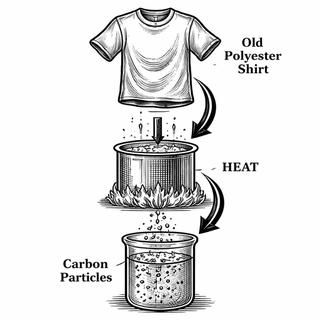
Cooking Clothes Into Carbon
Pyrolysis is one of those wonderfully simple ideas that chemistry occasionally offers up. Take organic material, heat it in the absence of oxygen, and watch it decompose into gases, liquids, and a solid carbonaceous residue. The process is remarkably unfussy about what you feed it. Wood? Great, you get biochar. Agricultural waste? No problem. Old t-shirts made from synthetic fibers? Apparently, that works too.
The solid product that emerges - technically called a solid pyrolysis product, or SPP - looks and behaves a lot like other industrial carbon particles. Carbon black. Activated carbon. Biochar. These materials have enormous commercial value. Carbon black goes into tires, inks, and plastics. Activated carbon filters your water. Biochar improves soil health. If textile-derived SPPs could substitute for any of these, we'd have a genuine circular economy story on our hands.
The catch? Synthetic textiles are not wood. They're loaded with dyes, finishing chemicals, flame retardants, and the polymers themselves. When you pyrolyze a cotton-polyester blend, whatever doesn't become gas has to go somewhere. And that somewhere is your SPP.
Putting Particles in the Water
A recent study published in 2025 tackled this blind spot head-on. Researchers produced SPP particles from textile waste feedstock and, for comparison, from wood (yielding traditional biochar) using a pyrolysis process designed to scale for actual waste management operations. Then they did something refreshingly thorough: they characterized both products six ways to Sunday.
Electron microscopy revealed the physical structure. Spectroscopy identified chemical composition. Gas adsorption measurements mapped out surface area and porosity. Standardized biochar analyses filled in the remaining gaps. The team wasn't just making carbon particles. They were building a complete dossier on what these particles actually are.
But the real question was biological. What happens when these particles end up in water?
To find out, the researchers ran standardized aquatic toxicity tests using particle suspensions at concentrations up to 500 mg/L. For context, that's a fairly aggressive dose - like dumping a teaspoon of fine carbon powder into a liter of pond water. They tested against a base food-web panel, meaning organisms at different trophic levels that represent the foundation of aquatic ecosystems. And they benchmarked everything against two industrial carbon standards: carbon black and powdered activated carbon.
The Comparison That Matters
This benchmarking approach is what makes the study genuinely useful. It's not enough to say "textile SPP is toxic" or "textile SPP is safe." The question is: compared to what?
Carbon black has been manufactured industrially for over a century. Activated carbon is literally used in water treatment. If textile-derived SPP turns out to be no more hazardous than materials we already use by the megaton, that's a very different story than if it's meaningfully worse.
The researchers used their extensive characterization data to understand why any observed toxicity differences might exist. Surface chemistry matters enormously for particle toxicity. A carbon particle with lots of reactive functional groups on its surface behaves very differently from one that's chemically inert. Particle size, shape, porosity, and surface area all play roles too. By measuring all of these properties, the team could connect any biological effects back to specific physical or chemical characteristics.
Why This Matters More Than You Think
The textile waste problem is accelerating. Fast fashion has roughly doubled clothing production since 2000, while the average number of times a garment gets worn has dropped by 36%. Most "recycled" textiles get downcycled into insulation or rags before eventually hitting the waste stream anyway. Pyrolysis offers a pathway to convert this waste into high-value carbon materials, potentially making textile recycling economically viable for the first time.
But here's where environmental science earns its keep. Scaling up a technology without understanding its environmental footprint is how we got into trouble with microplastics, PFAS, and a dozen other "seemed like a good idea at the time" chemicals. The fact that pyrolysis appears feedstock-agnostic - that it can process almost anything - is both its greatest strength and the reason we need studies like this one. Just because you can pyrolyze synthetic textiles doesn't mean the resulting product is environmentally equivalent to wood-derived biochar.
The Bigger Picture
This research sits at the intersection of several converging trends. Circular economy mandates are pushing industries to find value in waste streams. Carbon markets are creating financial incentives for carbon sequestration products. And environmental regulations are (slowly) catching up with novel materials.
What this study provides is the kind of foundational hazard data that regulators, industry, and environmental advocates all need to make informed decisions. Should textile-derived SPPs be regulated differently from biochar? Can they be used in soil amendment applications where they might leach into groundwater? Are they safe for applications like water filtration?
These aren't theoretical questions. Companies are already scaling pyrolysis for textile waste. The answers matter now.
The most valuable research often isn't the flashiest. It's the study that someone had the foresight to do before we scaled up a new technology and discovered the problems the hard way. We've run that experiment with too many materials already. Maybe this time, the science gets to lead.
This blog post discusses research findings and should not be taken as medical or environmental policy advice. If you have concerns about environmental toxicology or waste management, please consult relevant environmental health authorities. Research discussed here represents ongoing scientific investigation and further validation is still in progress.
All images used in this post are decorative illustrations only and do not represent or reflect the accuracy, reality, or correctness of the referenced research.
Primary Source: Aquatic Toxicological Assessment of Solid Pyrolysis Product (SPP) from Synthetic Textile Feedstock Relative to Biochar, Carbon Black, and Activated Carbon. PubMed. 2025. PMID: 41931823