
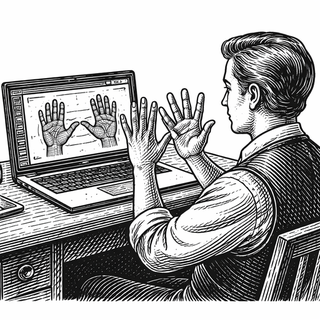
Picture this: you're recovering from a wrist injury, dutifully doing your hand exercises at home in your pajamas, and a camera on your laptop is quietly calculating your joint angles, range of motion, and muscle torque with the kind of precision usually reserved for a motion capture lab. No special gloves. No wearable sensors. No trip to the clinic. Just you, your hand, and an AI that's watching very, very carefully.
That's the vision behind NCT07492797, a clinical trial developing and validating an AI-powered camera system for real-time biomechanical monitoring during upper-limb rehabilitation. And honestly? It might be one of the most practical applications of computer vision I've come across in a while.
The Problem With Rehab (Besides the Exercises Themselves)
Here's the thing about physical rehabilitation that nobody really talks about - the exercises aren't the hard part. The hard part is everything around them. Getting to the clinic two or three times a week. Paying for those visits. Finding a specialist who isn't booked out six weeks. Living close enough to one in the first place.
For people recovering from musculoskeletal injuries or neurological conditions like stroke, consistent monitoring during rehab is genuinely make-or-break. A clinician needs to know whether your range of motion is improving, whether you're compensating with the wrong muscles, whether that joint angle is actually getting better or you're just getting more creative at faking it. (We've all been there.)
The current state of telehealth rehab is... let's call it "vibes-based." Most remote assessments rely on video calls where a therapist watches you move and makes qualitative judgments, or on patient self-reports. And look, I love self-reports as much as the next person, but asking someone "how does your wrist feel on a scale of 1 to 10" is not exactly the gold standard of biomechanical measurement.
So What Exactly Is This System Doing?
The trial is testing a computer vision system that uses a standard camera - we're talking regular webcam, nothing fancy - to extract real-time biomechanical data from your hand and upper-limb movements. The AI identifies anatomical landmarks from the video feed (think knuckles, wrist joints, fingertips) and then runs biomechanical models to compute actual measurements: joint angles, range of motion, estimated muscle force, and joint torque.
Participants in the study perform guided hand-movement tasks while the system records and analyzes their motion. The goal is to determine whether these camera-derived measurements are accurate and reliable enough to meaningfully track rehabilitation progress without requiring in-person visits.
If you're thinking "wait, isn't this basically what motion capture does in movies?" - yes, kind of! Except Hollywood mocap requires you to wear a skintight suit covered in reflective markers and stand in a room surrounded by infrared cameras. This system is trying to get comparable data from the camera that's already sitting on top of your monitor. The ambition is wild, and I'm here for it.
Why This Matters More Than You'd Think
The research on markerless motion capture for clinical applications has been building momentum. A 2021 study by Stenum et al. demonstrated that two-dimensional video-based pose estimation could reliably analyze gait parameters, suggesting that consumer-grade cameras could serve as legitimate clinical tools (DOI: 10.7717/peerj-cs.663). Meanwhile, deep learning frameworks specifically designed to assess physical rehabilitation exercises have shown promising accuracy in scoring movement quality from video alone (Liao et al., 2020; DOI: 10.1109/TNSRE.2020.2966249).
The hand, though, is a particularly gnarly challenge. Your hand has 27 bones, over 25 degrees of freedom, and muscles so small and overlapping that even experienced clinicians sometimes struggle to assess fine motor function without specialized equipment. Getting accurate torque and force estimates from video of hand movements is a significantly harder problem than, say, tracking someone's knee bend during a squat. Research on hand pose estimation has advanced rapidly - a 2023 review by Cheng et al. highlighted how deep learning models have dramatically improved 3D hand pose estimation accuracy (DOI: 10.1016/j.patcog.2022.109099) - but clinical validation has lagged behind the computer science.
That gap is exactly what this trial is trying to close.
The Bigger Picture: Rehab Without Borders
Let's zoom out for a second. The World Health Organization estimates that roughly 1.71 billion people globally live with musculoskeletal conditions. Stroke alone affects about 12 million people every year, and upper-limb impairment is one of the most common consequences. The demand for rehabilitation services far outstrips the supply of qualified therapists, especially in rural areas and lower-income countries.
A validated, camera-only monitoring system wouldn't replace therapists - let's be extremely clear about that. But it could extend their reach enormously. Imagine a therapist in Boston monitoring the rehab progress of 30 patients across three states, with objective biomechanical data streaming in between appointments. That's not science fiction. That's a webcam and a good algorithm.
There's also the data angle. Right now, rehab progress is typically assessed at discrete time points - you go to the clinic, get measured, go home. A continuous monitoring system would generate longitudinal data that could reveal patterns invisible in snapshot assessments. Maybe your range of motion is great on Tuesdays but terrible on Fridays. Maybe you're plateauing in ways that only show up over weeks of daily measurement. That kind of granularity could transform how clinicians personalize treatment plans.
A recent systematic review on telerehabilitation for musculoskeletal conditions found that remote interventions were generally non-inferior to in-person care for pain and function outcomes (Cottrell et al., 2022; DOI: 10.1016/j.msksp.2021.102340). But most of those studies used basic video conferencing. Adding objective biomechanical measurement to the mix could push remote rehab from "good enough" to genuinely better.
What Happens Next?
The trial is focused on validation right now - can the system actually measure what it claims to measure with sufficient accuracy? That's the right first question to ask, and it's the one that will determine whether this technology graduates from "cool demo" to "clinical tool."
If the results hold up, the implications ripple outward fast. Insurance companies love objective outcome measures. Clinicians love data that helps them make better decisions. Patients love not driving 45 minutes for a 20-minute appointment. It's one of those rare scenarios where everyone's incentives actually align.
I'll be watching this one closely. The gap between what AI can do in a research lab and what it can do in your living room has been shrinking fast - and this trial might just prove that your laptop camera has been an undercover rehab assistant this whole time.
Disclaimer: This blog post is for informational and educational purposes only and does not constitute medical advice. Clinical trials are investigational by nature, and outcomes are not guaranteed. Always consult a qualified healthcare professional for medical decisions. For full trial details, visit ClinicalTrials.gov - NCT07492797 or the table view.
References:
-
Stenum J, Rossi C, Roemmich RT. Two-dimensional video-based analysis of human gait using pose estimation. PeerJ Computer Science. 2021;7:e663. DOI: 10.7717/peerj-cs.663
-
Liao Y, Vakanski A, Xian M. A deep learning framework for assessing physical rehabilitation exercises. IEEE Trans Neural Syst Rehabil Eng. 2020;28(2):468-477. DOI: 10.1109/TNSRE.2020.2966249
-
Cheng Y, et al. Deep learning for hand pose estimation: A survey. Pattern Recognition. 2023;135:109099. DOI: 10.1016/j.patcog.2022.109099
-
Cottrell MA, et al. Telehealth for musculoskeletal conditions: A systematic review and meta-analysis. Musculoskelet Sci Pract. 2022;57:102340. DOI: 10.1016/j.msksp.2021.102340
is a contributor to Biomedical Observer, where he writes about clinical research that makes him say "wait, really?" at least once.