
Somewhere right now, a patient is lying still while a wound vacuum hums beside the bed, quietly pulling fluid away from damaged tissue and buying the body some time to repair itself. It is a clever bit of medical plumbing. But the sponge inside that system has a hard life. It has to stay soft enough for tissue, sturdy enough not to collapse, and hostile enough to bacteria that would very much like to move in and throw a housewarming party.
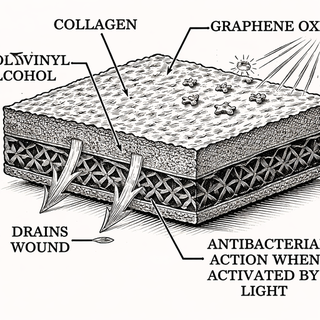
That awkward balancing act sits at the center of a new study on advanced wound care. Researchers report a collagen-based sponge designed for negative pressure wound therapy, or NPWT, that also brings extra strength and a heat-based antibacterial trick. The material combines collagen, polyvinyl alcohol, and graphene oxide into a composite sponge meant to drain wounds, keep its shape under suction, and help kill bacteria when activated by light. One sponge. Three jobs. No existential crisis required.
Why wound sponges matter more than they look
NPWT is already a well-established tool for difficult wounds. The basic idea is straightforward: place a porous dressing into the wound, seal the area, and apply controlled suction. That negative pressure helps remove excess fluid, can reduce swelling, supports blood flow, and encourages the kind of tissue growth clinicians want to see.
The sponge is not just filler. It is the working interface between machine and biology. If it compresses too easily, drainage suffers. If it degrades or deforms in a wet environment, performance drops. If bacteria colonize it, the whole setup starts looking less like high-tech healing and more like a microbial rental property.
That is the problem this paper goes after. Standard NPWT materials work, but building one that is biocompatible, mechanically reliable, and strongly antibacterial all at once has been stubbornly difficult.
The recipe: collagen, polymer, and a little graphene oxide
The new sponge is made from three components. Collagen is the familiar biological one. It is a structural protein found throughout the body and a natural candidate for wound dressings because tissues generally get along with it. Polyvinyl alcohol, or PVA, adds polymer support and helps improve the material's physical behavior. Then comes graphene oxide, the flashy ingredient.
Graphene oxide is a carbon-based material with a reputation for doing useful things in biomedical engineering, provided everyone minds the details. In this case, it appears to serve two main roles. First, it strengthens the sponge. Second, it gives the material a photothermal effect, meaning it can convert light into heat. That heat can be used to suppress bacterial growth.
The sponge itself was prepared through a low-temperature foaming process. That matters because the final structure needs pores. NPWT dressings depend on a porous architecture to move fluid efficiently while still holding together under stress.
What the researchers found
This is where the paper gets practical. Adding graphene oxide noticeably improved the mechanical properties of the composite sponge. The authors report a maximum compressive stress of 20.2 kPa, suggesting the material can tolerate being squeezed without folding like a sad dessert.
Even more interesting, the sponge recovered very well after repeated compression in the wet state, which is exactly where a wound dressing lives. In the formulation containing 0.05% graphene oxide, the permanent deformation rate was just 1.33%. That is a small number with a big implication: after being compressed, the sponge mostly bounced back rather than staying flattened.
That resilience carried over into suction testing. In aquatic environments, the composite sponge remained stable under negative pressure up to 24 kPa and showed high drainage efficiency. In plain English, it kept working while wet and under vacuum, which is not a bad thing for a device designed to sit in a wet wound under vacuum.
Then there is the antibacterial side. Thanks to graphene oxide's photothermal behavior, the sponge achieved inhibition rates above 96% against both tested bacterial strains. The abstract provided does not list the species, so that is as far as the evidence goes here. Still, a result above 96% is hard to ignore. It suggests that, when activated appropriately, this dressing may do more than passively sit in place. It may actively help clear one of wound care's most persistent enemies.
Why this is interesting beyond the bench
Advanced wounds are messy, slow, and expensive. They are also deeply human. A chronic wound can mean repeated clinic visits, prolonged pain, infection risk, limited mobility, and a life reorganized around dressing changes. None of that makes for a charming afternoon.
So a better NPWT sponge matters if it can eventually translate into practice. A dressing that drains well, resists collapse, and adds antibacterial action could simplify wound management and improve consistency. Fewer failures at the dressing level might mean fewer setbacks higher up the chain.
There is also something appealing about the design logic. Rather than bolting together separate fixes for mechanics and infection, the researchers built multiple functions into a single material. That is often where biomaterials get interesting. Not because they are futuristic in a glossy-magazine way, but because they start behaving less like passive stuffing and more like purpose-built tools.
The dry catch, of course, is that clever materials do not automatically become clinical products. Biology has a way of making promising prototypes fill out more paperwork.
The obvious caveats
This is still materials research, not a green light for routine patient care. The results described here are promising, but they are also preclinical. A sponge performing beautifully in compression tests, drainage setups, and antibacterial assays is a strong start, not a final verdict.
Several questions still hang in the air. How will this material behave over longer periods in complex wounds? What kind of light source is required for the photothermal effect, and how practical is that in real clinical workflows? How uniform is the heating? Can bacteria be suppressed without harming surrounding tissue? And what happens when all of this meets the glorious unpredictability of real patients, real exudate, and real clinical constraints?
Those are not minor details. They are the difference between an elegant paper and a usable therapy.
A small sponge with big ambitions
Still, this study points in a compelling direction. The researchers took collagen, gave it polymer support, added graphene oxide, and ended up with a sponge that appears tougher, springier, and more antibacterial than a simpler dressing would be. For NPWT, that combination makes a lot of sense.
Wound care rarely gets the glamour treatment. No one is making blockbuster films about compressive stress curves. Yet this is exactly the sort of incremental engineering that can change outcomes if it holds up. Sometimes progress arrives as a dramatic breakthrough. Sometimes it arrives as a better sponge that refuses to flatten, keeps fluid moving, and turns light into a bacterial eviction notice.
For patients with hard-to-heal wounds, the second kind would do nicely.
This blog post discusses research findings and should not be taken as medical advice. If you have concerns about wound healing or wound infections, please consult a healthcare provider. Research discussed here represents ongoing scientific investigation and clinical validation is still in progress.
All images used in this post are decorative illustrations only and do not represent or reflect the accuracy, reality, or correctness of the referenced research.
Primary Source: Functionalized collagen-based sponge dressing integrating negative pressure wound therapy and photothermal antibacterial treatment for advanced wound management. PubMed. https://pubmed.ncbi.nlm.nih.gov/42052720/