
How many invisible hitchhikers are swimming in your glass of water right now, and would you really want to wait two days to find out?
That question has haunted microbiologists for well over a century. I spent the better part of forty years watching graduate students pace around incubators, waiting for bacterial cultures to grow, and I can tell you from personal experience: the waiting is the hardest part. Not the science. Not the pipetting. The waiting. Traditional methods for identifying nasty bacteria like Staphylococcus aureus can take anywhere from 24 to 72 hours. In the meantime, contaminated food gets eaten, polluted water gets consumed, and infections get a generous head start.
So when a research team recently announced they'd built a biosensor that detects S. aureus at concentrations as absurdly low as a single bacterium per milliliter, and that it works in orange juice, lake water, and human urine - well, this old professor sat up in his armchair and paid attention.
The Humble Gelatin Gets a Promotion
Here's where the story gets wonderfully elegant. The sensor at the heart of this work is built around gelatin - yes, the same wobbly substance that makes your dessert jiggle and your bone broth glossy. Gelatin has a long and storied history in microbiology. The classic "gelatin liquefaction test" has been used since the days of Robert Koch to identify bacteria that produce gelatinase, an enzyme that chews through gelatin like a toddler through a birthday cake.
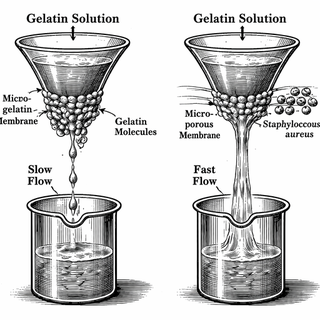
The researchers took this old-school concept and gave it a 21st-century makeover. Their microporous membrane-based polymer gating (MPG) biosensor works on a beautifully simple principle: push a gelatin solution through a membrane with tiny pores, and measure how long it takes. As gelatin molecules accumulate in those pores, they gum up the works - the flow slows down, and the time it takes for the solution to reach a detection line increases. Think of it like trying to pour honey through a coffee filter. The thicker the honey, the longer you wait.
Now here's the clever twist. S. aureus produces gelatinase, which breaks gelatin down into smaller fragments. If the bacterium is present in your sample, it digests the gelatin, the membrane stays clearer, and the flow time drops noticeably. More bacteria means more gelatinase, which means faster flow. The readout is simply time - no fluorescent labels, no expensive antibodies, no PhD required to interpret the results.
One Bacterium in a Haystack
The sensitivity of this device genuinely raised my eyebrows, and I assure you these eyebrows have seen a lot of impressive data in their time. The MPG biosensor achieved a detection limit of 1 CFU/mL. For the non-microbiologists reading along, CFU stands for "colony-forming unit," and detecting a single one per milliliter is like finding one specific person in a city of a million - except your city is made of liquid.
To put this in context, many commercially available rapid tests for bacterial pathogens have detection limits in the range of 10^3 to 10^5 CFU/mL (Lazcka et al., 2007). Polymerase chain reaction (PCR)-based methods can get lower, but they require thermocyclers, trained operators, and reagents that would make your departmental budget weep. The MPG biosensor achieves its remarkable sensitivity with a home-built portable pump and a strip of microporous membrane. My first car cost more than this device probably does.
From Lab Bench to Lake Water
Any sensor can look good in pristine buffer solutions under ideal laboratory conditions. I've seen hundreds of prototypes dazzle in the lab and then fall apart the moment you introduce a real-world sample. The researchers clearly anticipated this skepticism, because they tested their biosensor in three decidedly messy matrices: human urine, orange juice, and lake water.
All three worked reliably. The biosensor maintained its performance despite the complex chemical soups that these real-world samples represent. This matters enormously for practical applications. Environmental monitoring stations, food safety checkpoints, and clinical point-of-care settings don't have the luxury of centrifuges and clean rooms.
The Antibiotic Question
Perhaps the most exciting aspect of this work - and I don't use that word lightly after decades of reviewing grant proposals - is the antimicrobial susceptibility testing (AST) capability. The global rise of antibiotic-resistant bacteria is one of the defining public health challenges of our era. The World Health Organization has called antimicrobial resistance one of the top ten threats to global health, and resistant S. aureus strains (particularly MRSA) are responsible for thousands of deaths annually (Murray et al., 2022).
Current gold-standard AST methods, like broth microdilution, require overnight incubation and specialized equipment. The MPG biosensor sidesteps much of this by measuring flow time changes in S. aureus samples treated with different antibiotics. If an antibiotic effectively kills or inhibits the bacteria, less gelatinase gets produced, the gelatin stays intact, and the flow time remains elevated. If the bacteria are resistant and keep on growing, gelatinase production continues, gelatin breaks down, and the flow time drops. It's a binary logic that even my undergraduate students could follow on the first try - a pedagogical miracle in itself.
Why This Old Professor Is Optimistic
I've learned over the years to temper my enthusiasm for any single paper. The road from proof-of-concept to clinical deployment is long, potholed, and littered with the wreckage of promising prototypes. This sensor will need extensive validation across diverse bacterial strains, regulatory approval, and manufacturing scale-up before it shows up at your local clinic.
But the fundamental design philosophy here is sound and refreshing. Instead of adding complexity - more reagents, more steps, more expensive equipment - these researchers subtracted it. They took a 140-year-old microbiological principle, married it to a simple membrane and a portable pump, and produced something that reads out in units every human understands: time.
In an age when diagnostic tools increasingly resemble small spacecraft, there's something deeply satisfying about a device whose core innovation is watching how fast liquid drips through a filter. Sometimes the best science doesn't look like the future. It looks like a better version of the past.
This blog post discusses research findings and should not be taken as medical advice. If you have concerns about bacterial infections or antibiotic resistance, please consult a healthcare provider. Research discussed here represents ongoing scientific investigation and clinical validation is still in progress.
All images used in this post are decorative illustrations only and do not represent or reflect the accuracy, reality, or correctness of the referenced research.
Primary Source: Microporous membrane-based polymer gating biosensor for the detection of Staphylococcus aureus and antimicrobial susceptibility testing. PubMed. 2025. PMID: 42034897