
Getting catalytic tumor therapy to actually work inside the body currently requires generating enough toxic reactive oxygen species (ROS) to overwhelm cancer cells - while those same cells are running their own onboard antioxidant cleanup crew, mopping up the damage as fast as you can dish it out. It's like trying to flood a basement that has three industrial sump pumps running at full blast. A new iron-based nanozyme might just be the thing that unplugs all three pumps and opens the fire hydrant.
One Atom to Rule Them All
Single-atom nanozymes, or SAzymes, are one of the wilder concepts in modern nanomedicine. Instead of relying on traditional bulk catalysts, these engineered nanoparticles use isolated single metal atoms as their active sites - think of each one as a tiny, impossibly precise chemical machine. The idea is to drop these into tumor tissue and let them catalyze reactions that produce cell-killing ROS right where you need them.
The problem? Tumors are annoyingly good at surviving. They maintain high levels of glutathione (GSH), a natural antioxidant that soaks up ROS like a sponge in a rainstorm. So your fancy nanozyme generates some hydroxyl radicals, and the tumor just... shrugs them off. Rude.
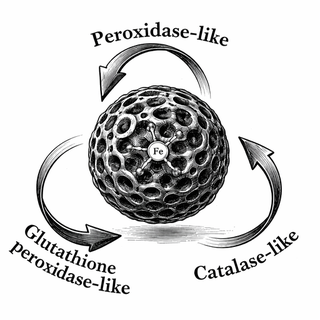
Researchers recently developed a spherical mesoporous iron-based SAzyme (Fe-SAzyme) that attacks this problem from three angles simultaneously. And when I say three, I mean it literally moonlights as three different enzymes at once (DOI: 10.1039/d5nr02953h).
The Triple Enzyme Hustle
Here's where it gets fun. This Fe-SAzyme doesn't just do one thing. It mimics three different enzymes:
Peroxidase-like activity - It converts hydrogen peroxide (H2O2), which tumors tend to overproduce, into highly toxic hydroxyl radicals. This is the offensive weapon, the thing actually doing damage to cancer cells.
Glutathione peroxidase-like activity - Remember that antioxidant sponge? This function oxidizes glutathione into its spent form (GSSG), effectively disarming the tumor's defense system. You can't block ROS if your shield just got melted.
Catalase-like activity - This one converts H2O2 into oxygen. Why does that matter? Tumors are notoriously hypoxic (low oxygen), and that hypoxia actually helps them resist therapy. By generating O2 locally, the nanozyme is remodeling the tumor microenvironment to be less hospitable to cancer.
So to recap: it generates the weapons, disables the shields, and terraforms the battlefield. All at once. From a single iron atom active site on a mesoporous sphere. That's a level of multitasking that would make any project manager weep with envy.
Now Add a Laser
As if triple enzyme activity wasn't enough, the team coated their Fe-SAzyme with PEG (for biocompatibility and stealth in the bloodstream) and TPP (a mitochondria-targeting molecule), then pointed a near-infrared laser at it.
Specifically, they used NIR-II light (the "second near-infrared window," wavelengths around 1000-1700 nm), which penetrates tissue more deeply than shorter wavelengths. Under this irradiation, the Fe-SAzyme converts light energy into heat with exceptional efficiency - that's photothermal therapy (PTT), and it can cook tumor cells directly.
But here's the clever bit: the heat doesn't just kill cells on its own. It also amplifies all three of those catalytic activities. Warmer reaction conditions mean faster catalysis, more ROS, more glutathione depletion, more oxygen production. The photothermal effect and the catalytic therapy don't just coexist - they synergize. It's the nanotechnology equivalent of adding nitrous to an engine that's already turbocharged.
Ferroptosis: Death by Iron
The end result of all this oxidative chaos is a specific type of cell death called ferroptosis. Unlike apoptosis (the tidy, programmed cell death your body uses for housekeeping), ferroptosis is driven by iron-dependent lipid peroxidation. When ROS levels spike and glutathione drops, the lipids in cell membranes start breaking down uncontrollably. The cell essentially rusts from the inside out.
Density functional theory (DFT) calculations - that's quantum chemistry-level modeling - confirmed that the Fe-SAzyme has a low energy barrier for generating hydroxyl radicals and a sustainable cyclic catalytic pathway. Translation: it doesn't just fire once. It keeps going, cycling through its catalytic reactions efficiently, which is exactly what you want for sustained tumor destruction.
Does It Actually Work?
In vitro (cell culture) and in vivo (animal model) experiments showed strong antitumor effects. The PEG modification gave the nanoparticles good biocompatibility, meaning they didn't cause obvious toxicity to healthy tissue. The TPP modification helped direct the nanozyme specifically to mitochondria inside cancer cells, which is particularly nasty for the tumor since mitochondria are already a major source of cellular ROS.
Under NIR-II irradiation, the combination of photothermal therapy and amplified triple catalysis produced significantly better tumor suppression than either approach alone. The synergy was real, not just marketing.
What's Next?
This is still preclinical research, so we're a long way from seeing iron nanozymes in an oncologist's office. The jump from mouse models to human clinical trials involves scaling up manufacturing, conducting extensive toxicology studies, and navigating regulatory pathways that make tax law look breezy.
But the concept is genuinely exciting. A single nanoplatform that simultaneously generates ROS, depletes antioxidant defenses, alleviates tumor hypoxia, provides photothermal therapy, and targets mitochondria? That's a lot of therapeutic mechanisms packed into something measured in nanometers. If even half of those advantages translate to clinical settings, it could represent a meaningful step forward in catalytic tumor therapy.
For now, the Fe-SAzyme joins a growing roster of nanomedicine platforms trying to outsmart cancer's frustratingly robust survival toolkit. And honestly, any particle that can moonlight as three enzymes, a space heater, and a mitochondrial homing missile deserves at least a slow clap.
This blog post discusses research findings and should not be taken as medical advice. If you have concerns about cancer treatment options, please consult a healthcare provider. Research discussed here represents ongoing scientific investigation and clinical validation is still in progress.
All images used in this post are decorative illustrations only and do not represent or reflect the accuracy, reality, or correctness of the referenced research.
Primary Source: NIR-II photothermal-amplified triple catalysis of a spherical mesoporous iron single-atom nanozyme for potentiating ferroptosis-based tumor therapy. Nanoscale. 2025. DOI: 10.1039/d5nr02953h