
Your liver regenerates itself like some kind of biological Wolverine, but if you lose a chunk of it to disease, we can't just print you a new one. Yet. The cells are willing, but the printing technology is weak. And that's the maddening paradox sitting at the heart of modern bioprinting research.
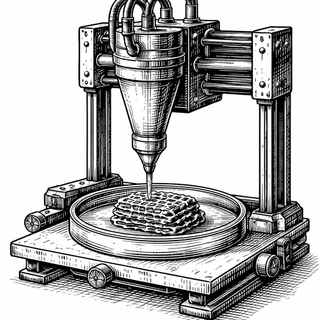
A recent review published in the bioprinting field takes a hard look at why we're still struggling to squeeze living cells through tiny nozzles without turning them into biological smoothies. The answer, it turns out, lies in the printhead - that unassuming component that's basically the bottleneck between our science fiction dreams and our rather mundane reality.
Extrusion Bioprinting: The Pastry Bag Problem
If you've ever piped frosting onto a cake, congratulations - you understand the basic physics of extrusion-based bioprinting. You're forcing a viscous material through a small opening to create precise patterns. Simple enough when you're working with buttercream, but considerably trickier when your "frosting" contains millions of living cells that would prefer not to be traumatized.
Extrusion bioprinting has emerged as the workhorse of the tissue engineering world, and for good reason. It's relatively straightforward, handles a wide range of materials, and can build complex 3D structures layer by layer. But here's where things get sticky (pun absolutely intended): the technology has hit some fundamental walls that no amount of incremental improvement seems to breach.
The review identifies four major headaches keeping bioprinting engineers up at night:
The Viscoelasticity Cage: Not all biological materials play nice with current printheads. You need your bioink to flow when pushed but hold its shape when deposited - a Goldilocks zone that excludes a lot of potentially useful materials.
The Multi-Material Mess: Want to print a structure with different cell types and support materials? Current systems make switching between materials about as efficient as changing tires during a Formula 1 race - technically possible, but painfully slow.
The Resolution Riddle: We can print structures, sure, but achieving the fine detail needed for truly functional tissue remains elusive. It's like trying to paint the Mona Lisa with a house brush.
The Speed vs. Survival Standoff: Here's the real kicker. Push cells through a nozzle faster, and you get better throughput. Push them too fast, and you get dead cells. It's the bioprinting equivalent of the speed limit - nobody wants to follow it, but ignore it at your peril.
Why the Printhead Is the Whole Enchilada
The review makes a compelling case that the printhead isn't just another component - it's THE component. Think of it this way: you can have the world's best bioink recipe and the most sophisticated motion control system, but if your printhead design is mediocre, you're still making mediocre tissues.
Current printhead designs have evolved considerably from their early iterations, incorporating features like temperature control, coaxial nozzles for creating core-shell structures, and pneumatic versus mechanical actuation systems. But the authors argue we're approaching the ceiling of what these designs can achieve.
What's needed, they suggest, is a fundamental rethinking of how printheads work. Not just incremental tweaks to existing designs, but genuinely novel approaches that address the core trade-offs rather than just shifting them around.
The Wish List: Where Printhead Design Needs to Go
The research community has identified several directions that next-generation printheads might take. These aren't pie-in-the-sky concepts - they're engineering challenges with potential solutions, waiting for someone to crack them.
Adaptive Flow Control: Imagine a printhead that could sense the properties of the bioink in real-time and adjust its parameters accordingly. Current systems are largely "set it and forget it," which works fine until your bioink decides to behave differently halfway through a print.
Gentler Delivery Mechanisms: The mechanical forces cells experience during extrusion are like being squeezed through a drinking straw at highway speeds. Novel approaches might use acoustic waves, magnetic fields, or other mechanisms to move cells without the mechanical trauma.
True Multi-Material Integration: Rather than switching between materials sequentially, future printheads might be able to blend and deposit multiple materials simultaneously, creating gradients and transitions that better mimic natural tissue architecture.
Microscale Precision: Achieving cellular-level resolution would open doors to printing truly functional microvasculature - the tiny blood vessels that remain one of bioprinting's great unsolved problems.
The Clinical Horizon
Let's be clear-eyed about where we stand. Nobody is printing transplantable organs tomorrow, or likely next year. The regulatory pathway alone for such technologies is a marathon, not a sprint. But the incremental progress in printhead design is enabling applications that seemed impossible a decade ago.
Research groups are successfully printing skin grafts, cartilage patches, and bone scaffolds that are already finding their way into clinical trials. These "low-hanging fruit" applications don't require the vascular complexity of solid organs, making them achievable with current technology while serving as proving grounds for more ambitious work.
The real excitement lies in what becomes possible when the next generation of printheads arrives. Structures that are currently unattainable - the review uses exactly this phrase - might suddenly become routine. And that's when bioprinting transforms from an interesting research tool into a genuine clinical capability.
The Engineering Reality Check
Here's where my engineering skepticism kicks in. Every few years, bioprinting gets hyped as being "just around the corner" from producing transplantable organs. The reality is more nuanced. We're making genuine progress, but the problems are genuinely hard.
The biological complexity of living tissue is staggering. Every cell needs nutrients, oxygen, and waste removal. Every tissue has a specific architecture that took millions of years of evolution to optimize. Replicating that with a machine - even a very sophisticated machine - is not a trivial exercise.
But that's precisely why work on printhead design matters. By addressing the fundamental engineering constraints at the point of deposition, researchers are laying the groundwork for the breakthroughs that will eventually make complex tissue fabrication possible.
What Comes Next
The review serves as both a progress report and a roadmap. It catalogues the clever solutions engineers have developed for extrusion bioprinting while honestly acknowledging where those solutions fall short. More importantly, it points toward specific technical directions that could overcome current limitations.
For those of us watching from the medical device industry, the takeaway is cautiously optimistic. Bioprinting isn't ready for prime time in most clinical applications, but the trajectory is encouraging. The focus on printhead innovation suggests the field is maturing - moving from "can we make it work at all?" to "how do we make it work well enough to matter?"
And that shift, boring as it might seem, is often where real progress happens. Not in the flashy demonstrations, but in the quiet work of making technology reliable, reproducible, and scalable. One carefully designed nozzle at a time.
This blog post discusses research findings and should not be taken as medical advice. If you have concerns about tissue engineering or regenerative medicine options, please consult a healthcare provider. Research discussed here represents ongoing scientific investigation and clinical validation is still in progress.
All images used in this post are decorative illustrations only and do not represent or reflect the accuracy, reality, or correctness of the referenced research.
Primary Source: Advances in extrusion-based bioprinting enabled by advanced printhead and nozzle designs. PubMed. 2025. DOI: https://pubmed.ncbi.nlm.nih.gov/41769382/