
Things are about to get weird: a new cancer-biomarker test takes one microliter of whole blood, runs it through a lateral flow strip, and reads the result by measuring gas pressure. Not color. Not fluorescence. Pressure. Somewhere, a balloon animal at a children’s party has just become a diagnostic metaphor.
The research, titled “An integrated pressure-based lateral flow immunoassay for microliter whole-blood AFP detection at the point of care,” describes a portable testing platform for alpha-fetoprotein, or AFP, a biomarker widely used in hepatocellular carcinoma care. Hepatocellular carcinoma, the most common primary liver cancer, is not famous for being polite. It often develops in people with chronic liver disease, may remain quiet for too long, and then expects clinicians to sort out a very high-stakes problem with imperfect tools. Medicine, as usual, has brought a clipboard to a knife fight.
Why AFP Still Matters
AFP is a protein produced during fetal development. In adults, elevated AFP can appear in several contexts, but one of its best-known clinical uses is in the diagnosis and postoperative surveillance of hepatocellular carcinoma. It is not a perfect marker. No biomarker is. If biomarkers had personalities, many would be brilliant but unreliable consultants who answer every question with “it depends.”
Still, AFP remains useful because it can help clinicians monitor disease activity, recurrence risk, and treatment response when interpreted alongside imaging, history, liver disease status, and the rest of the clinical picture. The catch is that AFP testing usually depends on centralized laboratories, equipment-heavy assays, and sample processing. That is fine if you live near a well-resourced medical center and can get blood drawn without rearranging your life. It is less fine if testing needs to happen at the bedside, in a community clinic, in a low-resource setting, or eventually at home.
This is where the new device tries to make itself useful.
A Lateral Flow Test With a Pressure Gauge
Most people met lateral flow assays during the COVID era, when the humble test strip briefly became a household oracle. The basic idea is straightforward: a liquid sample moves along a strip, meets antibodies or binding reagents, and produces a detectable signal if the target molecule is present.
Traditional lateral flow tests often rely on visual or optical readouts. That can be convenient, but optical signals can struggle with whole blood, especially when the sample itself is visually messy. Blood is biologically wonderful and optically rude. It contains cells, pigments, proteins, and enough matrix complexity to make any clean laboratory diagram feel personally betrayed.
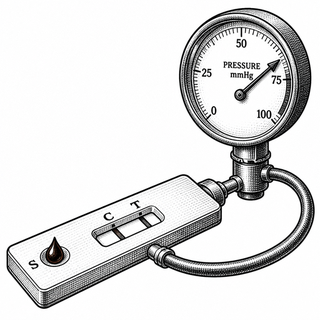
The platform in this paper, called PM-LFIA, combines a lateral flow immunoassay with a portable pressure meter. Instead of depending on color intensity alone, it uses nanozyme-catalyzed gas generation. In simpler terms: the test chemistry generates gas in proportion to the target biomarker signal, and the device quantifies the resulting pressure. The more AFP captured by the assay, the more measurable pressure change occurs.
That is an elegant bit of diagnostic judo. Rather than asking the device to squint at a tiny optical signal through whole blood interference, the system translates the molecular event into pressure, which can be easier to measure robustly with a portable device.
One Microliter, Thirty Minutes
The headline-grabbing number is the sample volume: 1 microliter of unprocessed whole blood. For context, a microliter is a thousandth of a milliliter. It is less “blood draw” and more “the amount a mosquito would consider a light snack.”
According to the study summary, the PM-LFIA platform achieved AFP detection from this tiny whole-blood sample within 30 minutes. Compared with conventional methods, it required 35-fold less sample volume and improved the detection limit by 215-fold.
Those are not small claims. A lower sample volume matters for patients who are difficult to draw from, for repeated monitoring, for pediatric or frail populations, and for settings where sample handling is limited. A better detection limit could matter if clinicians need to detect low concentrations more reliably, although the clinical value depends on how the assay performs across real patient populations and decision thresholds.
The authors also tested the device on 30 whole-blood samples and found that the results were consistent with hospital-based measurements. Thirty samples is not a final clinical validation, but it is a meaningful early feasibility step. In medicine, “promising in 30 samples” is the beginning of the conversation, not the victory parade. The confetti stays in the closet for now.
Why Whole Blood Is a Big Deal
Many assays prefer serum or plasma, which usually means collecting blood, processing it, and separating components before testing. That workflow is manageable in a hospital laboratory. It is less appealing for point-of-care testing, where simplicity is not a luxury but the entire point.
Whole-blood testing cuts out sample pretreatment. That can reduce time, equipment needs, training burden, and opportunities for error. It also makes the test more plausible for decentralized use. A test that works only after centrifugation and careful handling may be excellent science, but it is not exactly begging to be used in a rural clinic, an emergency department hallway, or a home monitoring setup.
The PM-LFIA approach is interesting because it tackles two problems at once: small sample volume and whole-blood interference. The pressure-based readout helps sidestep some optical problems, while the integrated format keeps the device practical.
Beyond AFP
The paper also reports applicability to other cancer biomarkers, including CEA and CA199. CEA, or carcinoembryonic antigen, is used in several cancer contexts, especially colorectal cancer surveillance. CA199 is commonly associated with pancreaticobiliary malignancies, among other uses. Like AFP, these biomarkers are clinically useful only when interpreted carefully. Biomarkers are not fortune tellers; they are clues with lab coats.
Still, the ability to adapt the platform beyond AFP is valuable. If the underlying method can be tuned for multiple targets, pressure-based lateral flow assays could become a broader point-of-care platform rather than a one-biomarker novelty. That would be the difference between inventing a clever kitchen gadget and inventing a new appliance category.
The Catch, Because There Is Always a Catch
The authors note that environmental sensitivity and device calibration remain challenges. That matters. Pressure readings can be affected by temperature, sealing, device mechanics, reagent consistency, and real-world handling conditions. A test that behaves beautifully under controlled conditions still has to survive the casual violence of clinical reality: rushed staff, variable storage, imperfect sampling, different hematocrit levels, and someone inevitably placing the device next to a coffee cup.
Calibration is another serious issue. Quantitative tests need reproducibility. If the output is going to guide clinical thinking, it cannot be merely clever. It has to be boringly reliable. In diagnostics, boring is a compliment.
There is also the broader question of clinical utility. Better analytical sensitivity does not automatically mean better outcomes. Future studies would need to show how this platform performs in larger and more diverse populations, across relevant AFP ranges, in patients with liver disease, cancer, postoperative surveillance needs, and potentially confounding conditions.
Why This Is Worth Watching
This research is compelling because it addresses a real bottleneck in cancer biomarker testing: how to move quantitative measurement closer to the patient without dragging the entire laboratory along for the ride. A portable pressure-meter lateral flow assay that uses a single microliter of unprocessed whole blood is not just a smaller test. It is a different way of thinking about signal readout.
If follow-up development succeeds, this kind of platform could support point-of-care testing in clinics, surveillance programs, resource-limited settings, or eventually home-based monitoring. That last possibility should be treated carefully, since home cancer biomarker testing raises questions about interpretation, anxiety, false positives, false negatives, and clinical follow-up. The last thing anyone needs is a bathroom-counter device that produces existential dread before breakfast.
But as a technology concept, PM-LFIA is clever. It takes a familiar testing format, adds pressure-based quantification, and reduces reliance on sample processing and optical clarity. It is the kind of incremental-looking innovation that may have larger consequences if it proves durable.
For patients with hepatocellular carcinoma, surveillance and follow-up are long games. Tools that make testing faster, smaller, and more accessible could matter, especially when paired with clinical judgment and appropriate imaging. The liver may be a notoriously stoic organ, but our diagnostics do not have to be equally silent.
This blog post discusses research findings and should not be taken as medical advice. If you have concerns about liver cancer, hepatocellular carcinoma, abnormal AFP results, or cancer surveillance, please consult a healthcare provider. Research discussed here represents ongoing scientific investigation and clinical validation is still in progress.
All images used in this post are decorative illustrations only and do not represent or reflect the accuracy, reality, or correctness of the referenced research.
Primary Source: “An integrated pressure-based lateral flow immunoassay for microliter whole-blood AFP detection at the point of care.” PubMed. 2026. PubMed: 41610743