
Once upon a time in a lab not so far away, a tiny ring of light decided it had had enough of expensive, complicated biosensing setups. Instead of demanding a giant optical bench and the emotional support of three postdocs, it said: what if I could help detect alpha-fetoprotein using a simpler, lower-cost method? That is, roughly speaking, the delightful premise behind a new electrical tracking-assisted cascaded microring biosensor for alpha-fetoprotein detection.
And yes, “cascaded microring biosensor” sounds like something you would find in a sci-fi vending machine. But stay with me, because this is one of those papers where the engineering idea is both elegant and sneakily practical.
The Biomarker: Alpha-Fetoprotein, the Tiny Signal With Clinical Weight
Alpha-fetoprotein, or AFP, is a protein that shows up in medical testing for several reasons. It is naturally high during fetal development, but in adults, elevated AFP can be associated with certain diseases, including liver cancer and some germ cell tumors. Clinicians do not interpret AFP in isolation, of course. Biology loves context, probably because it has never had to fill out paperwork. Still, AFP is a familiar biomarker in diagnostic and monitoring workflows.
The challenge is that biomarker detection needs to be sensitive, reliable, and ideally fast. Traditional assays can work very well, but they may require labeling steps, reagents, trained operators, or lab infrastructure. That is where label-free optical biosensors get exciting: they can detect binding events directly, often by sensing tiny changes in refractive index when molecules attach to a functionalized surface.
Translation: when AFP binds to its matching capture probe, the sensor “feels” that molecular handshake through a change in how light behaves.
Meet the Microring: A Racetrack for Light
A microring resonator is basically a microscopic loop that light can circulate through. Certain wavelengths resonate inside the ring, kind of like how certain notes ring out in a wine glass if you hit the right pitch. When molecules bind to the surface near the ring, they change the local refractive index, which shifts the optical resonance.
That shift is the signal.
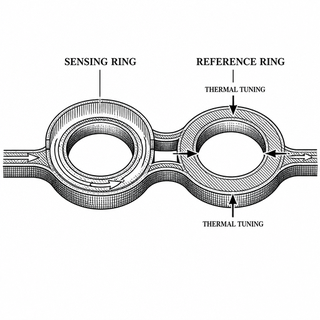
In this study, the researchers used a cascaded microring structure made of two rings: a sensing ring and a reference ring. The sensing ring had its upper cladding removed so the waveguide surface could be functionalized with AFP-specific capture probes. That exposed surface is where the biological action happens.
The reference ring, meanwhile, gets heated. Not because the ring is having a spa day, but because thermal tuning allows the system to track spectral changes electrically.
Wait, it gets better.
The Problem With Intensity Detection
Many optical biosensors track spectral shifts using relatively sophisticated equipment. That can be powerful, but cost and complexity are not exactly friends of point-of-care testing. The authors focused on intensity-based detection, which can use a simpler setup: a broadband light source, a fixed-bandwidth filter, an optical power meter, and a current source meter.
That sounds beautifully practical. But intensity-based detection has a catch: the linear detection range can be narrow. If the resonance shift moves too far outside the useful part of the optical response curve, the measurement becomes less reliable. It is like trying to weigh yourself on a bathroom scale that only works between 142 and 146 pounds. Great, unless life happens.
The electrical tracking scheme tackles that limitation by heating the reference ring to follow spectral changes. Instead of letting the signal wander out of the useful range, the system actively tracks it. This keeps the detection method low-cost while improving the usable measurement range.
That is the kind of engineering compromise I love: not “buy a more expensive instrument,” but “make the clever part smarter.”
So, How Well Did It Work?
The sensor was tested in two main ways: refractive index sensing using saline solutions and biosensing using AFP antigen-antibody binding.
For refractive index sensing, the reported sensitivity was 9475.5 mW/RIU. RIU stands for refractive index unit, which is the standard way to describe how strongly an optical sensor responds to changes in refractive index. Big response per tiny change is the name of the game.
For AFP detection, the sensor covered concentrations from 1 ng/mL to 1 μg/mL. Within that broader range, it showed a linear range from 8 to 64 ng/mL. The limit of detection was 2.86 ng/mL.
Those numbers matter because AFP assays commonly deal with clinically relevant concentration ranges, and getting into low-ng/mL territory is not trivial. A label-free sensor that can detect AFP at these levels using a comparatively simple optical setup is very much worth paying attention to.
Why This Is Actually Pretty Exciting
The big appeal here is not just that the sensor detects AFP. Plenty of systems can detect biomarkers. The interesting part is the combination of features:
It is label-free, meaning no fluorescent tags or extra labels are needed to see the binding event.
It supports real-time detection, which is useful when you want to monitor binding as it happens instead of waiting for a final endpoint.
It uses an intensity-based readout, which can be simpler and cheaper than full spectral interrogation.
It adds electrical tracking to overcome one of intensity detection’s usual weaknesses.
That last point is the little engineering flourish that makes the paper pop. The researchers are not simply saying, “Here is a microring sensor.” They are saying, “Here is a microring sensor with a built-in way to keep the measurement useful over a wider range without making the instrument dramatically more expensive.”
A tiny ring that knows how to stay on task. Honestly, relatable.
The Bigger Picture: Toward Practical Biosensing Platforms
If follow-up development succeeds, this kind of approach could help push optical biosensors closer to portable or point-of-care use. AFP is one target, but the same broad strategy could potentially be adapted for other biomarkers, including antigens and nucleic acids, as long as the sensor surface can be functionalized with the right capture probes.
That flexibility is where microring platforms get especially tempting. Swap the molecular recognition layer, tune the surface chemistry, validate the assay, and you may be able to point the same core technology at a different biological target.
Of course, “may be able to” is doing real work there. Biosensors are notorious for behaving beautifully in controlled experiments and then getting moody in real-world samples, where serum proteins, nonspecific binding, temperature shifts, and matrix effects all show up like uninvited guests at a very expensive dinner party.
Future work would need to show performance in complex clinical samples, long-term stability, reproducibility across devices, and clear comparisons with established AFP testing methods. Manufacturing consistency also matters. A sensor that works once is a cool demo. A sensor that works the same way across hundreds or thousands of chips is a product.
Why I Can’t Stop Thinking About It
What makes this study compelling is that it sits at the intersection of photonics, biosensing, and practical instrument design. It is not just a molecular detection story. It is a “how do we make sensitive detection cheaper and more usable?” story.
That is the part that feels quietly important for diagnostics. The future of biomarker testing is not only about finding new biomarkers. It is also about building systems that can measure known biomarkers faster, closer to the patient, and with fewer barriers.
This electrical tracking-assisted cascaded microring biosensor is a small device with a very specific job: detect AFP binding through optical changes while using electrical tuning to keep the readout useful. But the idea behind it feels bigger. It suggests a path toward compact optical biosensors that are not trapped inside high-end lab setups.
And for a microscopic ring of light, that is a pretty dramatic career arc.
This blog post discusses research findings and should not be taken as medical advice. If you have concerns about AFP levels, liver disease, cancer screening, or related conditions, please consult a healthcare provider. Research discussed here represents ongoing scientific investigation and clinical validation is still in progress.
All images used in this post are decorative illustrations only and do not represent or reflect the accuracy, reality, or correctness of the referenced research.
Primary Source: Electrical tracking-assisted cascaded microring biosensor for alpha-fetoprotein detection. PubMed Record ID 42070445. PubMed: https://pubmed.ncbi.nlm.nih.gov/42070445/