
What your doctor wishes they could tell you is this: for type 1 diabetes, we have become remarkably good at managing the problem without yet fully fixing it. Modern insulin keeps people alive and often thriving, but it can still feel like trying to conduct a symphony with oven mitts on - possible, admirable, and exhausting. The research behind islet encapsulation aims at a more elegant trick: replacing the insulin-making cells and sheltering them from the immune system that caused trouble in the first place.
That, in a nutshell, is why this recent PubMed review on type 1 diabetes and islet encapsulation is such an intriguing read. It takes the long view, from the early milestones of islet transplantation to today’s bioengineered capsules and materials designed to help transplanted cells survive and function. For an old academic like me, this is catnip. Medicine advances in bursts, but the best ideas often have very old roots.
The stubborn problem in type 1 diabetes
Type 1 diabetes happens when the body can no longer produce enough insulin because the insulin-making beta cells in the pancreas are destroyed. Without insulin, glucose builds up in the bloodstream instead of being properly ushered into cells for energy. Patients then have to do, by hand and by vigilance, what the pancreas once managed quietly in the background.
That is no small burden. Even with better insulin formulations, pumps, continuous glucose monitors, and increasingly clever software, treatment remains demanding. Blood sugar can swing too high or drop too low. Hypoglycemia is not just inconvenient - it can be frightening and dangerous. Quality of life can suffer simply because the body has turned routine metabolism into a full-time administrative job.
So naturally, scientists asked a sensible question: why not replace the missing insulin-producing cells?
Islet transplantation: a brilliant idea with a familiar obstacle
The pancreatic islets contain the cells that produce insulin. Transplanting healthy islets into someone with type 1 diabetes is, conceptually, rather beautiful. Instead of delivering insulin from the outside, one hopes to restore the body’s own ability to sense glucose and respond in real time.
And indeed, clinical islet transplantation has shown that this can work.
The trouble, as so often in biology, is that the immune system reads from a very strict guest list. Transplanted islets are often recognized as foreign and attacked. They may also suffer damage from inflammation and from inadequate oxygen supply - hypoxia - after transplantation. So although the concept is elegant, the execution has been limited by rapid immune rejection and destruction of the transplanted cells.
If you have spent any time in immunology, this will not surprise you. The immune system is a marvelous defense mechanism, but it can be a ghastly host.
The big idea: protect the cells without smothering them
This is where islet encapsulation enters the story.
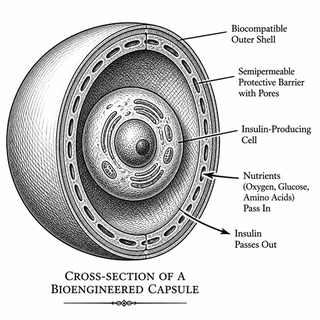
Encapsulation uses biomaterials to create a protective barrier around transplanted islets. The capsule is meant to allow small, life-sustaining molecules such as oxygen, nutrients, glucose, and insulin to pass through, while blocking the immune cells and factors that would otherwise attack the graft.
In plain English, researchers are trying to build a tiny fortress for insulin-producing cells - one with excellent plumbing, decent ventilation, and very selective door policy.
That barrier does more than fend off immune rejection. A well-designed encapsulation system can also provide a friendlier microenvironment for the islets themselves, improving their survival and performance. This matters because transplanted cells are delicate creatures. They need oxygen, structural support, and a surrounding material that does not provoke excessive inflammation or fibrosis.
Why biomaterials have become the star of the show
The review describes what it calls a paradigm shift toward biomaterial-based islet transplantation therapy. That phrase may sound a bit polished for polite company, but the meaning is straightforward. Researchers have recognized that simply transplanting cells is not enough. The material surrounding those cells can determine whether the therapy flourishes or fizzles.
Modern biomaterials are being designed with several goals in mind:
- Reduce or prevent immune rejection
- Improve oxygen delivery and reduce hypoxia
- Support islet viability and function
- Make the therapy practical enough for clinical use
This is where the field becomes especially lively. Bioengineering now allows scientists to tune the size, composition, permeability, and mechanical properties of encapsulation devices. Some systems use microcapsules around individual or small clusters of islets. Others use larger implantable devices that house many cells at once. Each approach has trade-offs in immune protection, oxygenation, retrievability, and scalability.
And there is the rub - because in medicine, every solution arrives carrying two new problems and a committee meeting.
Why this review matters now
What makes this review timely is not merely that encapsulation exists as an idea. It is that the field is inching toward clinically translatable therapy. That is the phrase researchers use when they are trying to move from elegant bench science to something a physician might realistically offer patients.
That transition is notoriously difficult. A treatment may work in a dish, then in animals, then stumble in humans because human biology is messier, longer-lived, and less inclined to cooperate with conference slides.
For islet encapsulation, the practical hurdles are substantial. The material must be biocompatible. The device must not trigger scarring that walls it off from nutrients. The enclosed cells must receive enough oxygen. Insulin must diffuse out fast enough to help control blood sugar effectively. The implant must also be safe, durable, and manufacturable at scale. One does not build a medical revolution out of good intentions and a pipette.
Still, the momentum is real. The review suggests that the accumulated knowledge from transplantation science and advanced biomaterials is beginning to converge. That is often how progress happens - not as a thunderclap, but as several stubborn disciplines finally agreeing to sit at the same table.
The patient impact, if this works
If encapsulated islet transplantation ultimately succeeds in routine care, the implications could be considerable.
The ideal outcome would not merely be fewer injections. It could mean more stable glucose control, fewer dangerous lows, and a life less dominated by constant calculation. Patients with type 1 diabetes already perform a quiet heroic labor every day. A functioning cell-based therapy might hand some of that labor back to biology, where it belonged all along.
That said, one should be careful not to oversell. This review is about the state of the science and the engineering pathway forward, not a declaration that the problem is solved. The history of diabetes research is full of hopeful milestones, some transformative and some humbling. Anyone who has watched medicine for long enough learns to welcome progress with optimism and a raised eyebrow.
A long historical arc - and a reason for guarded hope
One of the pleasures of this paper is its historical perspective. That matters. Scientific fields can look chaotic up close, but over decades they reveal a pattern. First comes the big idea. Then the early failures. Then better tools. Then a period when everyone realizes the first version was far too simple. After that, if one is lucky and persistent, the technology matures.
Islet encapsulation appears to be in that maturing phase.
Researchers are no longer asking only, "Can we transplant islets?" They are asking, "What material should surround them? How do we optimize oxygen supply? How do we prevent immune attack without harming function? How do we make this reliable enough for real patients?" Those are the right questions. They are less glamorous than the original dream, perhaps, but much more likely to get us somewhere useful.
And as a veteran of many scientific fashions, I confess I find that encouraging. The flashy miracle cures often vanish like summer tourists. The therapies that last are usually the ones built by patient people solving stubborn, unromantic problems one by one.
The takeaway
This review captures a field that has moved beyond wishful thinking into careful engineering. Type 1 diabetes remains a difficult condition to manage, even with all the modern tools we rightly celebrate. Islet transplantation offered a tantalizing route toward restoring natural insulin production, but immune rejection and poor cell survival stood in the way.
Encapsulation, using advanced biomaterials, may be one of the best attempts yet to overcome those barriers. By protecting islets while preserving their ability to sense glucose and release insulin, researchers are trying to turn a compelling concept into a workable therapy.
It is not a cure on the clinic shelf tomorrow morning. But it is the sort of progress that deserves attention - thoughtful, technically sophisticated, and grounded in a very human need: making life with type 1 diabetes less burdensome.
This blog post discusses research findings and should not be taken as medical advice. If you have concerns about type 1 diabetes, please consult a healthcare provider. Research discussed here represents ongoing scientific investigation and clinical validation is still in progress.
All images used in this post are decorative illustrations only and do not represent or reflect the accuracy, reality, or correctness of the referenced research.
Primary Source: Type 1 Diabetes and Islet Encapsulation: From Historical Milestones to Cutting-Edge Advances. PubMed record 41609637. Available at: https://pubmed.ncbi.nlm.nih.gov/41609637/