
If you've ever watched a wet paper towel somehow become both floppy and weirdly hard to tear, you already understand the basic principle behind this research. Materials can be soft, wet, and surprisingly stubborn at the same time. Hydrogels live in that same squishy neighborhood: mostly water, often flexible, occasionally useful, and sometimes as mechanically disappointing as a grocery bag in a rainstorm.
A new PubMed-indexed study, “Chemically modified bacterial cellulose-mediated fiber salting-out method for preparing tough hydrogels,” tackles one of the classic hydrogel headaches: how do you make a gel that is both strong and stretchy without turning it into either pudding or packing tape?
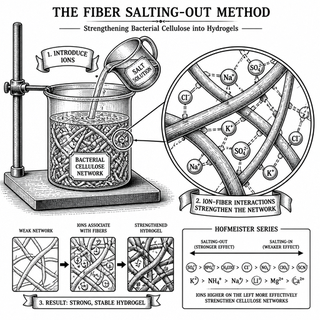
The answer proposed here involves bacterial cellulose, polyvinyl alcohol, chemical modification, and something called the Hofmeister series. That last phrase sounds like a villainous dynasty in a chemistry-themed board game, but it is actually a long-studied ranking of ions based on how they affect proteins, polymers, and water interactions.
Let’s pump the brakes before declaring victory for the future of soft biomaterials. This is promising materials science, not a ready-made medical implant. Still, the strategy is genuinely interesting.
Why Hydrogels Are So Hard to Get Right
Hydrogels are networks of polymer chains that hold a lot of water. That water-rich structure makes them appealing for biomedical uses, including wound dressings, tissue engineering scaffolds, drug delivery systems, wearable sensors, and soft robotics. They can feel more like living tissue than dry plastics do, which is useful when the thing you are designing may touch skin, tissue, or fluid-filled biological environments.
But mechanically, hydrogels can be fussy.
Make them too soft, and they tear easily. Make them too reinforced, and they may lose the stretchiness that made them useful in the first place. This is the biomaterials version of packing for a trip and somehow bringing both too much and not enough.
Bacterial cellulose has attracted attention because it forms fine, strong fiber networks. Unlike plant cellulose, bacterial cellulose can be produced by microbes in highly pure, nanoscale fibrous mats. It is strong, biocompatible in many contexts, and useful as a reinforcing material. In hydrogel design, it can act like microscopic rebar.
The problem is dosage and compatibility. Too little bacterial cellulose may not strengthen the gel enough. Too much may make the hydrogel less able to stretch. Reinforcement is not automatically improvement. Add enough steel rods to a trampoline and congratulations, you have invented a floor.
What This Study Tried
The researchers developed what they call a fiber salting-out method to prepare bacterial cellulose/polyvinyl alcohol hydrogels. Polyvinyl alcohol, or PVA, is a widely used synthetic polymer known for forming hydrogels with good film-forming and water-compatible properties.
The twist is that the bacterial cellulose was chemically modified using ions associated with the Hofmeister series, including carboxylate groups described in the abstract. The point of this modification appears to be improving how bacterial cellulose interacts with the PVA network and water, helping the fibers contribute to strength without destroying stretch.
In plain English: instead of just dumping cellulose fibers into a gel and hoping everyone gets along, the researchers tried to tune the fibers’ chemistry so the whole material behaves more cooperatively.
That is a sensible strategy. Composite hydrogels often fail not because the reinforcing material is weak, but because the ingredients do not transfer stress well across their interfaces. If the cellulose and polymer network do not “talk” mechanically, the gel may still rip, stiffen awkwardly, or lose elasticity.
The Salting-Out Idea, Without the Chemistry Fog Machine
“Salting out” usually refers to changing solubility or polymer interactions by adding salts. Different ions influence how water organizes around molecules and how polymers associate with each other. The Hofmeister series is one way chemists classify those ion effects.
In this study’s context, the salting-out concept is used around modified bacterial cellulose fibers to help build a tougher hydrogel network. The idea is that ion-mediated interactions can promote stronger physical associations between the cellulose fibers and PVA.
That matters because tough hydrogels need more than strength. They need ways to dissipate energy. When stretched or compressed, the network should absorb stress without immediately snapping. Good tough gels often use sacrificial bonds or reversible interactions that break and reform, spreading damage around instead of letting one crack sprint through the material like it has a dinner reservation.
The abstract suggests the researchers were aiming at exactly this balance: high strength and toughness after incorporating bacterial cellulose, while avoiding the usual tradeoff where too much cellulose reduces elongation.
What Makes This Interesting
The most interesting part is not simply “stronger hydrogel.” That phrase gets tossed around a lot in materials papers, sometimes with the enthusiasm of a protein powder ad.
The more compelling piece is the attempt to solve a known design tension: bacterial cellulose can improve strength, but it can also make gels less stretchable. A chemical modification strategy that helps preserve both properties could be useful across several fields.
Potential applications could include:
- Flexible wound dressings that resist tearing during movement
- Tissue scaffolds that need softness plus mechanical integrity
- Stretchable biosensors or wearable materials
- Soft robotics components that survive repeated deformation
- Water-rich structural materials where durability matters
Those are plausible directions, not guaranteed outcomes. A hydrogel that performs well in a lab test still has a long road before it becomes a medical product. Sterilization, long-term stability, manufacturing consistency, cytotoxicity, degradation behavior, regulatory testing, and real-world handling all have to show up to the party. They are not glamorous guests, but they determine whether the party actually happens.
Where We Should Be Skeptical
This is where the brakes come in.
The abstract tells us the method was developed and frames it as a solution to the strength-toughness problem in bacterial cellulose/PVA hydrogels. That is encouraging, but we do not have enough detail here to judge how broadly the results apply.
Key questions include:
- How much did strength improve compared with unmodified bacterial cellulose hydrogels?
- Was toughness measured under realistic wet conditions over time?
- How did the gels behave after repeated stretching or compression?
- Did the modification affect biocompatibility?
- Are the ions or chemical groups stable during washing, storage, or use?
- Can the method scale beyond carefully prepared lab samples?
These are not nitpicks. Hydrogels are notorious for behaving beautifully in one test and sulking in another. A material can ace tensile strength and still fail under fatigue, swelling, sterilization, or handling. Biomaterials do not get extra credit for being charming in a graph.
The use of bacterial cellulose is a methodological strength because it is a well-regarded reinforcing material with a meaningful nanoscale fiber structure. The focus on ion-mediated chemistry is also thoughtful, since interface engineering is often where composite materials succeed or fail. But until full mechanical data, durability testing, and biological performance are clear, this should be viewed as an intriguing platform rather than a finished solution.
Why This Could Matter Later
If follow-up studies confirm that this fiber salting-out approach reliably improves both toughness and extensibility, it could help expand the design space for water-rich materials. That is valuable because many biomedical and wearable technologies need materials that are not just strong in a dry, rigid sense, but resilient while wet, flexible, and repeatedly stressed.
A tough hydrogel that can bend, stretch, and resist tearing could be useful anywhere a material needs to behave less like plastic and more like tissue. That is the dream, anyway. The nightmare is a gel that looks great on day one and turns into sad jelly by day seven.
The real test will be whether this chemistry can be tuned, reproduced, and validated in application-specific settings. A wound dressing does not need the same mechanical profile as a cartilage scaffold. A wearable sensor does not face the same environment as an implantable material. Toughness is not one number. It is a whole personality profile.
The Bottom Line
This study offers a clever materials-engineering approach to a real hydrogel problem: bacterial cellulose can toughen gels, but balancing strength and stretch remains difficult. By chemically modifying bacterial cellulose and using a fiber salting-out method with PVA, the researchers propose a way to improve that balance.
That is worth paying attention to. It is also worth not getting carried away. The work sounds like a strong step in hydrogel design, but the clinical or commercial meaning depends on details beyond the abstract: reproducibility, long-term durability, safety, scalability, and performance in messy real-world conditions.
For now, this is promising bench science with a good idea at its core. The hydrogel may be tougher, but the claim still needs to survive the toughest material of all: follow-up evidence.
This blog post discusses research findings and should not be taken as medical advice. If you have concerns about biomaterials, wound care, implants, or related medical treatments, please consult a healthcare provider. Research discussed here represents ongoing scientific investigation and clinical validation is still in progress.
All images used in this post are decorative illustrations only and do not represent or reflect the accuracy, reality, or correctness of the referenced research.
Primary Source: Chemically modified bacterial cellulose-mediated fiber salting-out method for preparing tough hydrogels. PubMed Record ID 41713990. https://pubmed.ncbi.nlm.nih.gov/41713990/