
Dear osteoporotic spine, we need to talk.
You are doing your best. Truly. You have held people upright through decades of groceries, grandchildren, stairs, gardening, questionable lifting technique, and that one mattress that should have been replaced during the previous presidential administration. But when osteoporosis thins the bone, spinal screws can start behaving less like dependable hardware and more like a wall anchor in drywall that has seen too much drama.
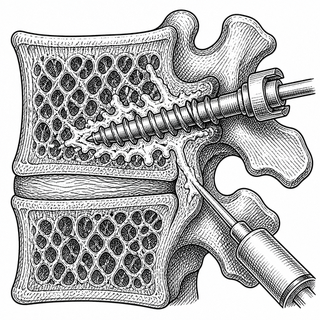
That is the clinical problem behind a new preclinical study on an injectable calcium phosphate nanocomposite, or CPN, designed to improve spinal screw fixation in osteoporotic bone. The researchers tested whether this material could provide both immediate mechanical support and longer-term biological integration in an osteoporosis sheep model.
That combination matters. In spine surgery, especially for patients with osteoporosis, surgeons are often trying to solve two problems at once: get the screw to hold today, and help the bone accept the implant over time. One is engineering. The other is biology. Ideally, you want both to show up to the same meeting.
Why Spinal Screws Struggle in Osteoporosis
Osteoporosis reduces bone density and changes bone architecture. To the naked eye, bone may still look sturdy, but under the microscope it can resemble a building with too many missing support beams. In spinal fusion or fixation procedures, screws need firm purchase in the vertebrae. If the bone is weak, screws may loosen, pull out, or fail to provide the stable support needed for healing.
Clinically, that can mean pain, revision surgery, delayed recovery, or a fixation construct that simply does not behave as planned. Nobody wants to hear that the hardware meant to stabilize the spine is now negotiating terms with gravity.
To improve fixation, surgeons may use augmentation materials. Two common categories are polymethyl methacrylate, better known as PMMA, and calcium phosphate cement, or CPC.
PMMA is strong and widely used, but it is biologically inert and does not remodel into bone. It can also generate heat as it cures, which is not exactly the kind of spa treatment surrounding tissue asked for. CPC is more bone-friendly and resembles mineral components of bone, but it may not provide enough mechanical strength in demanding fixation settings.
So the question becomes: can a material act more like a good houseguest? Strong when needed, biologically polite, and willing to gradually make room for new bone?
Enter the Calcium Phosphate Nanocomposite
The study evaluated an injectable calcium phosphate nanocomposite meant to balance mechanical strength with osseointegration, the process by which bone grows onto and around an implant.
In laboratory testing, CPN showed substantially stronger compression performance than conventional calcium phosphate cement. Its compressive strength was reported at 58.2 MPa, compared with 15.0 MPa for CPC. That is not a subtle difference. In bench-top terms, CPN brought a much firmer handshake.
The material also showed a modulus of 2.6 GPa, compared with 1.51 GPa for PMMA. Modulus describes stiffness, or how much a material resists deformation. In spinal fixation, stiffness has to be carefully balanced. Too weak, and the screw lacks support. Too stiff or biologically mismatched, and the surrounding bone may not adapt well.
The study also reported favorable injectability and degradation behavior. That matters because an augmentation material should be deliverable in a surgical setting without requiring a ritual, a magic word, and three extra hands.
The Sheep Model: Not Human, But Useful
The researchers used a sheep model of osteoporosis created through ovariectomy and methylprednisolone treatment. This is a common type of large-animal model for studying weakened bone because sheep vertebrae offer a more clinically relevant testing environment than small-animal models.
Of course, sheep are not people. Their spines, loading patterns, biology, and healing timelines differ from ours. Still, large-animal studies can provide valuable information before a technology moves closer to human trials. They allow researchers to ask: does this material behave well in living bone, under mechanical stress, over time?
In this study, CPN-augmented spinal screws were compared with PMMA and CPC augmentation. The researchers looked at static mechanical performance, fatigue behavior, imaging, histology, and safety markers.
Better Grip Today, Better Bone Tomorrow?
At 12 weeks, screws augmented with CPN showed enhanced static mechanical performance, including pull-out force and torque, outperforming PMMA and CPC. Pull-out force measures how much force is needed to yank a screw from bone. Torque reflects resistance to rotational loosening. These are not glamorous measurements, but they are highly practical. A spine screw does not need charisma. It needs to stay put.
The fatigue testing is also interesting. In the short term, CPN showed fatigue durability comparable to PMMA. Over longer-term assessment, it demonstrated better residual stability. That suggests the material may not only support the screw initially but also maintain fixation as biological remodeling occurs.
This is where the study becomes especially intriguing. PMMA can be mechanically helpful, but it does not become bone. CPC can be more biologically compatible, but may not offer enough strength. CPN appears designed to sit between those worlds: strong enough to help immediately, degradable enough to permit new bone formation, and osteoconductive enough to encourage integration.
That is the dream for many biomaterials. Be useful, then gracefully step aside while the body rebuilds. A rare trait in both surgical materials and committee meetings.
What the Imaging and Histology Showed
Micro-CT and histology supported the mechanical findings. CPN promoted more new bone formation and greater bone-implant contact over time. At 12 weeks, the reported bone volume fraction, or BV/TV, reached 56.1%. Bone-implant contact reached 78.1%.
Those numbers suggest that new bone was not simply loitering nearby. It was interacting meaningfully with the implant region.
For patients, the hoped-for translation is straightforward: better screw fixation in fragile bone could mean more durable spinal constructs, fewer mechanical failures, and potentially fewer revision surgeries. That would be a meaningful improvement, particularly for older adults and others with osteoporosis who already face higher surgical risk.
But this is still preclinical research. The bridge from sheep spine to human operating room is real, but it has tolls. Human studies would need to evaluate surgical handling, safety, long-term degradation, inflammation, infection risk, imaging compatibility, comparative outcomes, and performance across different spinal procedures.
Safety Signals: Encouraging, But Early
The study reported no organ damage or abnormal blood parameters, supporting biosafety in this animal model. That is a reassuring early signal.
Still, biomaterial safety is a long game. A material used near the spine must be predictable, stable during injection, mechanically reliable, and biologically well behaved. It must avoid unwanted migration, excessive inflammatory response, problematic degradation products, or interference with future surgery.
In other words, the material has to be strong, friendly, and tidy. Medicine asks a lot from a paste in a syringe.
Why This Research Feels Clinically Relevant
From the bedside perspective, osteoporotic spinal fixation is not an abstract engineering puzzle. It affects people who want to stand, walk, sleep, recover, and return to daily life without repeat operations. When fixation fails, the consequences can be painful and deeply disruptive.
That is why research like this matters. It tries to solve a practical problem with a material that respects both mechanics and biology. The most elegant solution is not always the hardest material or the fastest-setting cement. Sometimes it is the one that supports healing while allowing the body to participate.
The CPN approach is promising because it acknowledges a central truth of orthopedic and spine care: bone is not concrete. It is living tissue. Treating it like a passive construction material can only take us so far.
What Comes Next?
The next steps would likely include more preclinical durability work, larger safety datasets, optimization of injection technique, and eventual clinical trials. Researchers would need to determine which patients benefit most, which spinal procedures are best suited to the material, and how it compares with current augmentation options in real surgical practice.
For now, this study offers a compelling proof of concept: an injectable calcium phosphate nanocomposite may improve screw fixation in osteoporotic bone by combining immediate support with longer-term osseointegration.
For the osteoporotic spine, that could eventually mean hardware that holds better and bone that heals more cooperatively. Not a miracle. Not yet a clinic-ready promise. But a smart step toward making spinal fixation less of a wrestling match with fragile bone.
This blog post discusses research findings and should not be taken as medical advice. If you have concerns about osteoporosis, spinal surgery, or spinal fixation, please consult a healthcare provider. Research discussed here represents ongoing scientific investigation and clinical validation is still in progress.
All images used in this post are decorative illustrations only and do not represent or reflect the accuracy, reality, or correctness of the referenced research.
Primary Source: Injectable Calcium Phosphate Nanocomposite: Balancing Mechanical Support and Osseointegration for Enhanced Spinal Screw Fixation in an Osteoporosis Sheep Model. Source: PubMed. https://pubmed.ncbi.nlm.nih.gov/41365033/