
Getting treatment for bacterial endophthalmitis to patients currently requires placing antibiotics directly into the eye, while also trying to calm an inflammatory response that can behave like a fire alarm stuck on maximum volume. This could change that. A new injectable hydrogel, designed to release both an antibiotic and an anti-inflammatory compound inside the eye, aims to treat the infection and the collateral damage at the same time.
When the Eye Becomes an Emergency Room
Bacterial endophthalmitis is one of those diagnoses that makes eye specialists move quickly. It is a serious infection inside the eye, often involving the vitreous, the clear gel-like space behind the lens. When bacteria get into that protected compartment, they can multiply fast, and the immune system responds with understandable enthusiasm.
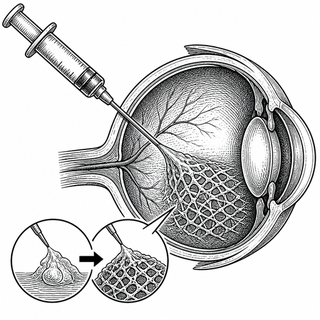
The trouble is that the retina, the delicate light-sensing tissue at the back of the eye, does not appreciate enthusiastic chaos. Even if antibiotics kill the bacteria, inflammation can keep damaging retinal tissue. That is the clinical double-bind: stop the microbes, but do not let the immune response remodel the room while putting out the fire.
Current treatment often relies on intravitreal antibiotics, meaning medication is injected directly into the eye. That route makes sense because it puts drug where it is needed. But antibiotics alone may not fully address the inflammatory storm that contributes to lasting visual impairment or blindness.
The Hydrogel Idea
The study describes an injectable thermosensitive hydrogel built from chitosan, beta-glycerophosphate, and gelatin. In plain English: it starts as a fluid that can pass through a needle, then rapidly forms a soft gel once inside the eye.
That temperature-sensitive behavior matters. A drug depot that gels after injection can stay in place and release medication over time. Think of it less like dumping a bucket of water on a campfire and more like installing a tiny sprinkler system. A very tiny one. Please do not install actual sprinklers in eyes.
This hydrogel carries two therapeutic payloads:
- Moxifloxacin, an antibiotic used to fight bacteria
- Curcumin, packaged as a cyclodextrin inclusion complex to help with delivery and anti-inflammatory activity
The design is intentionally staged. Moxifloxacin is released quickly to attack bacteria early, while curcumin is released more gradually to help quiet inflammation over time.
Why Pair an Antibiotic With Curcumin?
Curcumin, the biologically active compound associated with turmeric, has long attracted interest for anti-inflammatory effects. In the clinic, however, the challenge is not whether a compound sounds promising in theory. The challenge is getting the right amount to the right tissue for the right amount of time without causing new problems.
That is where the cyclodextrin inclusion complex comes in. Cyclodextrins are ring-shaped molecules that can help carry compounds that otherwise behave awkwardly in watery biological environments. Curcumin is famous for being biologically interesting but pharmaceutically fussy, the lab equivalent of a brilliant colleague who refuses to answer email. Packaging it more effectively may improve its usefulness in a controlled-release system.
In this study, the hydrogel was designed to provide sustained release for 14 days, which is especially relevant for an infection where both the bacteria and the inflammatory aftermath matter.
What the Researchers Tested
The investigators evaluated whether the hydrogel could be injected, form a gel after injection, release both drugs over time, and behave appropriately inside the eye.
Several properties stand out:
- Injectability: the precursor solution could be delivered through injection before gelling.
- Rapid gel formation: the material formed a gel after intravitreal injection.
- Sustained release: moxifloxacin and curcumin were released over time, supporting a two-phase therapeutic strategy.
- Low mechanical modulus: the gel was soft enough to reduce concern about mechanical irritation.
- Minimal swelling: swelling inside the eye is not a feature anyone is rooting for.
- Biodegradation: the material showed a profile suited to temporary intraocular use.
- Biocompatibility: testing supported tolerability in the studied models.
The team also tested antibacterial activity against Staphylococcus aureus, a bacterium that can cause severe ocular infection. In both laboratory and animal evaluations, the hydrogel showed antibacterial effects and anti-inflammatory activity. The reported outcomes included preserved retinal structure and improved visual function in the treated models.
Why This Is Clinically Interesting
From a bedside perspective, the appeal is straightforward: endophthalmitis needs fast, local, sustained control. A single platform that combines antimicrobial action with inflammation control could potentially reduce the treatment gap between “we killed the bacteria” and “the retina survived the experience.”
That distinction matters enormously to patients. Vision loss is not an abstract endpoint. It changes how someone reads a medication label, recognizes a grandchild, drives, works, cooks, texts, or navigates a dim hallway without performing an unplanned furniture inventory.
A dual-drug depot could also help with one of medicine’s recurring problems: timing. In infection care, the right drug at the wrong time can underperform. Here, the rapid antibiotic release is matched with longer anti-inflammatory support, which is a thoughtful design for a disease that unfolds in phases.
The Fine Print: Promising, But Not Yet Practice-Changing
This research is preclinical. That means it is scientifically intriguing, but not yet something patients should expect to receive in routine care. Before a hydrogel like this could become a clinical treatment, researchers would need more data on dosing, safety, sterilization, manufacturing consistency, long-term ocular effects, and how it compares with current standards in well-designed clinical trials.
There are also practical questions. Would the gel affect vision while present in the vitreous? How predictable is drug release across different eyes and disease severities? Could the formulation be adapted for other pathogens beyond S. aureus? Would clinicians use it alongside existing intravitreal antibiotic protocols, or as a replacement for some components?
Those questions are not cold water. They are the normal checklist that separates a clever biomedical idea from a treatment that can walk into clinic wearing sensible shoes.
A Small Gel With a Big Assignment
What makes this hydrogel compelling is not just that it carries two drugs. It is that the formulation seems designed around the actual clinical problem: bacterial destruction plus inflammatory restraint.
That is the kind of translational thinking that bridges lab and bedside. The biology says the infection is urgent. The patient says vision is everything. The material science says maybe we can deliver therapy in a smarter rhythm.
Will this become a future treatment for bacterial endophthalmitis? Too early to say. But as a concept, an injectable, biodegradable, dual-release hydrogel is a strong step toward therapies that do more than hit one target and leave the rest to chance.
And for a disease where the eye is both the battlefield and the treasure, that smarter strategy is worth watching.
This blog post discusses research findings and should not be taken as medical advice. If you have concerns about bacterial endophthalmitis, eye infection, eye pain, vision loss, or symptoms after eye surgery or injection, please consult an eye care professional or seek urgent medical care. Research discussed here represents ongoing scientific investigation and clinical validation is still in progress.
All images used in this post are decorative illustrations only and do not represent or reflect the accuracy, reality, or correctness of the referenced research.
Primary Source: An injectable dual-drug-loaded hydrogel for the treatment of bacterial endophthalmitis. PubMed Record 41512470. https://pubmed.ncbi.nlm.nih.gov/41512470/