
When I saw this study title, I rolled my eyes. Then I read it. “Nanotechnology-driven drug delivery systems for breast cancer” sounds like something a grant committee and a sci-fi writer built together during a fire drill. But underneath the buzzwords is a very real problem: cancer drugs are powerful, messy, and often about as selective as a toddler with a paint roller.
Breast cancer treatment has improved enormously, but anyone who has spent time around chemotherapy patients knows the bargain can be brutal. We throw drugs at tumors, and the rest of the body catches plenty of shrapnel. Hair follicles, gut lining, immune cells, nerves, bone marrow - all innocent bystanders. The dream is simple: get more drug into the tumor, less drug everywhere else, and make resistant cancer cells stop acting like nightclub bouncers turning away treatment at the door.
That is where nanotechnology comes in.
The Problem With “Just Give More Chemo”
Traditional chemotherapy often circulates through the whole bloodstream. That can be useful, but it also means the drug is not politely knocking only on tumor-cell doors. It visits the liver, kidneys, bone marrow, digestive tract, and pretty much any tissue with bad luck and a blood supply.
Breast cancer also has another trick: multidrug resistance, or MDR. This is when cancer cells become harder to kill even after being exposed to drugs that should work. One major culprit is P-glycoprotein, a cellular pump that kicks drugs back out before they can do their job. Think of it as a tiny molecular sump pump, except instead of saving your basement, it helps cancer dodge chemotherapy. Rude, but biologically impressive.
The review summarized here looks at how micro- and nanocarriers may help solve these problems by packaging cancer drugs inside engineered delivery systems. These carriers can improve drug stability, change how long drugs circulate, help drugs accumulate in tumors, and even combine several therapies in one package.
Small package, big attitude.
What Are These Nanocarriers?
Nanocarriers are microscopic delivery vehicles. They are not “tiny robots” in the Hollywood sense. Nobody is sending a submarine through your bloodstream while someone shouts “Enhance!” at a monitor. These are engineered particles or structures designed to carry therapeutic cargo.
The review highlights several types:
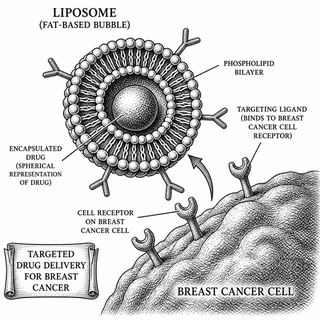
Liposomes are tiny fat-based bubbles. They can hold drugs inside and help shield normal tissues from exposure. Liposomal drug delivery is not just theoretical; versions of this approach have already been used in oncology.
Nanoparticles are a broad category. They may be polymer-based, lipid-based, inorganic, or hybrid structures. Their appeal is flexibility: researchers can tune size, surface charge, coating, drug-loading capacity, and release behavior.
Metal-organic frameworks, or MOFs, are porous structures built from metal ions and organic linkers. Imagine a microscopic scaffolding system with lots of storage space. In cancer therapy, that means potential room for drug molecules, imaging agents, or combination payloads.
Exosomes are naturally produced vesicles that cells use for communication. Because they come from biological systems, they may have advantages in compatibility and targeting, though manufacturing and quality control remain a headache big enough to deserve its own waiting room.
Nanofibers can act as local delivery platforms, releasing drugs over time. These may be useful where sustained treatment near a tumor site is desirable.
The shared goal is not just “make it small.” Small is not magic. The goal is to engineer delivery systems that behave better than free-floating drug molecules.
Why Breast Cancer Is a Tough Target
Breast cancer is not one disease wearing one nametag. There are hormone receptor-positive cancers, HER2-positive cancers, triple-negative cancers, and countless molecular differences within those groups. Tumors also change over time, especially under treatment pressure.
That heterogeneity matters. A nanocarrier that works beautifully in one tumor environment may do very little in another. Tumors differ in blood vessel structure, immune activity, acidity, oxygen levels, and surface markers. The delivery truck needs the right address, but cancer keeps renovating the neighborhood without filing permits.
This is why “targeted delivery” sounds cleaner than it is. Researchers can decorate nanoparticles with ligands, antibodies, peptides, or other molecules meant to recognize tumor cells. They can design carriers that release drugs in acidic environments or respond to enzymes found near tumors. These strategies are clever. They are also hard to standardize across real patients, whose tumors rarely behave like the tidy diagrams in a journal figure.
The Most Interesting Part: Combination Delivery
One of the strongest themes in this review is co-delivery. Instead of sending one drug alone, nanocarriers can package multiple agents together.
That might mean chemotherapy plus siRNA, which can silence genes involved in resistance. It might mean chemotherapy plus a P-glycoprotein inhibitor, trying to stop cancer cells from pumping the drug back out. It might mean combining chemotherapy with photothermal agents, which heat tumor tissue when activated by light.
This is where the field gets legitimately exciting. Cancer resistance is rarely a one-switch problem. It is usually a whole electrical panel of bad decisions. Combination nanocarriers may let researchers hit several pathways at once, with better timing and localization than giving each agent separately.
In lab and animal models, the review notes that these systems have shown promising results against multidrug resistance. That does not mean we should start ordering parade balloons. Many cancer therapies look spectacular in controlled preclinical settings and then enter human trials looking like they forgot their lines. Still, the concept is strong: deliver the drug, block the resistance mechanism, and do it in the same neighborhood.
What Has to Go Right Before This Changes Care?
For nanotechnology-driven drug delivery to become routine in breast cancer treatment, several things need to work outside the lab.
First, safety has to be boring. In medicine, boring safety is beautiful. We need to know where these carriers go, how long they persist, how they are cleared, and whether they trigger inflammation, immune reactions, organ toxicity, or unexpected long-term effects.
Second, manufacturing has to be consistent. Making a nanoparticle in a research lab is one thing. Producing it at scale, with reproducible size, charge, purity, loading efficiency, and release behavior, is another. The body notices small differences. Regulators do too, and they carry clipboards.
Third, cost matters. Precision oncology is already expensive. A therapy that works only if it requires boutique manufacturing, complex storage, and heroic billing gymnastics may struggle to reach the patients who need it.
Fourth, clinical trials need to prove more than elegance. Better tumor targeting is nice. Better survival, fewer side effects, improved quality of life, and clear benefit over existing therapy are what matter at the bedside.
Why This Review Is Worth Paying Attention To
This paper is a review, meaning it pulls together current progress rather than reporting one new clinical trial. That is useful here because the field is broad and moving quickly. Liposomes, nanoparticles, MOFs, exosomes, and nanofibers are not interchangeable. Each has different strengths, weaknesses, and translational problems.
The big message is that nanotechnology may help make breast cancer treatment more precise, less toxic, and better at overcoming drug resistance. That is not hype by itself. The hype begins when people pretend the remaining obstacles are minor. They are not.
But the direction makes sense. Cancer therapy is shifting away from carpet-bombing and toward smarter delivery, better combinations, and patient-specific strategy. Nanocarriers fit that trend. They are not a cure-all, but they may become part of the toolkit, especially for tumors that resist standard treatment or require combination approaches that are too toxic when given conventionally.
As an ER doctor, I have a soft spot for treatments that do their job without turning the rest of the body into collateral paperwork. If these systems can carry potent drugs more selectively, manage resistance, and spare patients some of chemotherapy’s usual misery, that would be more than a technical achievement. That would be mercy with engineering.
The Bottom Line
Nanotechnology-driven drug delivery for breast cancer is not fantasy medicine. It is a serious research area aimed at a serious clinical problem: how to get cancer drugs where they need to go, keep them there long enough to work, and stop resistant tumor cells from shrugging them off.
The review makes a persuasive case that liposomes, nanoparticles, MOFs, exosomes, and nanofibers could help reshape breast cancer therapy. The most promising ideas involve targeted delivery and combination systems that attack both tumor growth and drug resistance.
The catch is familiar: promising biology must survive the swamp of human trials, safety testing, manufacturing, cost, and messy real-world tumors. Medicine has seen plenty of beautiful ideas trip over reality in the hallway.
Still, this one is worth watching.
This blog post discusses research findings and should not be taken as medical advice. If you have concerns about breast cancer or cancer treatment, please consult a healthcare provider. Research discussed here represents ongoing scientific investigation and clinical validation is still in progress.
All images used in this post are decorative illustrations only and do not represent or reflect the accuracy, reality, or correctness of the referenced research.
Primary Source: Nanotechnology-driven drug delivery systems for breast cancer: A review. PubMed Record ID 41579835. https://pubmed.ncbi.nlm.nih.gov/41579835/