
The future is here, and apparently it has been quietly fermenting in a bacterial culture dish. In a new PubMed-indexed study, researchers report a personalized biomimetic biological cornea made using bacterial synthetic biology, customized curvature modeling, aldehyde-modified bacterial nanocellulose, human-derived corneal lenticule microparticles, and Celastrol. That is a lot of ingredients for one medical material, but the recipe is familiar to anyone who has watched device development: take a hard clinical shortage, add manufacturing constraints, season with biocompatibility problems, and hope the final product does not collapse like a bad souffle.
Why Corneas Are Harder Than They Look
The cornea is the clear front window of the eye. It has to transmit light, hold shape, protect the eye, and maintain a smooth optical surface. It is not just transparent tissue. It is a load-bearing, curvature-sensitive, biologically active optical component.
That combination makes corneal replacement a particularly irritating engineering problem. Donor corneal transplantation works well for many patients with corneal blindness, but donor tissue is limited. Even when tissue is available, supply chains, screening, storage, surgical access, and matching requirements all create friction. The clinical need is real, but the logistics can feel like trying to run a Michelin kitchen during a power outage.
Artificial corneal materials have been explored for years, but the bar is high. A substitute has to be clear enough, strong enough, shaped correctly, comfortable enough, and friendly enough to cells that the surrounding tissue does not treat it like a suspicious object left in the driveway.
The Study’s Big Idea
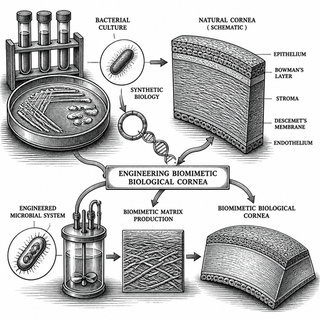
The research describes a personalized biomimetic biological cornea called DBC@L-Cel. The base material is dialdehyde bacterial nanocellulose, or DBC. Bacterial nanocellulose is appealing because bacteria can produce a fine nanofiber network that resembles parts of natural extracellular matrix architecture. In plain English: bacteria can spin a useful microscopic scaffold without needing a tiny foreman in a hard hat.
The “personalized” part comes from curvature customization. Corneal shape matters because vision depends on precise optical geometry. A generic clear patch is not enough. The material needs to match the patient’s corneal curvature and morphology as closely as possible.
The study reports that DBC achieved 91.91% transmittance, which is notable because transparency is the first gatekeeper for any corneal substitute. If light cannot pass through cleanly, the rest of the performance sheet is mostly decorative.
The researchers also incorporated human-derived corneal lenticule microparticles, referred to as L, and Celastrol, referred to as Cel. The goal was to improve biocompatibility, adhesiveness, and anti-scarring behavior. That matters because the eye is not a passive socket waiting politely for new materials. It responds, remodels, scars, inflames, and generally has opinions.
The Device Industry Angle
From a medical device business perspective, this is interesting because it blends several trends that usually live in separate conference rooms.
First, there is personalization. Custom curvature pushes this toward patient-specific manufacturing, which can be clinically attractive but operationally expensive. Personalized implants sound elegant in a slide deck. On the factory floor, they mean process controls, validation headaches, batch traceability, and the thrilling question of how much customization regulators will tolerate before everyone needs another meeting.
Second, there is biologically derived manufacturing. Bacterial synthesis can be powerful, but it changes the risk profile. You are not machining titanium or molding silicone. You are guiding living production systems to make a material that must behave consistently. That is less like stamping spoons and more like running a bakery where the yeast has a regulatory affairs department.
Third, there is combination-material complexity. DBC provides structure and optical-mechanical properties. Corneal lenticule microparticles add human-derived biological cues. Celastrol adds anti-scarring potential. Each addition may improve performance, but each also adds characterization burden. In development, “multifunctional” often means “more ways for the review team to ask questions.”
Why Celastrol Is in the Mix
Celastrol is a bioactive compound that has attracted interest for anti-inflammatory and anti-fibrotic effects in different research contexts. In this corneal material, the point is anti-scarring capability. Scarring is a major enemy of corneal clarity. A technically successful implant that becomes cloudy after tissue remodeling is not a win. It is just a transparent ambition with poor follow-through.
The idea of building anti-scarring behavior into the implant material is sensible. Instead of relying only on external drugs or hoping the wound-healing response behaves nicely, the material itself participates in managing the local biological environment.
That said, bioactivity raises practical questions. How much Celastrol is present? How is it released? How long does it remain active? What are the local toxicity margins? Does the effect hold in more demanding models? Those are not complaints. They are the standard potholes on the road from beautiful bench data to something a surgeon can order.
What Makes This More Than “Another Biomaterial Paper”
The most compelling part is the pairing of optical/mechanical matching with shape customization. Corneal replacement is not merely a materials problem. It is a geometry problem, a wound-healing problem, a surgical-handling problem, and a manufacturing problem wearing the same lab coat.
A 91.91% transmittance figure suggests the base DBC material may be optically promising. Matching mechanical properties to natural cornea is also valuable because stiffness affects handling, comfort, integration, and long-term behavior. If a corneal substitute is too floppy, too rigid, or mechanically mismatched, biology will eventually submit its review comments, usually in red ink.
The nanofiber network structure is also relevant. Cells tend to care deeply about texture and architecture at small scales. A scaffold that resembles natural tissue structure may support better integration than a flat, inert sheet. Think of it as giving cells a familiar kitchen instead of asking them to cook dinner in an airport bathroom.
The Real-World Promise
If follow-up development succeeds, this kind of platform could reduce dependence on donor corneas and expand access for patients with corneal blindness. It could also support more tailored reconstructive options, especially for patients whose corneal geometry is not well served by off-the-shelf approaches.
There is also a manufacturing dream here: grow the scaffold, modify the chemistry, customize the shape, incorporate biological and therapeutic components, then produce a patient-matched implant. That is a very attractive story for translational medicine.
But attractive stories still need process validation, sterilization strategy, shelf-life data, packaging compatibility, preclinical safety, surgical usability, and clinical outcomes. The cornea may be clear, but the development pathway is not.
What Comes Next
The next milestones are predictable and hard. Researchers will need stronger evidence on long-term transparency, immune response, integration, mechanical stability, degradation behavior, anti-scarring durability, and reproducible manufacturing. Large-animal work and eventual clinical studies would be needed before anyone starts talking about real-world adoption.
For companies watching this space, the question is not simply whether the material works in a study. The question is whether it can become a controlled, scalable, reimbursable, surgically practical product. That is where many elegant biomaterials go to discover they were actually prototypes wearing formal shoes.
Still, this research is worth watching. It points toward a future where replacement tissues are not harvested, but brewed, shaped, functionalized, and tuned. For corneal blindness, that could be a major shift. For the medical device industry, it is another reminder that the next platform technology may arrive not from a cleanroom, but from a bacterial production system behaving suspiciously like a contract manufacturer.
This blog post discusses research findings and should not be taken as medical advice. If you have concerns about corneal disease, corneal blindness, or vision changes, please consult a healthcare provider. Research discussed here represents ongoing scientific investigation and clinical validation is still in progress.
All images used in this post are decorative illustrations only and do not represent or reflect the accuracy, reality, or correctness of the referenced research.
Primary Source: Bacterial synthesis of personalized biomimetic biological cornea. PubMed Record 41551761. https://pubmed.ncbi.nlm.nih.gov/41551761/