
Fourth quarter, tie game: enrofloxacin is trying to slip past the detection defense, and a new DNA-based biosensor has just checked in with a triple-amplification playbook. The crowd is awake. The commentators are leaning forward. Somewhere, a molecule in a lab tube is yelling for a replay review.
What Is Enrofloxacin, and Why Are We Watching It?
Enrofloxacin is a fluoroquinolone antibiotic used mostly in veterinary medicine. It helps treat bacterial infections in animals, but like many antibiotics, it comes with a public-health catch: residues can linger in food products or environmental samples if monitoring is weak.
That matters because antibiotic residues are not just a paperwork problem. They can contribute to antimicrobial resistance pressure, complicate food safety, and make regulators reach for their sternest clipboards. Detecting tiny amounts reliably is therefore useful, especially if the test can be sensitive, selective, and practical outside highly specialized labs.
This new study reports a biosensor designed to detect enrofloxacin using DNA hairpins, an aptamer recognition sequence, and an autocatalytic circuit. That sounds like someone let a molecular biologist name a pinball machine, but the core idea is elegant.
The Basic Trick: DNA That Unfolds When the Antibiotic Shows Up
The sensor uses an aptamer, which is a short nucleic acid sequence designed to bind a specific target. In this case, the target is enrofloxacin. Think of the aptamer as a tiny molecular bouncer. It is not impressed by just any molecule trying to get into the club.
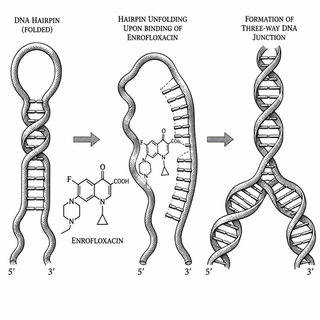
When enrofloxacin binds, it triggers the release of a DNA strand called the trigger DNA, or T. That trigger then starts a chain reaction involving hairpin DNA probes. Hairpins are DNA strands folded back on themselves, a bit like molecular paperclips. When the right trigger comes along, the hairpins open and cross-hybridize, forming three-way DNA junction structures.
Here is where the amplification becomes interesting. The products bring together split pieces of the trigger sequence, reconstructing a complete trigger DNA strand. So the original trigger starts the process, and the reaction regenerates more trigger, which can keep pushing the circuit along.
That is the “autocatalytic” part: the system helps make more of the thing that drives itself. In kitchen terms, it is less “one person making pancakes” and more “the pancakes have started training apprentices.” Please do not try that at home.
Why Triple Signal Amplification Matters
Detecting low concentrations of antibiotics is hard because the signal can be faint. A biosensor needs to distinguish a true tiny signal from background noise, sample messiness, and the occasional molecular photobomb.
This study’s strategy appears to stack multiple amplification mechanisms:
- Enrofloxacin binding releases the initial trigger DNA.
- The trigger promotes formation of three-way DNA junction products.
- The reaction regenerates intact trigger sequences, accelerating further junction formation.
The abstract also points toward magnesium-related catalytic signal generation, likely involving a DNAzyme-like component, though the provided summary cuts off before the full mechanism is visible. That means we should be careful not to over-narrate the chemistry beyond what is provided. The safest read is that the design combines target recognition, DNA circuit amplification, and downstream signal amplification to improve detection sensitivity.
That is a strong conceptual setup. DNA circuits are attractive because they can be programmed with high sequence specificity, and aptamers can provide target recognition without needing antibodies. In theory, that can make assays cheaper, more adaptable, and more stable than some protein-based systems.
What the Study Seems to Do Well
The method is smart because it uses the target molecule to unlock a self-propagating signal system. That is a good way to address a common analytical chemistry problem: very small target amounts often do not produce enough signal on their own.
The design also appears selective by construction. The aptamer is meant to recognize enrofloxacin, while the hairpin probes are sequence-programmed to respond to the released trigger. Two layers of specificity are better than one, assuming both behave cleanly in real samples.
The three-way junction design is also appealing. DNA nanotechnology often shines when it converts small molecular events into larger structural or optical readouts. It is the lab equivalent of turning a whisper into a stadium chant, ideally without accidentally starting a wave in the wrong section.
Let’s Pump the Brakes
This is promising, but “promising biosensor” is not the same thing as “ready for routine food-safety deployment by Tuesday.”
First, the abstract tells us the sensor has high sensitivity and selectivity, but we need the full paper details to judge how impressive that is. What was the limit of detection? What samples were tested? Milk? Meat extracts? Water? Buffer only? A biosensor can look spectacular in a clean tube and then become emotionally unavailable when exposed to real-world sample matrices.
Second, aptamer-based systems can be very specific, but specificity must be tested against closely related antibiotics and common interfering compounds. Enrofloxacin has chemical cousins. A good sensor needs to avoid confusing the family reunion.
Third, autocatalytic amplification is powerful, but it can also raise questions about background activation. If the system regenerates trigger DNA, even small unintended activation could potentially grow into a misleading signal. That does not mean the method is flawed. It means controls, kinetics, and false-positive rates matter a lot.
Fourth, practical deployment depends on more than sensitivity. A field-ready assay needs reasonable cost, stability, ease of use, reproducibility across batches, and tolerance for imperfect handling. The best biosensor on paper still has to survive the indignities of actual use, including temperature swings, sample gunk, and humans who label tubes with the confidence of sleepy raccoons. Fine, no raccoons. Sleepy humans are trouble enough.
Why This Research Is Still Intriguing
Even with those caveats, the study fits into a larger trend: using programmable DNA systems as analytical tools. DNA is no longer just the thing we sequence or blame for inherited eyebrow decisions. It can be engineered into switches, circuits, scaffolds, amplifiers, and reporters.
For antibiotic monitoring, that flexibility could be valuable. Regulators and food-safety labs need methods that catch residues at low levels. Producers need tools that are reliable and practical. Public health benefits when monitoring becomes faster and more accessible.
If this kind of sensor can be validated in real samples and packaged into a workflow that does not require elite lab gymnastics, it could contribute to better screening for veterinary antibiotic residues. It might not replace gold-standard confirmatory methods like chromatography-mass spectrometry, but it could become a useful front-line screening tool.
The Bottom Line
This study describes a clever DNA circuit biosensor for enrofloxacin detection, built around aptamer recognition, hairpin DNA probes, three-way junction formation, and self-amplifying trigger regeneration. The design is scientifically appealing because it uses molecular recognition and signal amplification in a coordinated way.
But the real test is not whether the circuit sounds impressive. It does. The real test is whether it performs reliably in messy, real-world samples, against similar compounds, across repeated runs, and under practical conditions. That is where biosensors either grow up or stay as beautiful lab choreography.
For now, this is a neat piece of molecular engineering with plausible food-safety relevance. Applause is fair. A standing ovation can wait for validation.
This blog post discusses research findings and should not be taken as medical advice. If you have concerns about antibiotic exposure, food safety, or antimicrobial resistance, please consult a qualified healthcare or public-health professional. Research discussed here represents ongoing scientific investigation and validation is still in progress.
All images used in this post are decorative illustrations only and do not represent or reflect the accuracy, reality, or correctness of the referenced research.
Primary Source: Antibiotic-induced autocatalytic DNA circuit for enrofloxacin detection based on triple signal amplification strategy. PubMed Record ID 41628528. https://pubmed.ncbi.nlm.nih.gov/41628528/