
What has holes like a sponge, manners like a butler, and ambitions large enough to tidy up a brain cell’s worst afternoon?
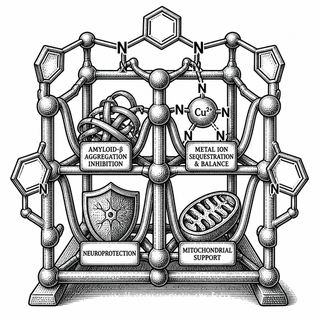
The answer, at least in this new Alzheimer’s disease study, is a covalent organic framework-based biomimetic nanoplatform. That is a mouthful large enough to frighten a first-year graduate student, so let us unpack it gently. Think of it as a tiny, carefully built molecular scaffold, rather like a microscopic wine rack, except instead of holding bottles it may help manage several messy features of Alzheimer’s disease at once.
The Old Problem With Alzheimer’s
I have watched Alzheimer’s research for a long time. Long enough to remember when amyloid-beta plaques were discussed with the confidence of a detective pointing at a muddy footprint. The plaques mattered, surely. But as decades passed, the plot thickened.
Alzheimer’s disease is not one tidy malfunction. It is more like a household where the plumbing leaks, the lights flicker, the pantry is on fire, and someone has misplaced the keys. Researchers have focused on several recurring troublemakers: abnormal amyloid-beta aggregation, disturbed metal ion balance, and oxidative stress.
Amyloid-beta, often shortened to Aβ, is a small protein fragment that can clump into larger aggregates. In Alzheimer’s disease, these aggregates are one of the recognizable pathological features in the brain. Metal ions, including copper, also matter because the brain uses metals in normal chemistry, but too much, too little, or badly handled metal chemistry can feed harmful reactions. Oxidative stress is the cellular wear-and-tear that occurs when reactive molecules overwhelm the cell’s defenses. A little oxidation is normal biology. Too much is biology leaving its tea kettle on the stove.
That is why a multi-target approach is attractive. If Alzheimer’s biology is a tangled knot, tugging one thread may not be enough.
Enter the COF, Stage Left
The research described in PubMed record 41610695 reports an “integrated multifunctional nanoplatform” built around a covalent organic framework, specifically TD-COF. Covalent organic frameworks, or COFs, are crystalline porous materials made from organic building blocks connected by strong covalent bonds.
The appeal of a COF is its architecture. These materials can be designed with pores, chemical groups, and molecular surfaces suited to particular jobs. In this case, the platform was engineered to address several Alzheimer’s-related processes, including amyloid-beta aggregation, disrupted metal ion homeostasis, and oxidative stress.
That is the intriguing part. Many proposed treatments in neurodegeneration try to do one thing very well. This system is more like a tidy laboratory assistant with three clipboards. It aims to interfere with amyloid aggregation, engage with metal ion imbalance, and reduce oxidative stress through one engineered nanoscale platform.
Why “Biomimetic” Matters
The word biomimetic means “imitating biology,” though biology itself rarely sends thank-you notes. A biomimetic nanoplatform is designed to behave, at least in selected ways, like something compatible with living systems.
In Alzheimer’s research, this matters because the brain is not an easy organ to reach or influence. It is protected, chemically complex, and deeply intolerant of clumsy interventions. Any proposed therapy must not only show activity in a test tube, but also survive the practical questions that have humbled many elegant ideas: Can it reach the right place? Can it behave predictably? Can it avoid causing new problems while fixing old ones?
The study’s approach is notable because it does not treat the brain’s Alzheimer’s-related chemistry as a single villain story. Instead, it recognizes the biochemical crowd scene. Amyloid-beta clumping, metal dysregulation, and oxidative stress can interact with one another. That makes a multifunctional platform scientifically sensible, even if the road from nanomaterial to approved therapy is long and paved with reviewers asking for more controls.
Aβ Aggregation: The Clumping Problem
Amyloid-beta aggregation has been one of Alzheimer’s research’s longest-running characters. Individual Aβ peptides can assemble into oligomers and fibrils, and these structures have been linked to neuronal toxicity. Preventing, slowing, or modifying this aggregation remains a major goal.
A porous framework may help by presenting chemical surfaces that interact with amyloid-beta and interfere with its tendency to clump. Imagine trying to organize a chaotic dance floor by introducing a very polite, very structured piece of furniture. Not glamorous, perhaps, but sometimes furniture changes the traffic pattern.
That analogy limps, as all analogies do after lunch, but the concept is useful: molecular architecture can influence molecular behavior.
Metal Ions and Oxidative Stress
The study also addresses metal ion homeostasis. In Alzheimer’s disease, metal ions such as copper have been implicated in amyloid chemistry and oxidative reactions. Copper is not “bad” by itself. The brain needs metals. The problem is mismanagement.
A material that can interact with copper-related chemistry may help reduce downstream oxidative stress. Oxidative stress can damage proteins, lipids, and DNA, contributing to cellular dysfunction. So a nanoplatform with built-in metal-handling and antioxidant-like behavior could, in principle, dampen several damaging processes at once.
This is where the research becomes especially interesting. It is not simply throwing a sponge into a puddle. It is designing the sponge so it recognizes which puddle, where to sit, and how not to soak up the cat. Precision matters.
The Promise, With Sensible Caution
What might this mean in the real world if follow-up development succeeds? A multi-target nanotherapy could complement the current direction of Alzheimer’s treatment, which increasingly acknowledges that no single pathway explains the whole disease. Such a platform might someday be used to reduce toxic aggregation, rebalance harmful metal chemistry, and protect neurons from oxidative injury.
But let us keep both feet on the laboratory floor. Nanomedicine is full of beautiful concepts that must pass difficult tests. Researchers will need to show safety, delivery to relevant brain regions, persistence at useful levels, clearance from the body, reproducibility, and meaningful benefit in biological models that predict human outcomes. The brain, being the brain, does not hand out visitor badges casually.
Still, the strategy is worth watching because it reflects a maturing view of Alzheimer’s. The field has moved beyond “find one culprit and arrest it.” Biology, regrettably, is not a detective novel with a final chapter and a butler confession.
Why This Study Caught My Eye
What I like about this work is its engineering imagination. Covalent organic frameworks are not merely passive carriers. They can be designed as active participants in therapy, with structure and chemistry doing useful work together.
That shift matters. In older drug delivery thinking, the carrier was often a truck and the drug was the cargo. Here, the truck may also be a mechanic, a traffic officer, and a small-town pharmacist. A busy vehicle, certainly, but one suited to a complicated disease.
For readers following Alzheimer’s research, the takeaway is not that a cure has arrived. It has not. The takeaway is that researchers are building more sophisticated tools for diseases that refuse to behave simply. That is good science: not louder promises, but better-shaped questions.
And after decades of watching the field, I find that encouraging. Not giddily encouraging, mind you. Retired professors ration giddiness carefully. But encouraging all the same.
This blog post discusses research findings and should not be taken as medical advice. If you have concerns about Alzheimer’s disease or memory changes, please consult a healthcare provider. Research discussed here represents ongoing scientific investigation and clinical validation is still in progress.
All images used in this post are decorative illustrations only and do not represent or reflect the accuracy, reality, or correctness of the referenced research.
Primary Source: In-situ engineering of a covalent organic framework-based biomimetic nanoplatform for multi-target therapy of Alzheimer's disease. PubMed Record 41610695. https://pubmed.ncbi.nlm.nih.gov/41610695/