
Ka-pow: a missing tooth exits the scene. Enter Titanium Implant, cape fluttering, corrosion-resistant armor shining, ready to save the jawbone from chaos. But then comes the plot twist: bone looks at the smooth metal surface and says, “Nice suit, but do I really want to move in?” That awkward handshake between implant and bone is where many dental implant innovations are born.
A new study on a boronized Ti6Al4V/hydroxyapatite composite takes aim at exactly that problem. The researchers engineered a titanium alloy surface designed to be more welcoming to bone-forming cells, then tracked how those cells responded at the genetic and signaling level. For anyone thinking commercially, this is the fun part: the paper is not just saying “we made a rougher implant.” It is saying, “we may have found a surface recipe that nudges cells toward bone formation through identifiable biological pathways.”
That is much closer to product logic.
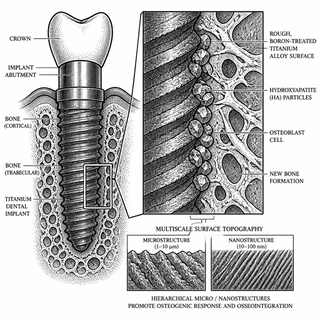
Why Dental Implants Still Have Room to Improve
Titanium and titanium alloys are already stars in dentistry. They are strong, biocompatible, and resistant to corrosion, which is a polite way of saying they do not panic when placed in the chemically lively environment of the mouth.
But titanium has two persistent business problems disguised as biology problems.
First, its stiffness does not perfectly match bone. That mismatch can affect how mechanical forces are distributed. Second, plain titanium surfaces are not always bioactive enough, especially in the early period after implantation. Early osseointegration, the process where bone grows onto and bonds with the implant, is where success starts earning its keep.
From a founder’s lens, early osseointegration is the customer onboarding flow of implant dentistry. If bone cells do not engage quickly, the whole user experience gets wobbly.
The Product Idea: Boronized Titanium Plus Hydroxyapatite
The study focused on a composite made from Ti6Al4V, a widely used titanium alloy, combined with hydroxyapatite, often abbreviated HA. Hydroxyapatite is the mineral that gives bone and teeth much of their structure, so adding it to an implant surface is like putting up a “bone-friendly neighborhood” sign.
The “boronized” part refers to modifying the surface with boron treatment. Surface engineering matters because cells do not simply respond to what an implant is made of. They respond to what they touch. Texture, chemistry, stiffness, nanoscale features, and surface energy can all influence whether cells attach, spread, communicate, and begin building matrix.
In this study, scanning electron microscopy and atomic force microscopy showed that the treated composite had a micro/nanostructured surface with increased roughness. That is not just cosmetic. At the cellular scale, roughness can act like better architectural scaffolding. Cells are picky tenants, but give them enough texture and the right biochemical cues, and suddenly they start talking about long-term leases.
What the Cells Did Next
The researchers cultured osteoblasts, the cells responsible for making bone, on the boronized Ti6Al4V/HA composite and compared their genetic activity with cells grown on standard Ti6Al4V.
The result was a sizable transcriptional shift: 683 genes were upregulated and 838 genes were downregulated. In plain English, the cells were not shrugging. They were reorganizing their internal playbook.
Gene ontology analysis pointed to processes involving cell adhesion, extracellular matrix remodeling, and integrin-mediated signaling. These are highly relevant to implant success. Cells need to stick, sense their environment, build matrix, and coordinate with neighboring cells. No adhesion, no party.
Pathway analysis also found activity related to the cell cycle, PI3K/Akt signaling, and calcium signaling. These pathways sit close to the machinery of growth, survival, differentiation, and mineralization. For implant development, that combination is commercially interesting because it suggests the surface may be doing more than passively sitting there. It may be actively shaping cell behavior.
TRIP13: The Unexpected Signal in the Boardroom
The study highlighted eight upregulated genes: CYP1A1, CRLF2, HBEGF, IRAK2, DLL1, CYP1B1, BLOC1S5-TXNDC5, and TRIP13. Among these, TRIP13 became a key focus.
TRIP13 expression correlated positively with osteogenic differentiation. In other words, higher TRIP13 activity appeared linked with stronger bone-forming behavior. The researchers also connected this response with activation of the PI3K/Akt signaling pathway.
TRIP13 is not exactly a household name. It sounds like either a gene, a secret moon mission, or a suspiciously expensive conference package. But in this context, it may serve as a useful biological marker or mechanistic clue for how engineered implant surfaces encourage osteoblasts to mature into better bone builders.
That matters because implant companies do not just need prettier surfaces. They need defensible mechanisms, measurable biomarkers, and repeatable manufacturing logic. A surface that can be tied to a specific cellular response is easier to optimize, compare, validate, and eventually position.
The Commercial Angle
The market opportunity is straightforward: better early osseointegration could mean more reliable implants, shorter healing windows, improved outcomes in challenging patients, and stronger differentiation for manufacturers in a competitive dental implant market.
This research could support several product paths:
- Next-generation implant surface coatings
- Bioactive titanium alloy platforms for dental and orthopedic use
- Quality-control assays based on osteogenic gene expression
- Companion preclinical screening tools for implant surface development
The most valuable part may be the mechanism. A company can copy roughness. It is much harder to build a convincing biological story that says, “this surface activates osteogenic behavior through a TRIP13-associated PI3K/Akt response.” That kind of story can support R&D prioritization, investor conversations, regulatory strategy, and clinical trial design.
Of course, this is still preclinical research. Osteoblast culture data and molecular pathway findings are not the same as long-term implant survival in real patients chewing real food under real-world conditions. Biology in a dish is wonderfully informative, but it does not have to deal with late-night popcorn decisions.
What Comes Next
The next steps are predictable but essential: more validation, animal studies, mechanical testing, manufacturing reproducibility, safety assessment, and eventually clinical evidence. Researchers will need to show that the surface performs consistently, bonds well to underlying implant materials, does not create unwanted degradation issues, and improves real osseointegration outcomes.
There is also the question of whether TRIP13 is a driver, a marker, or part of a broader response. If TRIP13 actively helps regulate osteogenic differentiation on this surface, it could become a target for deeper biomaterials design. If it is mainly a signal that cells are already moving in the right direction, it may still be useful as a readout for screening better surfaces.
Either way, this paper gives implant developers a more detailed map. Not a finished product, not a clinical guarantee, but a sharper path from surface engineering to cellular behavior.
For a founder-minded reader, that is the exciting bit. The future of implants may not be only about stronger screws or prettier coatings. It may be about materials that whisper the right instructions to cells at exactly the right time.
And if a titanium implant can persuade bone to RSVP early, stay committed, and start building, that is not just good biology. That is a product strategy with teeth.
This blog post discusses research findings and should not be taken as medical advice. If you have concerns about dental implants, bone healing, or oral health, please consult a healthcare provider. Research discussed here represents ongoing scientific investigation and clinical validation is still in progress.
All images used in this post are decorative illustrations only and do not represent or reflect the accuracy, reality, or correctness of the referenced research.
Primary Source: Regulation of osteogenic differentiation of boronized Ti6Al4V/HA composite involving TRIP13-PI3K/Akt signaling pathway. PubMed Record 41581318. PubMed link