
A good nanomedicine paper is a little like an ambitious kitchen experiment: take one metal oxide base, fold in a second metal with therapeutic attitude, stuff the pores with a dye, and hope the final dish does more than look impressive under the microscope. In this study, the recipe is mesoporous gallium-enriched cerium oxide nanoparticles loaded with indocyanine green, or Ga&Ce-ICG. It is not exactly weeknight pasta. It is more “molecular tasting menu with laser-guided plating.”
The target is cervical cancer, a disease that remains a major global health problem. It is the fourth most common cancer among women worldwide, and persistent infection with high-risk human papillomavirus, or HPV, is the main driver behind most cases. Screening, vaccination, surgery, radiation, and chemotherapy have all changed the landscape, but treatment can still be limited by late diagnosis, recurrence, toxicity, incomplete tumor removal, and the plain stubbornness of malignant tissue.
So the idea behind this paper is appealing: build a nanoparticle that can help surgeons see tumor tissue and then help destroy remaining cancer cells through a burst of reactive oxygen species. That is the pitch. It is a strong pitch. It is also where we gently place one hand on the lab bench and say: promising, yes. Clinically settled, no.
What Did the Researchers Build?
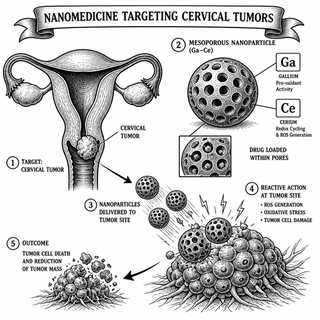
The research describes a one-step method for engineering mesoporous gallium-enriched cerium oxide nanoparticles. “Mesoporous” means the particles have tiny pores, like microscopic sponges. Those pores can hold other molecules, and in this case they were loaded with indocyanine green, often shortened to ICG.
ICG is not some obscure lab-only dye. It is already used clinically for near-infrared fluorescence imaging, including in surgical settings. That gives it a practical edge: doctors are familiar with the concept of using ICG to help visualize tissues. The nanoparticle strategy here tries to make ICG more targeted and more multifunctional, turning it from a “please glow over there” tool into part of a more elaborate tumor-seeking package.
The gallium and cerium components are where the therapeutic ambition enters. Cerium oxide nanoparticles are known for unusual redox behavior, meaning they can participate in chemical reactions involving electron transfer. Gallium, meanwhile, has attracted interest in cancer research because it can interfere with iron-dependent biological processes. Cancer cells tend to be metabolically hungry little bureaucracies, constantly filing requests for nutrients and growth signals. Gallium can sometimes sneak into those systems wearing an iron-like mustache.
The combined Ga&Ce-ICG system is designed to accumulate in tumors, respond to the acidic tumor microenvironment, and trigger a highly synergistic reactive oxygen species burst.
The ROS Burst: Helpful Fireworks, If Controlled
Reactive oxygen species, or ROS, are chemically reactive molecules containing oxygen. At low or regulated levels, cells use them in normal signaling. At high levels, they can damage proteins, membranes, and DNA. Cancer therapies often try to exploit that vulnerability by pushing tumor cells past their stress tolerance.
In this paper’s concept, the acidic tumor microenvironment acts like a trigger. Tumors often have regions that are more acidic than normal tissue because of altered metabolism and poor perfusion. The nanomedicine is designed to respond to that environment, helping release or activate its components where they are needed.
That is elegant in principle. It is also one of those ideas that sounds cleaner in a schematic than inside a living organism, where biology behaves less like a flowchart and more like a group project with no assigned leader. Tumor acidity varies. Nanoparticle distribution varies. Blood flow varies. Immune clearance varies. The best version of this technology would need to prove that it can reliably reach tumors, avoid healthy tissues, and generate enough ROS to matter without creating off-target damage.
Still, the strategy is scientifically interesting because it tries to combine diagnosis, surgical guidance, and therapy in one platform. That “see it and treat it” pairing is a major goal in oncology nanomedicine.
Bioimaging-Guided Surgery: The Practical Hook
One of the more grounded parts of the study is the imaging angle. Surgery for solid tumors often depends on how clearly tumor margins can be identified. If surgeons remove too little, malignant cells may remain. If they remove too much, healthy tissue may be unnecessarily damaged.
Fluorescence-guided surgery aims to make the invisible more visible. ICG can fluoresce in near-infrared light, which penetrates tissue better than visible light. By packaging ICG inside tumor-accumulating nanoparticles, the researchers are trying to improve the signal at the tumor site.
That is a sensible clinical problem to tackle. It is not just “nanoparticles because nanoparticles.” There is a real workflow challenge: help clinicians find tumor boundaries and then reduce residual disease. If a system could do both safely, it would be useful.
The caveat is that accumulation in tumors is not the same as precision targeting in patients. Nanoparticles often accumulate in tumors in preclinical models through mechanisms that may not translate neatly to human cancers. Mouse tumors are useful, but they are not tiny people with fur accessories. Human tumors are larger, more heterogeneous, and embedded in bodies with complex immune, vascular, and metabolic behavior.
What Makes This Study Worth Watching?
The most interesting part is the bimetallic design. Instead of relying on a single therapeutic mechanism, the platform combines gallium, cerium oxide, and ICG into one nanomedicine. The study frames this as a highly synergistic ROS-generating system, meaning the combined effect is intended to be stronger than the sum of the individual parts.
That matters because many cancer treatments fail not from lack of activity, but from insufficient activity at tolerable doses. If synergy allows lower doses of each component while still achieving strong tumor suppression, that could be valuable.
The one-step synthesis method is also worth noting. In nanomedicine, manufacturing complexity can become a quiet dealbreaker. A beautifully engineered particle that requires seventeen delicate steps and the emotional support of three postdocs may struggle to become a scalable therapy. A simpler synthesis route is a genuine advantage if it produces consistent, reproducible particles.
Where the Brakes Belong
This is where skepticism earns its keep. Based on the supplied summary, this appears to be early-stage research. The abstract describes development, tumor accumulation, acidic microenvironment response, imaging, and ROS-mediated tumor suppression. Those are promising features, but several big questions remain.
First, safety. ROS can kill tumor cells, but ROS does not read the room. Healthy tissues can also be damaged if exposure is poorly controlled. The paper’s platform needs careful evaluation for toxicity, biodistribution, clearance, immune effects, and long-term retention.
Second, translation. Nanomedicines have produced plenty of exciting preclinical results and fewer clinical blockbusters than the hype cycle once suggested. Delivery remains hard. Tumor heterogeneity remains hard. Scaling production remains hard. Regulatory evaluation of multifunctional particles can be especially demanding because each component and interaction needs to be understood.
Third, cervical cancer care is not one-size-fits-all. Disease stage, HPV status, tumor location, access to surgery, radiation availability, fertility considerations, and global health infrastructure all affect what “real-world impact” means. A sophisticated nanoparticle therapy may be technically impressive, but deployment would require affordability, imaging equipment, trained teams, and evidence from rigorous trials.
None of this sinks the idea. It just keeps it wearing its proper shoes: preclinical promise, not clinical proof.
Why This Still Matters
Cervical cancer is preventable in many cases through HPV vaccination and screening, yet it still causes enormous harm, especially where access to prevention and treatment is limited. New therapies are not a substitute for vaccination, screening, and equitable care. But better tools for surgery and residual tumor control could still matter, particularly for patients who need more precise local treatment.
This Ga&Ce-ICG platform is intriguing because it addresses two linked problems: seeing the tumor and attacking it. The imaging component could help guide surgery, while the ROS-generating chemistry could help suppress remaining tumor cells. That combination is a tidy idea, and in cancer therapy, tidy ideas are rare enough that we should at least offer them a chair.
But the next steps are everything. The field needs data on reproducibility, dosing, safety margins, comparison with existing therapies, performance in more realistic tumor models, and eventually human studies. Until then, this is not a new treatment patients can ask for in clinic. It is a clever experimental platform with a plausible mechanism and a long road ahead.
For now, the takeaway is balanced: the study offers a smart design for cervical tumor imaging and suppression, but the nanomedicine still has to survive the usual gauntlet of biology, manufacturing, toxicity testing, and clinical validation. Science has baked an interesting cake. We are not serving it at the hospital cafeteria yet.
This blog post discusses research findings and should not be taken as medical advice. If you have concerns about cervical cancer, HPV infection, screening, or treatment options, please consult a healthcare provider. Research discussed here represents ongoing scientific investigation and clinical validation is still in progress.
All images used in this post are decorative illustrations only and do not represent or reflect the accuracy, reality, or correctness of the referenced research.
Primary Source: Gallium-enriched bimetallic nanomedicine for cervical tumour suppression via bioimaging-guided surgery and highly synergistic reactive oxygen species burst. PubMed Record ID 41579569. PubMed. DOI not available.