
Breaking news from the world of oncology drug delivery: chemotherapy may have found a better way to stop wandering off like an unsupervised intern with a hospital badge. A new study describes a thermosensitive nanogel designed to carry oxaliplatin directly into tumors, respond to radiofrequency heating, and release the drug slowly over several days instead of dumping it into the body all at once.
That may sound like a tiny engineering footnote. It is not. It is a small materials-science maneuver aimed at one of cancer treatment’s stubborn policy-level problems: we have powerful drugs, but getting them to the right place, at the right dose, for the right duration remains harder than any reimbursement form has a moral right to be.
The Problem With Useful Poison
Oxaliplatin is a platinum-based chemotherapy drug used in several cancers, especially gastrointestinal malignancies. Like many chemotherapy agents, it works because cancer cells are vulnerable to damage that interferes with replication. Also like many chemotherapy agents, it does not arrive carrying a clipboard that says “tumor cells only.”
That is the tradeoff. The drug can attack cancer, but it can also cause systemic toxicity. Patients may experience nerve damage, gastrointestinal problems, blood count suppression, and other side effects that make treatment feel less like precision medicine and more like carpet cleaning with a fire hose.
The study’s goal was straightforward: keep more oxaliplatin inside the tumor for longer, while reducing how much of it sloshes around everywhere else. In health policy terms, this is the dream of targeted delivery: better therapeutic value per unit of toxicity. If that phrase sounds like something that belongs in a regulatory submission, well, eventually it might.
Enter the Nanogel
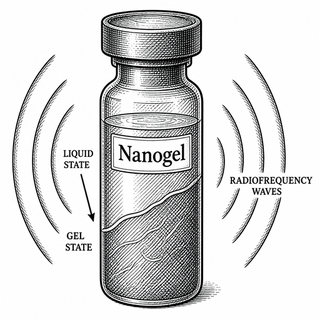
The researchers developed an oxaliplatin-loaded nanogel made from poly(N-isopropyl acrylamide-co-acrylic acid), a polymer system with thermosensitive behavior. In plain language, this material changes its physical state in response to temperature. It can behave more fluidly under one condition and more gel-like under another.
The formulation used 0.8 mg/mL oxaliplatin dispersed in an 8% nanogel. The team tested its sol-gel transition using vial inversion and rheological analysis, which is a fancy way of asking, “Does this thing actually become gel-like when it is supposed to?” Science has many elegant instruments, but sometimes the question is still: if we turn the vial upside down, does it move?
The nanogel also responded to radiofrequency heating. That matters because radiofrequency approaches are already used in some tumor treatments to generate localized heat. Combining heat responsiveness with chemotherapy release creates the possibility of a two-part attack: localized thermal treatment plus sustained local drug exposure.
Five Days Is a Long Time in Drug Delivery
One of the key findings was controlled oxaliplatin release for up to five days. That is significant because tumors are not one-and-done adversaries. A short burst of chemotherapy may not maintain enough pressure on the cancer cells, especially if the drug clears quickly from the tumor site.
The study found that the nanogel improved tumor retention compared with free oxaliplatin. Platinum content analysis showed higher platinum levels in tumors treated with the nanogel formulation. Since oxaliplatin contains platinum, tracking platinum is a practical way to estimate where the drug ended up.
This is where the delivery system starts to look less like a lab curiosity and more like a possible systems fix. If a therapy can remain concentrated in the tumor, clinicians may be able to reduce systemic exposure, improve local effectiveness, and potentially simplify treatment schedules. That is a lot of “may,” but in early-stage research, “may” is the official currency, accepted everywhere except final FDA approval.
What Happened in the Tumor Models?
The animal study results were striking. A single administration of the oxaliplatin-loaded nanogel led to sustained tumor regression. After 14 days, relative tumor volume fell to 0.81 ± 0.06 times the initial volume.
The comparison groups did not fare nearly as well. Tumors treated with the same dose of free oxaliplatin grew to 3.22 ± 0.65 times their original size. Tumors treated with the blank nanogel grew to 7.01 ± 0.47 times the initial volume. Tumors treated with saline reached 10.07 ± 1.57 times the initial size.
That spread is hard to ignore. The nanogel was not merely a passive container. It appears to have changed the drug’s local behavior in a way that improved antitumor activity.
The researchers also reported preliminary biocompatibility findings suggesting that incorporating oxaliplatin into the nanogel reduced toxic side effects compared with free oxaliplatin. That is especially relevant because oncology treatment is not just about shrinking tumors. It is also about keeping patients well enough to continue therapy, recover, and live their lives without needing a side quest through every adverse event category.
Why This Matters Beyond One Study
Localized chemotherapy has a policy logic behind it. If treatments can be made more targeted, health systems may eventually see fewer complications, fewer supportive medications, fewer hospital visits, and better quality of life. Those outcomes matter to patients first, but they also matter to payers, regulators, clinicians, and the quietly exhausted people who build clinical pathways.
This kind of research also fits into a broader shift in cancer care: the treatment is no longer just the drug. The delivery system is part of the therapy. A molecule can be potent, but if it cannot be placed and retained effectively, its real-world value drops. Drug delivery is where chemistry meets logistics, and as anyone who has watched a hospital committee schedule a meeting knows, logistics can defeat almost anything.
Nanomedicine has long promised smarter delivery, but the field has faced challenges. Nanoparticles may accumulate unpredictably, clear too quickly, trigger immune responses, or struggle to scale from elegant laboratory design to practical manufacturing. Tumor biology is also uneven. What works in one tumor model may not translate cleanly to humans.
So the interesting part here is not that this nanogel magically solves chemotherapy. It does not. The interesting part is that it tackles several problems at once: local retention, sustained release, radiofrequency responsiveness, and reduced toxicity signals.
The Regulatory Road Ahead
Before this becomes a clinical tool, there are many questions to answer. What tumor types would be best suited to intratumoral administration? How reproducible is the gel’s behavior across different tissue environments? Can the formulation be manufactured consistently? What happens with repeated dosing? How does radiofrequency timing affect release? What toxicology studies are needed before human trials?
These are not glamorous questions, but they are the scaffolding of actual medical progress. Translational research has to survive the full parade: formulation stability, animal toxicology, manufacturing controls, trial design, reimbursement logic, and the ever-popular “please resubmit with additional documentation” ritual.
Still, the concept is appealing. A treatment that stays where it is injected, releases over several days, works with localized heating, and reduces systemic toxicity could become part of a more precise cancer treatment toolkit.
A Small Gel With Big Administrative Implications
The most promising therapies are not always the ones that simply hit harder. Sometimes they hit smarter, linger longer, and create fewer downstream problems. This thermosensitive oxaliplatin nanogel is still early-stage research, but it points toward a future where chemotherapy delivery is engineered with the same seriousness as the drug itself.
If further studies confirm safety and effectiveness, systems of care could benefit from treatments that are more localized, less toxic, and potentially easier to integrate into interventional oncology workflows. That would be good news for patients, clinicians, and possibly even the policy people, who would finally get to use the phrase “value-based nanogel” in a meeting and pretend they had not been waiting years for the opportunity.
This blog post discusses research findings and should not be taken as medical advice. If you have concerns about cancer treatment or chemotherapy side effects, please consult a healthcare provider. Research discussed here represents ongoing scientific investigation and clinical validation is still in progress.
All images used in this post are decorative illustrations only and do not represent or reflect the accuracy, reality, or correctness of the referenced research.
Primary Source: Thermosensitive nanogel-based oxaliplatin delivery system for synergistic intratumoral radiofrequency chemotherapy. PubMed Record ID 41581319. https://pubmed.ncbi.nlm.nih.gov/41581319/