
A soft beep, a glint of conductive material, and a tiny biological sample meeting a sensor surface: that is the kind of future cancer testing researchers are trying to build. Not the dramatic, sci-fi kind with lasers shouting at tumors, but the quieter kind where a small device might help spot cancer signals earlier, faster, and closer to where people actually live. Think less “spaceship command center” and more “very smart postage stamp with a medical degree.”
That future is the focus of a recent PubMed-indexed review, Advancing cancer diagnosis and therapy: MXene-based biosensing and nanomedicine applications, which examines how MXenes could support cancer detection, imaging, drug delivery, and therapy. MXenes are two-dimensional nanomaterials with a useful mix of traits: strong electrical conductivity, large surface area, mechanical durability, optical properties, and biocompatibility. In plain language, they are thin, reactive, highly adaptable materials that can be engineered to notice tiny biological clues.
For public health, that matters because cancer outcomes are not shaped only by biology. They are shaped by transportation, insurance coverage, clinic availability, trust, language access, and whether someone can take a day off work without losing wages. A promising sensor is not automatically an equity tool, but if it becomes affordable, accurate, portable, and easy to use, it could help move cancer screening closer to communities that are too often asked to travel the farthest for the most basic care.
What Are MXenes, Without the Nanomaterial Fog Machine?
MXenes are a family of ultra-thin materials, usually described as two-dimensional because they are only a few atoms thick. Their structure gives them a large surface area, which is helpful when scientists want to attach molecules, detect biomarkers, or build highly sensitive biosensors.
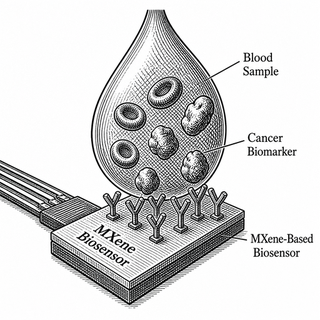
The review highlights their role in biosensing, which means detecting biological signals that may point to disease. In cancer, those signals can include proteins, genetic fragments, enzymes, or tiny particles released by cells. A biosensor works a bit like a highly trained doorman at a molecular nightclub: it recognizes who is on the list, notices when someone suspicious shows up, and sends a signal.
The paper discusses MXene-based sensors for biomarkers across many cancers, including gastric, colorectal, colon, breast, pancreatic, oral, ovarian, lung, prostate, leukemia, and neuroendocrine malignancies. That range is notable because cancer is not one disease. It is a sprawling family reunion of diseases, and some relatives are much better behaved than others.
Biomarkers: The Breadcrumbs Cancer Leaves Behind
Cancer cells can release or influence molecules that circulate in blood, saliva, tissue, or other biological samples. The review mentions biomarkers such as MUC1, miRNA-122, CEA, HER2, CgA, CYFRA21-1, ALP, PSA, and exosomes.
Some of these names sound like rejected Wi-Fi passwords, but they represent real biological clues. HER2, for example, is well known in breast cancer care. PSA is associated with prostate cancer screening and monitoring. CEA can be relevant in colorectal and other cancers. Exosomes are tiny vesicles released by cells, and researchers are studying them as rich sources of cancer-related information.
The appeal of MXene-based biosensors is sensitivity. If a sensor can detect very low levels of a biomarker, it may help identify disease earlier or monitor how treatment is going. Earlier detection can mean more treatment options, less aggressive care, and better survival. That is the hopeful part. The realistic part is that early detection only helps if people can access follow-up testing, diagnosis, and treatment. A sensor that finds trouble but leaves a patient stranded in a referral maze is not a victory lap. It is a very expensive “now what?”
Why This Could Matter for Underserved Communities
Many cancer disparities begin before treatment starts. People in rural areas may live hours from specialty care. Low-income patients may face delayed screening because of cost, childcare, work schedules, or lack of nearby services. Communities affected by medical mistrust may avoid systems that have historically failed them. Language barriers and fragmented care can turn a straightforward screening pathway into a paperwork obstacle course wearing sensible shoes.
Portable biosensors could help if they are developed thoughtfully. Imagine cancer biomarker testing that can be used in community clinics, mobile health units, local labs, or primary care settings. Imagine faster preliminary information for people who cannot easily access major cancer centers. Imagine monitoring treatment response with less burden on patients who already spend too much time arranging rides, waiting in exam rooms, and wondering why every parking garage seems designed by someone who personally dislikes humans.
This is where MXenes become more than a materials science curiosity. Their conductivity and modifiable surfaces could make them useful in compact devices that detect cancer-related biomarkers quickly. Their optical properties may support imaging and therapy. Their large surface area may help with drug delivery, where medicines are carried more precisely toward target tissues.
Still, equity is not built into a nanomaterial. It has to be designed into the whole system: price, distribution, validation across diverse populations, plain-language results, clinician training, referral pathways, and insurance coverage.
Beyond Detection: Imaging, Drug Delivery, and Therapy
The review also discusses MXenes in nanomedicine, including bioimaging, drug delivery, and cancer therapy. Because MXenes can interact with light and biological environments in useful ways, researchers are exploring whether they can help visualize tumors or deliver treatment more efficiently.
Drug delivery is especially interesting. Many cancer treatments affect both cancer cells and healthy tissues, which is why side effects can be so punishing. Nanomedicine aims to improve targeting, sending more of the treatment where it is needed and less where it is not. That sounds simple, but the body is not a tidy plumbing system. It is more like a busy city during road construction, with immune cells, proteins, barriers, and clearance pathways all redirecting traffic.
If MXene-based systems can be engineered safely, they may contribute to more precise therapy. But this area is still developing. Questions about long-term safety, biodistribution, immune response, metabolism, and manufacturing consistency need careful answers before widespread clinical use.
The Promise and the Fine Print
The most exciting part of this research area is also the part that needs the most caution. MXene-based biosensors may be able to detect cancer biomarkers at early stages, and early detection can save lives. But a promising sensor in a laboratory is not the same thing as a validated clinical tool.
To become useful in real care, these technologies must prove that they work reliably with real patient samples, across different populations, cancer stages, and clinical settings. They must be compared against existing standards. They must show low false-positive and false-negative rates. A false alarm can cause anxiety and unnecessary procedures. A missed signal can delay care. Neither is a small matter.
There is also the matter of scalability. Can these sensors be produced consistently? Can they remain stable during storage and transport? Can clinics use them without highly specialized staff? Can results be explained in a way that patients understand? The science may be nanoscale, but the implementation questions are full-sized.
A Health Equity Lens for the Next Step
For me, the big question is not only “Can MXenes detect cancer biomarkers?” It is “Can this technology help people who are currently being missed?”
That means future research should include diverse study populations from the beginning, not as a late-stage checkbox. It should test devices in settings beyond elite research hospitals. It should consider costs, training, language access, and follow-up care. It should ask community clinics what they actually need before handing them a device with seventeen steps and a charging cable no one can find.
MXene-based biosensing is not a magic wand. But it could become one part of a smarter, more accessible cancer care system. If developed responsibly, these materials may help bring earlier detection and more precise treatment within reach for communities that have carried an unfair burden of late diagnosis and limited access.
Tiny materials, big implications. Sometimes public health progress arrives not with a parade, but with a sensor surface quietly doing its job.
This blog post discusses research findings and should not be taken as medical advice. If you have concerns about cancer risk, screening, diagnosis, or treatment, please consult a healthcare provider. Research discussed here represents ongoing scientific investigation and clinical validation is still in progress.
All images used in this post are decorative illustrations only and do not represent or reflect the accuracy, reality, or correctness of the referenced research.
Primary Source: Advancing cancer diagnosis and therapy: MXene-based biosensing and nanomedicine applications. PubMed. https://pubmed.ncbi.nlm.nih.gov/41797089/