
Every living cell runs a tiny, frantic accounting department, and until recently we have been reading its books by candlelight. A new sensor called eroGFP1.2 just turned the lights on, and if you squint at it the right way, you can see a whole product category being born.
Let me back up, because "intracellular redox potential" is the kind of phrase that empties a room faster than a timeshare presentation. Here is the friendly version. Your cells are constantly balancing two opposing crowds: oxidants, which want to steal electrons, and reductants, which keep handing them out. That balance, the redox state, is basically the cell's mood ring. When it tips too far toward oxidation, you get the cellular equivalent of rust, and that rust shows up in aging, cancer, neurodegeneration, and roughly every disease that has ever made anyone money in a pharma pitch deck. Knowing the exact redox state inside a living cell, in real time, in a specific compartment, is enormously valuable. The trouble has always been measuring it without killing the patient, who in this case is a single cell.
The tool we already had, and why it kept disappointing us
For about two decades, the workhorse for this job has been a clever invention called roGFP, a redox-sensitive green fluorescent protein. It is a descendant of the same jellyfish glow protein that won a Nobel Prize and currently lights up half the freezers in modern biology. The idea is elegant. Engineer two cysteine amino acids into the protein so that when the surroundings get oxidizing, they form a disulfide bond and the protein's fluorescence shifts. Shine the right light, read the ratio of two signals, and you have a number. No dyes to inject, no cells to grind up. The cell builds its own meter from its own DNA.
Beautiful concept. Mediocre execution, at least in the original versions. The classic roGFP1 was dim and a little hard of hearing, responding weakly when you actually needed a clear answer. That is fine if you are staring at a thick, well-lit slab of cells. It falls apart the moment you want to peek inside a small, awkward organelle like the Golgi apparatus, which is the cell's shipping-and-packaging department, or when you try to image a living, wriggling animal where every photon counts. A dim sensor in a dark, moving target is a recipe for a grant renewal full of the word "challenging."
What the upgrade actually delivers
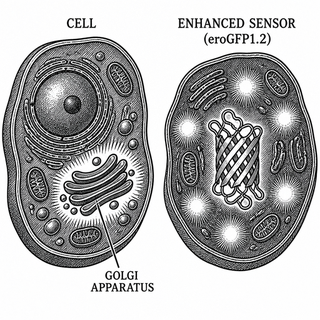
This is where the new work comes in. The team rationally engineered an enhanced variant they named eroGFP1.2, and the spec sheet is the part that should make any founder lean forward. More than a fivefold jump in brightness, plus a 50 percent wider dynamic range, measured in both E. coli and in human HeLa cells. In plain terms, the new sensor is five times louder and gives you a meaningfully bigger swing between "all calm" and "everything is on fire." It is the difference between a bathroom scale that reads in 20-pound increments and one that finally shows the decimals.
Brightness alone would be a nice incremental paper. What makes this look like a platform rather than a feature is what they did next.
First, they used eroGFP1.2 to actually map the redox potential across different compartments inside HeLa cells. Different rooms in the cellular house keep wildly different chemical climates, and now you can read each thermostat instead of guessing from the hallway.
Second, and this is the genuinely shrewd move, they bolted the sensor onto human glutaredoxin-1, an enzyme abbreviated Grx1. Glutathione is the cell's most abundant homemade antioxidant, the in-house fire extinguisher, and tracking it specifically has always been tricky. By fusing Grx1 to the sensor, they made it speak glutathione fluently rather than reacting to whatever oxidant happened to wander by. That is the molecular equivalent of giving your meter a specialized probe instead of a vague guess. Specificity is what turns an interesting reading into an actionable one.
Third, they put it to work in a living animal. They watched a burst of reactive oxygen species light up the wound site after snipping the tailfin of a larval zebrafish. Zebrafish larvae are transparent, which makes them the unofficial show ponies of live imaging, and seeing a real-time chemical alarm fire at an injury is exactly the kind of footage that sells a tool to an entire field.
Why a startup brain should care
Here is the commercial read. Sensors are picks and shovels. You do not have to win the gold rush yourself if you supply everyone digging. A brighter, more responsive, compartment-aware redox sensor plugs straight into drug screening, where companies are desperate to know whether a candidate molecule is quietly oxidizing cells to death. It plugs into aging research, into cancer metabolism, into the entire reactive-oxygen-species conversation that refuses to go away. Every one of those is a paying customer who needs a better meter, and the better meter is now genetically encoded, which means it copies itself for free every time a cell divides. Try finding a reagent business with margins like that.
I will keep my enthusiasm leashed. This is a tool paper, validated in bacteria, cultured human cells, and fish larvae, which is a long and honorable way from anything you would call a clinical product. Sensors that shine in a tidy lab dish sometimes get shy in messier biology, and "fivefold brighter" is a benchmark, not a promise that every experiment downstream will behave. But the strategic shape here is hard to miss. The team did not just make one molecule glow harder. They showed the upgrade generalizes across organisms, across compartments, and across a clever enzyme fusion. That is the difference between a gadget and a platform, and platforms are where the durable value lives.
Sometimes the most valuable thing you can build is not a cure. It is a better way to see the problem.
This blog post discusses research findings and should not be taken as medical advice. If you have concerns about a health condition involving oxidative stress or cellular metabolism, please consult a healthcare provider. Research discussed here represents ongoing scientific investigation and clinical validation is still in progress.
All images used in this post are decorative illustrations only and do not represent or reflect the accuracy, reality, or correctness of the referenced research.
Primary Source: An improved fluorescent indicator for monitoring intracellular redox potential. PubMed. 2026. PMID: 41916016